
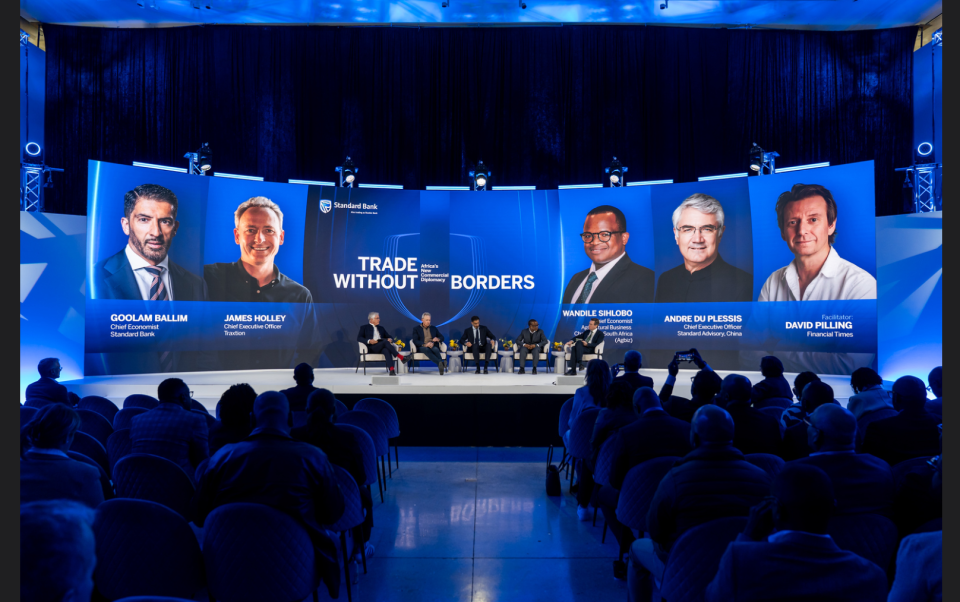
Standard Bank’s Africa Unlocked 2026 demonstrated how African businesses are using investment, industrialisation, innovation and partnerships to build stronger economies, create jobs and deliver lasting social impact.
Africa’s future will be shaped less by the amount of capital flowing into the continent and more by what that capital builds once it arrives.
That message echoed throughout Africa Unlocked 2026, Standard Bank Business and Commercial Banking’s flagship pan-African business forum, where business leaders, entrepreneurs, investors, policymakers and innovators gathered in Cape Town to examine how Africa can strengthen its own economic future by building productive industries, embracing technology and creating long-term shared value.
Rather than focusing on economic challenges alone, the conference highlighted practical examples of African businesses expanding across borders, strengthening supply chains, investing in manufacturing, developing local skills and creating businesses capable of generating both commercial success and measurable societal benefit.
Opening the conference, Bill Blackie, Chief Executive of Business and Commercial Banking at Standard Bank, challenged delegates to think differently about the role of capital. Rather than viewing finance as the destination, he described capital as an accelerator that enables businesses to build productive industries, create employment, strengthen local value chains and improve Africa’s long-term economic resilience.
Throughout the conference, speakers repeatedly argued that Africa’s competitiveness will increasingly depend on its ability to manufacture, process and innovate locally instead of exporting raw materials while importing higher-value products. Delegates described industrialisation as a critical driver of sustainable growth, allowing businesses to create greater economic value while supporting employment, supplier development and regional competitiveness.
Entrepreneur Mohammed Dewji, President and CEO of MeTL Group, reinforced this message by sharing how long-term investment in manufacturing transformed his family business into one of Africa’s largest privately owned enterprises. He challenged business leaders to build industries that solve African problems, develop local talent and create opportunities that extend well beyond individual companies.
A recurring theme throughout the programme was shared value—the principle that businesses create greater long-term success when commercial growth is achieved alongside measurable social and environmental outcomes. Rather than treating community investment as a separate activity, delegates explored how businesses increasingly create social impact through their core operations by developing suppliers, supporting entrepreneurs, investing in people and strengthening local economies.
Artificial intelligence featured prominently across multiple discussions, but the conversation deliberately moved beyond the technology itself. Speakers explored how AI can become a catalyst for social innovation, using technology to improve productivity, strengthen industries, support better decision-making and develop solutions tailored to African markets, languages and development priorities.
Technology leaders argued that Africa’s opportunity lies not simply in adopting global AI platforms, but in developing African expertise capable of creating technologies that respond to the continent’s unique economic and social challenges across healthcare, agriculture, logistics, financial services and manufacturing.
Energy, infrastructure and logistics also emerged as essential building blocks of inclusive economic growth. Delegates discussed how reliable infrastructure enables businesses to expand production, improve competitiveness, strengthen regional trade and create wider participation throughout African value chains.
Agriculture was highlighted as one of the sectors best positioned to combine economic growth with social impact. Discussions focused on strengthening food systems, increasing local value addition, improving export competitiveness and creating employment opportunities throughout rural communities.
The conference also emphasised the importance of patient capital—long-term investment that allows businesses time to build sustainable industries rather than focusing solely on short-term financial returns. Delegates noted that industrial development often requires investors prepared to support businesses through longer growth cycles while creating broader economic and developmental outcomes.
Another defining theme was the growing importance of social capital—the networks of trust, collaboration and partnerships between business, government, universities, development finance institutions and entrepreneurs. While financial capital funds projects, delegates argued that social capital enables knowledge sharing, innovation and collaboration that allows businesses and industries to scale more effectively.
Environmental, Social and Governance (ESG) principles were similarly discussed as a strategic business framework rather than simply a reporting requirement. Speakers highlighted how integrating environmental responsibility, strong governance and measurable social outcomes into business strategy strengthens organisational resilience while creating long-term value for shareholders, employees, communities and the broader economy.
Across every session, one conclusion consistently emerged: Africa’s long-term success will depend on combining financial capital with human capital, innovation, industrial capability and collaborative partnerships that strengthen both economies and societies.
As Africa Unlocked 2026 concluded, delegates left with a shared conviction that Africa’s next phase of growth will be driven not by potential alone, but by businesses willing to invest in industries, develop people, strengthen institutions and build solutions capable of creating lasting economic and social impact across the continent.
