
South Africa and Egypt have launched a joint business council to deepen trade, investment and industrial cooperation while opening new commercial opportunities across wider African markets.
The Joint South Africa-Egypt Business Council was launched on the margins of the Alamein-Africa Business Forum, creating a new private-sector platform aimed at translating the relationship between the two countries into practical commercial partnerships.
The Department of Trade, Industry and Competition described Egypt as one of South Africa’s key strategic partners in North Africa and its largest export market in the region.
With a population of more than 102 million people and an economy valued at approximately US$362 billion, Egypt also provides South African businesses with potential access to markets across North Africa, the Middle East and the Horn of Africa.
Trade between the two countries has already been growing.
According to Statistics South Africa data cited by the dtic, direct bilateral trade increased by 26% from R3.4 billion in 2024 to R4.3 billion in 2025.
South African exports to Egypt increased by 21% over the same period, rising from R1.3 billion to R1.6 billion.
While South Africa recorded a trade deficit with Egypt between 2021 and 2025, the growth in overall trade and exports indicates increasing commercial activity between the two economies.
The new council is expected to move that relationship beyond conventional trade by creating sector-specific partnerships capable of generating investment, production and jobs.
Among the initiatives planned through the council is a Mining and Minerals Partnership aimed at linking opportunities across two of Africa’s significant mineral and industrial economies.
An Automotive and New-Energy Mobility Partnership will also explore collaboration around vehicle manufacturing, component production and the transition towards emerging mobility technologies.
Agriculture and agro-processing have been identified as another area for cooperation, with plans for an Agriculture and Agro-processing Corridor designed to strengthen production, processing and trade between businesses in both countries.
Infrastructure and engineering companies are also expected to benefit from an Engineering and Infrastructure Partnership, while a Renewable Energy and Green Industrial Platform will focus on investment opportunities linked to Africa’s energy transition.
One of the most significant proposals is the creation of an Africa Joint-Venture Investment Fund.
The private-sector investment vehicle is intended to support companies and projects with the potential to expand beyond the South African and Egyptian domestic markets and operate across the wider continent.
For both countries, the strategy reflects the growing importance of the African Continental Free Trade Area in encouraging companies to think beyond national markets.
Rather than viewing South Africa and Egypt purely as trading partners, the business council is intended to position the two economies as gateways into different parts of the continent.
South Africa brings established manufacturing, mining, financial services and automotive capabilities, while Egypt provides a significant domestic market, strong industrial capacity and geographic access to North Africa and surrounding regions.
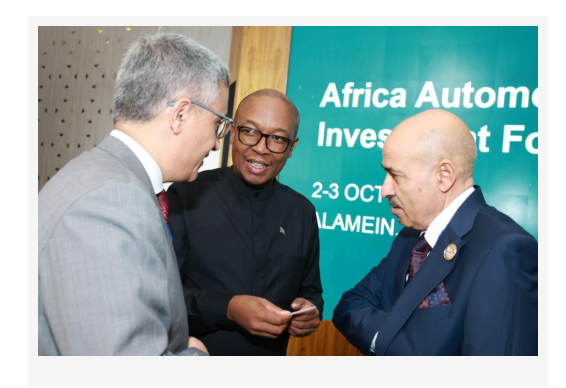
Trade, Industry and Competition Minister Parks Tau also participated in the Africa Automotive Investment Forum held alongside the inaugural Alamein Africa Forum.
The forum focused on unlocking Africa’s automotive potential under the AfCFTA and brought together governments, vehicle manufacturers, component suppliers, investors, financiers, logistics companies and development partners.
For South Africa, the automotive discussions provided an opportunity to reinforce the country’s position as a manufacturing and investment hub while building stronger connections between local producers and emerging African markets.
The objective is to develop more integrated continental supply chains in which vehicles, components, skills, capital and logistics networks increasingly connect African economies with one another.
The forum was hosted by Egypt’s Minister of Investment and Foreign Trade, Dr Mohamed Farid Saleh, in collaboration with Afreximbank and the African Association of Automotive Manufacturers.
Participants also witnessed the launch of the Joint Business Council, placing private-sector collaboration at the centre of the broader relationship.
The dtic said the partnership is intended to deepen bilateral trade and investment by creating practical commercial relationships between South African and Egyptian companies while using both countries as gateways into wider African markets.
The opportunity now lies in turning the council’s proposed partnerships into measurable investment, business expansion and employment.
With bilateral trade already moving upward, the new platform provides companies in both countries with a structure through which that growth can extend into manufacturing, energy, agriculture, mining, infrastructure and new continental value chains.
For South Africa and Egypt, the council represents more than another bilateral agreement. It creates a mechanism through which two of Africa’s largest and most diversified economies can work together to build commercial opportunities that extend well beyond their borders.
previous post
