
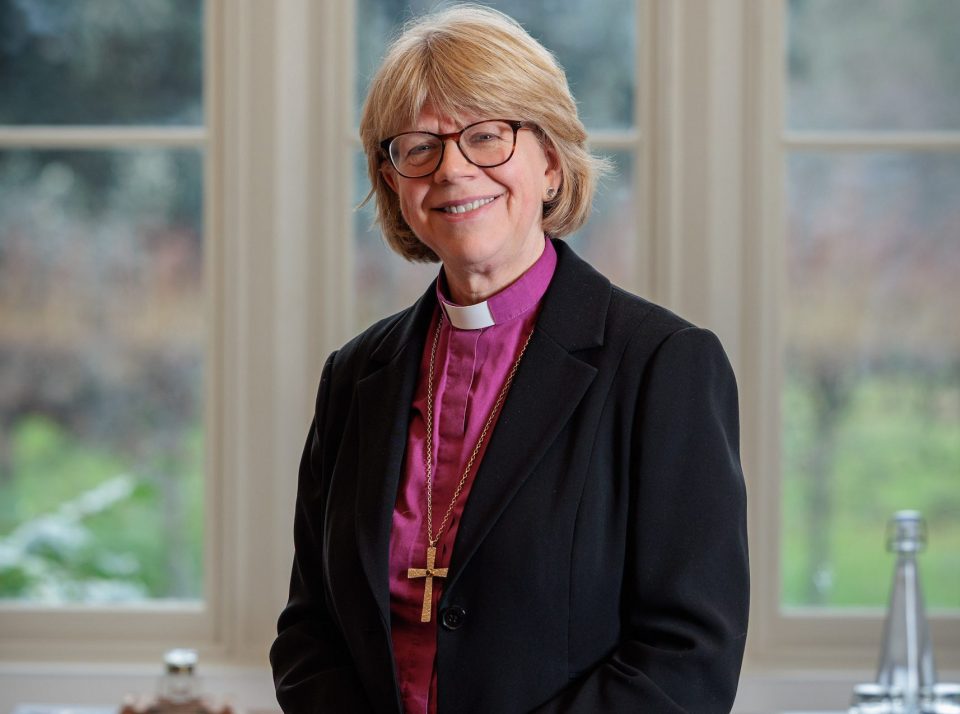
Archbishop Sarah Mullally will deliver the 2026 Desmond Tutu International Peace Lecture in Cape Town, linking women’s leadership, reconciliation and human dignity across generations and communities.
The first woman to serve as Archbishop of Canterbury will take the stage at the Baxter Theatre on 7 October, the day Archbishop Emeritus Desmond Tutu would have celebrated his 95th birthday.
Mullally became the 106th Archbishop of Canterbury in January 2026, breaking a 1,400-year precedent by becoming the first woman to hold the office. Her formal installation took place at Canterbury Cathedral in March. Church of England
Her keynote address will form the centrepiece of the 16th Desmond Tutu International Peace Lecture, held this year under the theme “United for Humanity: A Kinder, Braver World.”
The Desmond & Leah Tutu Legacy Foundation says the lecture will ask what Tutu’s belief in shared humanity requires from individuals and institutions at a time of division, weakening public trust and continuing pressure on human dignity.
The 2026 commemoration also connects three significant moments in South Africa’s history.
This year marks 70 years since approximately 20,000 women marched to the Union Buildings in Pretoria in protest against apartheid pass laws, while the country also reflects on three decades since the Truth and Reconciliation Commission began its public work.
For the Foundation, those anniversaries provide an opportunity to consider how far South Africa has travelled towards the equality, dignity and reconciliation envisioned by earlier generations.
Mullally’s presence adds particular significance to that conversation.
Her elevation to one of the Anglican Communion’s most prominent leadership positions represents a historic breakthrough for women within the church, while South Africa continues confronting questions around women’s safety, equality and access to opportunity.
Archbishop Tutu himself advocated for the inclusion and ordination of women within the church, making Mullally’s participation particularly relevant to the Foundation’s focus on women’s contribution to more just and humane societies.
Foundation CEO Janet Jobson said Tutu understood humanity as something expressed through people’s relationships and responsibilities towards one another.
“This year, extraordinary historical moments converge,” she said, pointing to Tutu’s 95th birthday, the anniversary of the Women’s March and the legacy of the Truth and Reconciliation Commission.
Rather than treating those moments purely as historical anniversaries, the Foundation wants the lecture to examine what they mean for present-day South Africa.
That includes asking whether constitutional rights and formal equality are translating into dignity, security and opportunity in people’s everyday lives.
The theme also reflects one of the central ideas associated with Tutu’s public life: Ubuntu and the belief that individual wellbeing is inseparable from the wellbeing of others.
The Foundation describes the 2026 lecture as a call to combine compassion with courage.
“A kinder world requires compassion, but it also requires bravery,” Jobson said.
“It requires us to make room for others, confront uncomfortable truths, choose reconciliation over division, and recognise that hope itself is a collective act.”
The Desmond Tutu International Peace Lecture has developed into a global platform for conversations around justice, reconciliation, leadership and human dignity.
The Foundation schedules the lecture around 7 October, Tutu’s birthday, as part of its effort to keep his ideas and values connected to contemporary social challenges. Desmond & Leah Tutu Legacy Foundation
Previous speakers have included former United Nations Secretary-General Kofi Annan, Graça Machel, former Irish president Mary Robinson, former Public Protector Thuli Madonsela, journalist Maria Ressa and philanthropist Melinda French Gates.
The Foundation confirmed Mullally’s participation as part of its wider TUTU95 campaign, which asks what shared humanity demands from society today. LinkedIn
That question gives the event a social-impact dimension beyond commemorating Tutu’s legacy.
The issues surrounding equality, reconciliation and dignity ultimately influence how communities function, how institutions treat people and whether vulnerable groups are able to participate fully in society.
The Truth and Reconciliation Commission demonstrated the importance of creating spaces where painful experiences could be heard publicly, while the Women’s March demonstrated the power of collective action in demanding greater freedom.
The Foundation’s challenge is to connect those histories with current realities rather than allowing them to become symbolic anniversaries disconnected from present-day problems.
Mullally’s own career provides another perspective on service and leadership.
Before entering full-time church ministry, she worked as a nurse and became England’s Chief Nursing Officer at the age of 37. She was ordained in 2001 and later became the first woman to serve as Bishop of London before becoming Archbishop of Canterbury. Church of England
Her journey therefore brings experience from healthcare, public service and religious leadership into a lecture centred on humanity, courage and institutional responsibility.
The 2026 Peace Lecture will take place at the Baxter Theatre’s Pam Golding Theatre in Cape Town from 12:30 to 14:30 on 7 October and will also be livestreamed globally.
For the Desmond & Leah Tutu Legacy Foundation, the occasion is ultimately less about looking back at what Tutu achieved than asking how his principles can continue shaping action.
Thirty years after the TRC, 70 years after women marched for freedom and 95 years after Tutu’s birth, the message behind the lecture is that dignity and reconciliation remain unfinished work.
The challenge is turning those values into choices, institutions and communities capable of building the kinder and braver world the 2026 lecture is calling for.
