
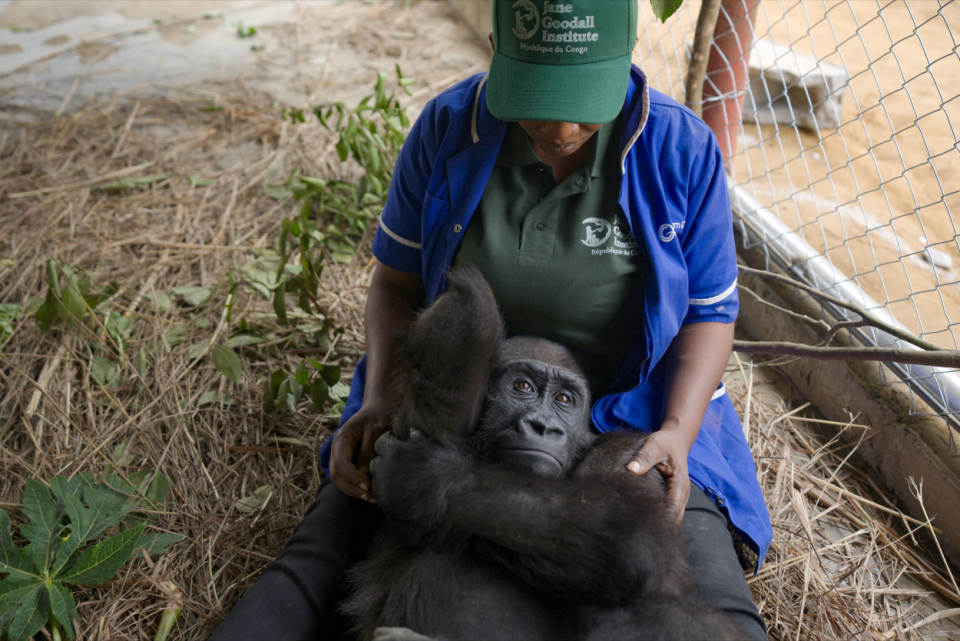
A rescued gorilla has begun a new conservation journey after DHL coordinated a complex cross-border transfer from Nigeria to specialist care in the Republic of Congo.
Bili, a young gorilla rescued and rehabilitated in Nigeria, has been transferred from the Pandrillus Foundation’s Drill Ranch in Calabar to the Jane Goodall Institute Republic of Congo’s Tchimpounga Chimpanzee Rehabilitation Center near Pointe-Noire.
The operation demonstrates how commercial logistics infrastructure can be used for conservation when wildlife organisations, governments, veterinarians and private-sector partners coordinate across borders.
DHL Express acted as the logistics partner, managing aviation planning and cross-border cargo support for a journey involving teams in Nigeria, Gabon, Côte d’Ivoire and the Republic of Congo.
Bili’s journey began on 21 September with an approximately 22-hour road transfer from Calabar to Lagos.
The following day, she travelled aboard a DHL cargo flight from Lagos Murtala Muhammed International Airport to Pointe-Noire via Libreville, arriving in the Republic of Congo on 23 September.
She was then transferred by road into the care of the Jane Goodall Institute Republic of Congo at Tchimpounga.
“This was far more than a flight. It was a carefully coordinated conservation operation that required specialist animal care, regulatory compliance, security, ground transportation and aviation expertise across several countries,” said Anthony Beckley, VP Operations and Aviation at DHL Express Sub-Saharan Africa.
Bili travelled in a purpose-built crate designed by Pandrillus to comply with live-animal transport requirements.
Her transfer also required export and import permits, CITES documentation, veterinary health certification, customs procedures and international aviation requirements to be completed before departure.
Throughout the journey, she was accompanied by Dr Rebeca Atencia, Executive Director and Head Veterinarian of the Jane Goodall Institute Republic of Congo, together with Imelda Effiong, who had cared for Bili for three years.
The operation brought together a network of conservation and government partners including the Nigeria Customs Service, Nigeria’s Ministry of Environment and Department of Forestry, the Republic of Congo’s Ministry of Forest Economy, Focused Conservation, Pandrillus Foundation, the Jane Goodall Institute Republic of Congo, The Aspinall Foundation and The Royal Foundation’s United for Wildlife.
For DHL, the transfer also connects with its involvement in the United for Wildlife Transport Taskforce, which brings transport and logistics companies together with conservation organisations, law enforcement and policymakers to tackle wildlife trafficking.
The significance of that partnership extends beyond individual animal transfers.
Global transport networks can be exploited by wildlife traffickers, but the same networks, specialist knowledge and international relationships can also support enforcement, intelligence sharing and legitimate conservation operations.
“Protecting Africa’s wildlife requires more than good intentions. It requires practical cooperation across borders and between conservation organisations, authorities and the private sector,” Beckley said.
DHL said its involvement in the taskforce has included efforts to increase awareness of wildlife crime, identify high-risk trafficking routes and strengthen collaboration with customs and law-enforcement agencies.
Bili’s move is therefore one example of what those partnerships can make possible when specialist logistics capacity is applied to wildlife protection.
Her immediate destination, Tchimpounga, provides rehabilitation and long-term care for wildlife affected by illegal hunting and trafficking.
The Jane Goodall Institute describes the sanctuary as one of the few facilities equipped to care for a wide range of Central and West African wildlife requiring specialised rehabilitation. the Jane Goodall Institute
Bili’s journey is not expected to end there.
The longer-term objective is to eventually integrate her into the gorilla reintroduction programme at the Lésio-Louna Gorilla Reserve, implemented through cooperation between the Republic of Congo’s Ministry of Forest Economy and The Aspinall Foundation.
That process will depend on her health, behaviour, rehabilitation and readiness for further integration.
The move therefore represents a transition rather than a final release.
Pandrillus played an important role before that transition became possible.
The organisation operates wildlife rehabilitation facilities in Nigeria, including Drill Ranch in Calabar, where rescued animals can receive veterinary care and specialised rehabilitation. Pandrillus
Bili had been in the organisation’s care for three years following her recovery in Lagos in 2023.
Moving a rescued animal between countries can be considerably more complex than transporting ordinary cargo.
Veterinary requirements, wildlife-trade regulations, airport handling procedures, security, customs clearances and animal welfare all have to work together, while delays can create additional stress for the animal.
The involvement of multiple government agencies and conservation organisations was therefore essential to completing the journey safely.
“We are proud that DHL’s network and people could help bring all these elements together and support Bili’s journey to a safe, long-term home, with her safety and wellbeing at its centre,” Beckley said.
The transfer also illustrates a wider role for corporate resources in conservation.
Companies may not operate wildlife sanctuaries or manage protected areas, but they can contribute expertise that conservation organisations do not necessarily possess themselves.
In DHL’s case, that expertise includes international aviation networks, customs coordination, cross-border logistics and the ability to move highly specialised cargo between countries.
When combined with veterinary expertise, government regulation and conservation knowledge, those capabilities can help turn a complicated rescue operation into a viable route towards rehabilitation.
For Bili, that cooperation has now carried her from Nigeria to a specialist conservation facility in the Republic of Congo.
The next stage will be slower and determined by her individual progress.
But the wider impact of the journey is already clear: wildlife conservation increasingly depends on partnerships capable of crossing institutional and national boundaries just as effectively as the threats facing Africa’s endangered species.
