
Johannesburg’s inner-city regeneration work has supported 7,332 livelihoods, paid R147 million in wages and trained residents while improving public spaces and local enterprise opportunities across communities.
The Johannesburg Inner City Partnership is marking its 30th anniversary by focusing not only on the organisation’s history, but on the people whose employment, skills and businesses are helping reshape the city.
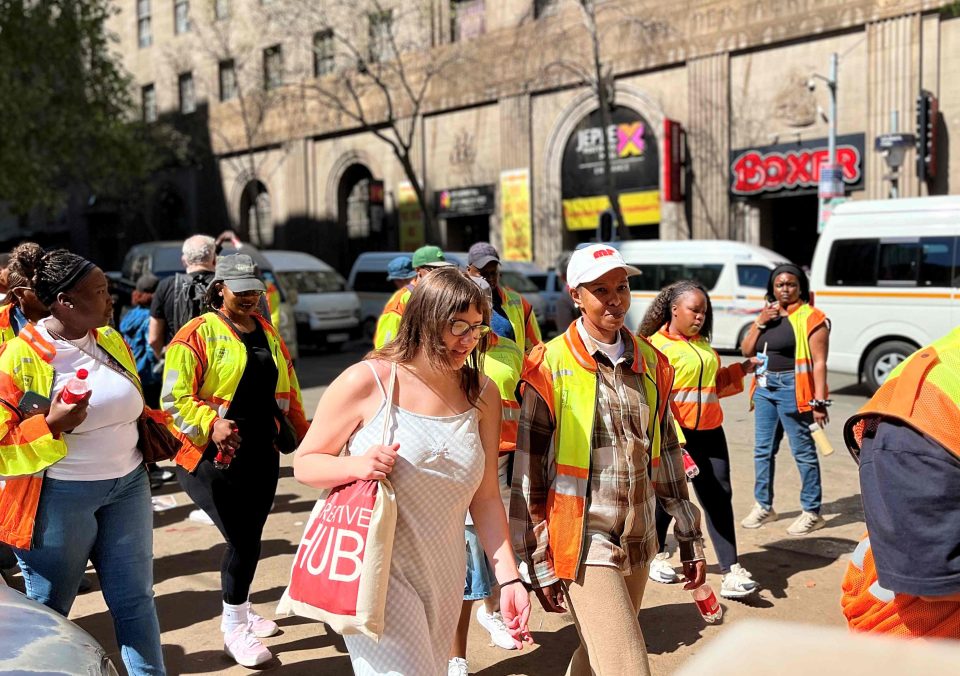
Its first anniversary activation brought JICP partners and the Joburg Photowalkers onto the streets of Johannesburg to experience the Walkable Network and document the people behind the regeneration work.
At the centre of the walk were previously unemployed inner-city residents who now work through JICP programmes and who share another connection with the organisation: they also turn 30 this year.
Each participant selected a place in the inner city that carries personal meaning and used the walk to share memories, experiences and hopes for Johannesburg.
Their stories are being captured through photography and short videos, turning the anniversary into a record of how people experience a city undergoing regeneration.
The approach reflects JICP’s broader philosophy that transforming Johannesburg requires investment in both physical spaces and the people who live and work within them.
JICP was established in 1996 and works through partnerships involving communities, businesses, government and civil-society organisations to improve Johannesburg’s inner city. Its current strategy places employment, public-space activation and urban management at the centre of regeneration. JICP
The organisation says its current regeneration programmes have supported 7,332 livelihoods and paid R147 million in wages.
More than 4,000 of the opportunities have gone to women and 4,400 to young people, positioning employment as one of the most significant social-impact outcomes of the work.
Another 1,651 people have received training, while 333 micro-enterprises have been supported and 537 public spaces activated.
Behind those figures are residents earning incomes while doing work that improves the neighbourhoods in which they live.
That link between employment and urban improvement is central to the Social Employment Fund model being used across several JICP programmes.
Rather than creating temporary work disconnected from community needs, participants are involved in activities such as cleaning public spaces, improving safety, maintaining infrastructure, greening neighbourhoods and supporting local organisations.
JICP says its Social Employment Fund activities have already provided opportunities to thousands of inner-city residents while contributing to cleaner and more functional public spaces. JICP
The anniversary project is also demonstrating how skills developed through these programmes can create further opportunities.
Photographer and trainer Thusi Vukani of Platinum Sketch has trained 49 participants from JICP’s Social Employment Fund programmes to document the projects taking place around them.
Participants are therefore not only involved in regeneration work but are learning how to photograph and record the impact of that work.
Vukani’s own photography has helped build a growing visual archive of JICP projects, capturing residents, neighbourhoods and changes taking place across the inner city.
That skills-transfer model reflects a wider goal: programmes become more valuable when participants leave with abilities that can generate opportunities beyond the original project.
JICP is expanding that principle through several initiatives.
Its Pocket Plazas programme is creating smaller nature-based public spaces along the Walkable Network where people can rest, trade, wait for transport and interact.
The Joburg Fix Squad combines practical infrastructure improvement with an Earn & Learn model, training residents to repair potholes, walkways, stormwater systems and other public infrastructure.
JICP describes the programme as a way of building local technical capacity while improving the functionality and safety of inner-city streets. JICP
A further round of the Social Employment Fund will continue creating paid work connected to waste management, public spaces and community improvement.
The FLARE programme is focusing on food loss and organic waste, using recovery, composting and reuse to develop a more circular approach to food systems.
Community Nurseries will meanwhile grow plants and trees for public spaces while building environmental skills and creating livelihood opportunities.
Together, the initiatives connect employment with the everyday work required to keep a city functioning.
That matters because urban regeneration can easily become focused primarily on buildings, property development and infrastructure.
JICP’s model places residents inside the regeneration process.
Its work in Makers Valley, for example, combines cleaning, public-space activation, skills development and support for creative enterprise. Two former programme participants later established EcoFashion Design after taking part in placemaking activities and sustainable-fashion training. JICP
Elsewhere, JICP programmes have linked environmental work with employment, recognising that unemployment and deteriorating urban environments can reinforce each other.
Providing structured work can therefore generate two forms of impact simultaneously: an income for a participant and an improvement to the community.
The 30th anniversary gives JICP an opportunity to measure that impact differently.
The R147 million in wages and thousands of livelihood opportunities provide the numbers.
The photographs and personal stories show what those numbers look like at street level.
A cleaner walkway may represent paid work for one resident. A planted public space may reflect a new environmental skill for another. A newly supported micro-enterprise may become the first step towards someone employing other people.
That is why the organisation is using its anniversary to document people rather than simply commemorate its history.
Over the coming months, further activations are expected to bring more participant stories into Johannesburg’s streets and public spaces.
The intention is to encourage people to experience the inner city differently by walking it, discovering its businesses and meeting residents involved in its regeneration.
After three decades, JICP’s work increasingly demonstrates that rebuilding an urban centre is not only about repairing infrastructure.
It is also about creating livelihoods, developing skills, supporting enterprises and giving residents a practical role in shaping the places where they live and work.
For Johannesburg, that means regeneration measured not simply by what changes on the street, but by how many people gain opportunities while helping create that change.
