
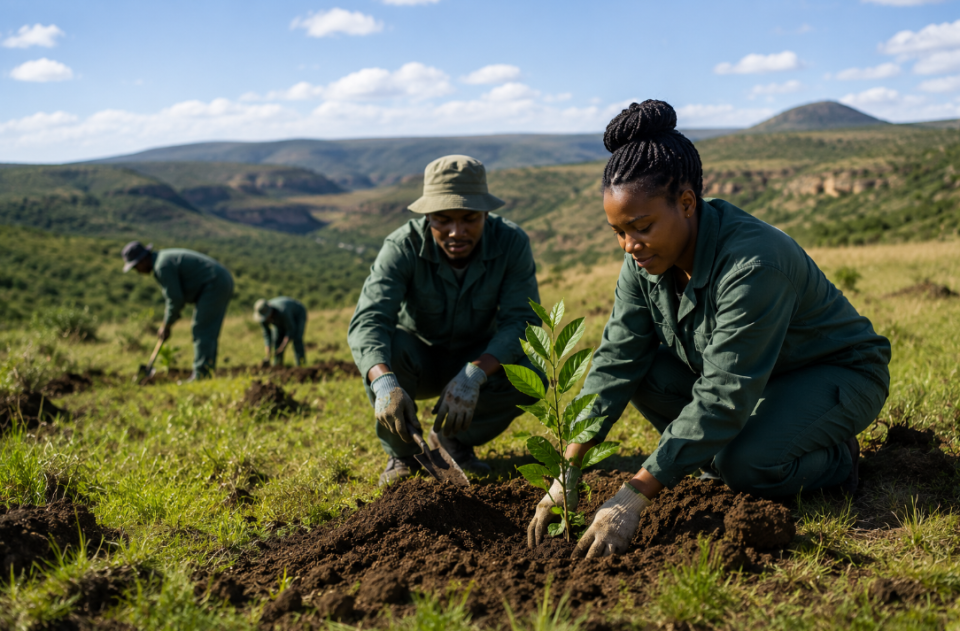
South Africa is targeting the restoration and sustainable management of eight million hectares of degraded landscapes, linking healthier land to food security, water resilience and rural livelihoods.
The commitment forms part of South Africa’s position at the 17th session of the Conference of the Parties to the United Nations Convention to Combat Desertification (UNCCD COP17), taking place in Ulaanbaatar, Mongolia, from 17 to 28 August 2026.
Deputy Minister of Forestry, Fisheries and the Environment Bernice Swarts is leading the South African delegation, which is advocating for stronger international cooperation on drought resilience, increased financing for land restoration and an effective global framework for addressing land degradation beyond 2030.
South Africa enters the negotiations with significant practical experience. Of approximately 17 million hectares initially identified under the country’s voluntary Land Degradation Neutrality targets in 2018, about 2.9 million hectares have already been restored, conserved or placed under sustainable management.
The country has since reviewed its targets through the second phase of the UNCCD Land Degradation Neutrality Target Setting Programme.
Its revised target commits South Africa to the restoration, rehabilitation, conservation, maintenance and sustainable management of eight million hectares of degraded landscapes.
The new target is intended to create a more realistic and implementable framework that is specific, measurable, time-bound and better integrated into national planning.
Reaching that scale, however, will require significantly increased financial and technical support.
For South Africa, restoring degraded land has implications that extend well beyond environmental conservation. Productive and healthy landscapes support agriculture, strengthen food and water security, protect livelihoods and improve the ability of communities to withstand prolonged drought.
“Land degradation and drought are not abstract environmental concerns for South Africa. They directly affect water security, food production, rural livelihoods, economic resilience and the well-being of vulnerable communities,” Swarts said.
“South Africa goes to COP17 determined to turn global commitments into measurable action. This requires predictable finance, practical partnerships and an international drought response that matches the scale and urgency of the challenge.”
South Africa is also using COP17 to advance negotiations towards a legally binding international protocol on drought.
The country was nominated as Africa’s drought champion ahead of the conference by the 20th ordinary session of the African Ministerial Conference on the Environment.
In this role, South Africa is supporting the African position calling for an international instrument that strengthens cooperation, accountability and implementation in preparing for, responding to and recovering from drought.
The proposed approach would place greater emphasis on proactive drought-risk management, helping countries and communities prepare before livelihoods, agricultural production and ecosystems are severely affected.
Financing will be another central part of South Africa’s position.
Desertification, land degradation and drought remain among the least-funded priorities across the three Rio Conventions, despite their direct relationship with climate resilience, biodiversity, food security, water security and sustainable development.
South Africa is calling for substantially greater financial and technical resources for affected developing countries, including funding through the Global Environment Facility, Green Climate Fund, multilateral development institutions and bilateral and private-sector partners.
The country will also support calls for developed countries to provide adequate and predictable assistance to affected developing nations.
COP17 will consider the future strategic framework of the UNCCD beyond 2030, with South Africa advocating for an approach that is inclusive, science-based and measurable while recognising the different circumstances and capacities of participating countries.
The conference is being held under the theme “Restoring Land, Restoring Hope”, reflecting the connection between environmental restoration and the people whose lives and economic opportunities depend on healthy landscapes.
“Restoring land is ultimately about restoring opportunity and hope,” Swarts said.
“The decisions taken in Ulaanbaatar must enable countries to protect livelihoods, strengthen resilience and deliver visible improvements in the lives of people who depend most directly on healthy land.”
For South Africa, achieving the eight-million-hectare target could therefore deliver a wider social dividend by protecting natural resources while strengthening agricultural production, rural livelihoods, water security and the resilience of communities increasingly exposed to drought and land degradation.
