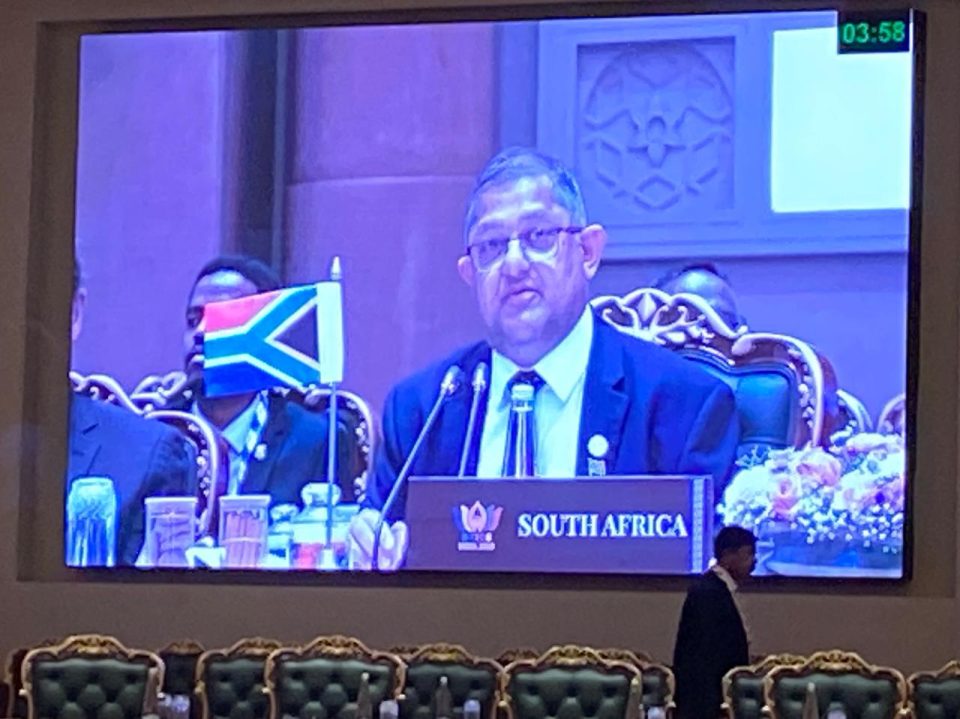
Community-led climate adaptation and traditional knowledge were placed at the centre of South Africa’s contribution to the 12th BRICS Environment Ministerial Meeting in India.
Deputy Minister of Forestry, Fisheries and the Environment Narend Singh addressed ministers and delegates in New Delhi on 18 August, highlighting cooperation on climate resilience, biodiversity, ecosystem restoration and sustainable livelihoods.
The meeting is being held under India’s 2026 BRICS Presidency and the theme “Building for Resilience, Innovation, Cooperation and Sustainability”.
Singh said developing countries possess knowledge, experience and practical solutions that can contribute to addressing climate change, biodiversity loss and environmental degradation.
A significant focus of the address was the role communities can play in responding to climate risks.
Across the Global South, communities are increasingly experiencing droughts, floods, heatwaves, biodiversity loss and ecosystem degradation, with consequences for livelihoods.
Singh said climate adaptation should therefore incorporate local knowledge and community experience alongside scientific approaches.
“South Africa firmly believes that traditional knowledge systems and scientific knowledge are complementary and mutually reinforcing,” he said.
The country has supported proposed BRICS Principles for the Adoption of Traditional Knowledge for Climate Change Adaptation, as well as the establishment of a BRICS Dialogue on People-Centred Community-Led Adaptation.
Two local initiatives have also been contributed to a BRICS compendium documenting traditional knowledge and community-based adaptation.
These include the Working for Water and Working for Ecosystems Programme, which combines ecosystem restoration and biodiversity conservation with invasive species management, water security and sustainable livelihood creation.
The Ecosystem-Based Disaster Risk Reduction Programme has also been submitted. The initiative demonstrates how ecosystem restoration can be used to reduce the effects of climate-related disasters while strengthening resilience in vulnerable communities.
According to Singh, these programmes illustrate how environmental interventions can simultaneously address climate risks, sustainable development and poverty alleviation.
The meeting also considered sustainable lifestyles, environmental education and youth participation as part of the wider response to environmental challenges.
Singh said sustainable development required policy and technological interventions alongside changes in consumption and production patterns.
Landscape restoration, afforestation, forest-fire management and disaster resilience were among the other areas highlighted for greater BRICS cooperation.
South Africa has adopted integrated landscape approaches intended to restore degraded ecosystems, improve biodiversity, strengthen water security and support livelihoods.
The country also backed stronger cooperation on early-warning systems, fire-risk management and disaster preparedness as climate variability increases wildfire risks.
Circular economy initiatives formed another component of the discussions, including cooperation around Extended Producer Responsibility frameworks.
Singh said circular economy approaches could contribute to reducing waste and improving resource efficiency while creating employment and supporting sustainable economic growth.
The address also called for stronger South-South cooperation, capacity building, technology cooperation and financial support for developing countries implementing climate adaptation and resilience programmes.
South Africa supported the adoption of the BRICS Environment Ministers Joint Ministerial Statement and the knowledge products and technical papers developed during India’s presidency.
The meeting provides BRICS members with a platform to exchange approaches to environmental challenges while developing cooperation around community adaptation, ecosystem restoration, climate resilience and sustainable economic development.
The address links community-led adaptation to practical programmes, with the South African initiatives that could serve as BRICS models for climate resilience illustrating how ecosystem restoration can also support livelihoods.
RELATED STORIES
DFFE Champions Sustainable Rangeland Restoration
June 17, 2026
South Africa Targets 10 Million Trees
September 1, 2026
BRAG: DFFE Showcases Green Economy Opportunities
August 24, 2026
Nqadu Kingdom Secures Green Partnership
July 21, 2026
Greenbelt Restoration Creates Local Work
August 30, 2026