
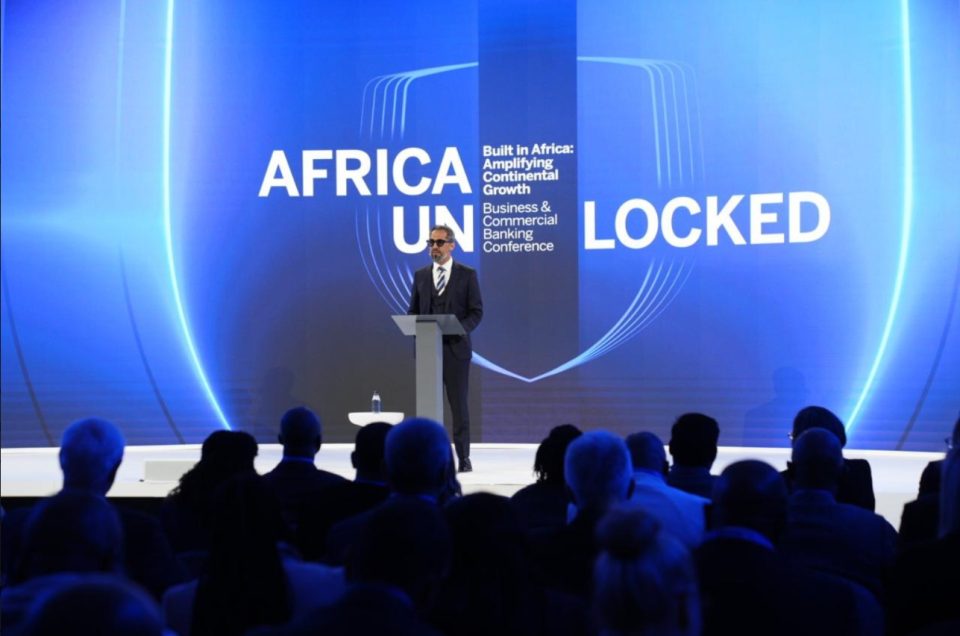
African businesses must build industries that create jobs, develop skills and improve lives, Tanzanian businessman Mohammed Dewji told delegates at Africa Unlocked 2026 today.
Speaking at the conference, Mohammed Dewji challenged African business leaders to think beyond growth, revenue and market expansion, and consider the wider value their businesses create for people and communities.
Dewji said Africa’s current generation has a responsibility to build businesses, industries and institutions that can shape the continent’s economic future while expanding opportunities for its people.
“Every generation is remembered for what it built,” he said. “Some generations built nations. Others built institutions. Today, we have the opportunity—and the responsibility—to build Africa’s next chapter.”
His message placed people at the centre of Africa’s growth story, arguing that successful businesses should be built around solving real problems rather than simply identifying profitable markets.
“We never asked, ‘What business should we enter?’ We asked, ‘What problems can we solve?’”
For Dewji, this approach has shaped the growth of MeTL Group from a trading business into a diversified African company with manufacturing interests spanning food processing, edible oils, beverages, textiles, soaps, detergents and other consumer goods.
The group now manufactures more than 50 product categories, operates in 11 African countries and employs more than 40,000 people.
“When you build around people rather than markets, growth becomes the outcome—not the objective,” Dewji said.
His comments reflect a growing shared-value approach to business, where companies look for opportunities to address social and economic challenges through their core operations rather than treating social impact as something separate from business strategy.
For Africa, Dewji believes local manufacturing and value creation are central to this approach.
He argued that the continent cannot create lasting prosperity by continuing to export raw materials and import finished products. Greater investment in manufacturing, processing and beneficiation can help African economies retain more value while creating employment, building skills and strengthening local supply chains.
Dewji’s own experience of growing a business also shaped his message on access to capital.
When he began expanding MeTL, Tanzania’s banking sector was still developing and the financing available locally was not enough to support the company’s ambitions. Like many African entrepreneurs, the business had to look beyond its borders for growth capital.
Many institutions saw the potential, he said, but few were prepared to support the ambition. Eventually, one banking partner did, helping to change the trajectory of the business.
“Behind every successful African company is someone who believed before everyone else did,” Dewji said.
His challenge to banks, investors and business leaders was to consider whose ambition they are prepared to support before success becomes obvious.
However, Dewji’s address also raised a wider question about the relationship between business success and social responsibility.
Dewji, who has committed to giving at least half of his personal wealth to philanthropy, said giving should not be viewed simply as charity.
“For me, philanthropy is not just charity. It is an investment in human capital,” he said.
Through the Mo Dewji Foundation, investments have been made in education, healthcare and access to clean and safe water.
Dewji said the foundation’s healthcare work has treated more than 120,000 patients and helped restore sight through 10,000 eye surgeries. Its interventions also support children with cancer and children born with spina bifida and hydrocephalus.
In education, the foundation has supported young Tanzanians through higher-education scholarships, with Dewji reporting a 96% post-graduation success rate.
The foundation’s approach to water demonstrates how a targeted social intervention can produce several interconnected outcomes.
“One well changes education, health and livelihoods at the same time,” Dewji said.
This interconnected approach is increasingly important within social-impact investment, where organisations are being challenged to look beyond individual outputs and understand how interventions affect wider systems.
Access to clean water, for example, is not only a health intervention. It can affect school attendance, household productivity, livelihoods and the amount of time people spend collecting water.
Dewji also highlighted the role of partnerships in addressing some of Africa’s skills and employment challenges.
He shared the example of a scholarship programme that combines university education with extended practical experience in manufacturing environments.
The programme was developed through a partnership involving business and philanthropy, with students studying at leading Tanzanian universities before gaining practical industry experience.
For Dewji, the initiative addresses a critical gap between academic education and the skills young graduates need in the workplace.
It also demonstrates the role of social capital in development. Relationships between businesses, universities, philanthropic organisations and other partners can combine different resources, networks and expertise around a common social challenge.
“This is the power of partnership,” Dewji said. “It connects businesses with education. It connects global expertise with local talent.”
As Africa’s economies continue to evolve, Dewji said investment in physical infrastructure must be matched by investment in people.
Education, technology, skills development and knowledge transfer will be critical to ensuring that Africa’s young population can participate meaningfully in the continent’s economic growth.
The challenge for African business leaders, according to Dewji, is therefore not simply to build bigger companies, but to consider what those companies leave behind: stronger industries, skilled people, sustainable employment and wider opportunities.
His closing message brought the business and social-impact elements of his address together in a single challenge to Africa’s current generation.
“Our greatest legacy will not be the businesses we build, but the people who benefit from them.”
