
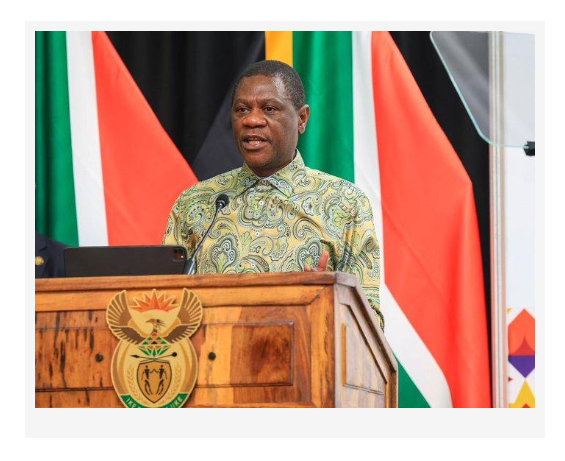
South Africa’s unions must help shape the artificial intelligence transition to protect workers, expand skills and prevent technology from deepening inequality, Deputy President Paul Mashatile says.
Speaking at the Federation of Unions of South Africa’s 8th National Congress in Johannesburg, Mashatile called on organised labour to move beyond reacting to technological change and become an active participant in determining how artificial intelligence reshapes South African workplaces.
“The rise of artificial intelligence presents organised labour with a historic challenge and opportunity,” Mashatile said.
“Those who anticipate change and prepare workers with the skills, protections and voice needed in the digital economy will help shape the future.”
His message places AI firmly within South Africa’s wider social-impact conversation.
Technology can increase productivity, create new industries and change how existing jobs are performed. But without investment in people, skills and worker protections, those same developments could widen existing inequalities between people who are able to participate in the digital economy and those who are displaced by it.
Mashatile warned that unions unable to prepare for that transition risk allowing technology to deepen inequality and exclusion.
He said organised labour should increasingly be prepared to negotiate over workplace data, technological restructuring and workers’ access to upskilling and reskilling.
That also means ensuring representation keeps pace with changing forms of employment.
As digital platforms, informal work and other less secure employment models expand, unions will need to consider how workers outside traditional employer-employee structures are protected and represented.
“Trade unions must prepare to bargain over workplace data, technological restructuring and access to upskilling and reskilling. They must be able to represent workers in informal, digital and other insecure forms of employment,” Mashatile said.
The challenge creates an opportunity for greater shared value between government, business, organised labour and education providers.
Employers benefit when workers have the skills required for increasingly technology-driven workplaces. Workers benefit when technological change leads to progression and new opportunities rather than simply redundancy. Government benefits when productivity gains translate into stronger economic participation and employment.
Achieving that balance will require reskilling programmes to move from a corporate commitment on paper to practical access for employees whose occupations are being transformed.
Mashatile also challenged organised labour to examine whether institutions established to advance workers’ interests are delivering meaningful transformation.
Despite South Africa’s progressive labour legislation, he said inequalities based on race, gender and disability remain evident, particularly at senior management level.
“Legislation alone will not achieve transformation,” Mashatile said.
He called on employers to confront unequal recruitment practices, pay disparities and inadequate skills development, while urging unions to monitor whether employment equity plans are actually producing results.
The message reflects an important distinction between compliance and impact.
Employment equity policies may satisfy regulatory requirements, but meaningful social transformation depends on whether historically excluded people gain real access to leadership, skills, income and economic opportunity.
For Mashatile, that transformation must ultimately become visible in the structure of the economy itself.
The Deputy President also linked workplace transformation to the growing pressure South African households and businesses are experiencing from the cost of electricity.
Government is reviewing electricity pricing policy in an effort to balance affordability for vulnerable households with the sustainability of electricity supply and the competitiveness of industry.
Electricity costs remain particularly important for energy-intensive industries including steel, ferroalloys and chemicals.
“We cannot build our industry without addressing electricity affordability,” Mashatile said.
Government is also targeting poor maintenance, electricity theft and weak revenue management within municipal distribution systems to prevent responsible consumers carrying the financial burden of avoidable losses.
The economic context gives additional urgency to those interventions.
Mashatile said South Africa’s economy contracted by 0.2% during the second quarter of 2026, with mining, manufacturing and trade under pressure.
Approximately 8.5 million South Africans are unemployed, while the official unemployment rate has reached 33.6%.
Behind those figures are households, graduates and communities experiencing the consequences of limited economic opportunity.
“These figures represent people unable to provide for their families, graduates unable to enter the labour market, and communities where opportunity is limited,” Mashatile said.
“When a factory closes, suppliers lose business, local enterprises lose customers and entire communities decline.”
That ripple effect demonstrates why job protection and job creation cannot be separated from broader questions about industrial policy, technology, energy affordability and skills development.
As artificial intelligence changes the labour market, South Africa will therefore need to manage two priorities simultaneously: protecting people from unnecessary exclusion while ensuring the economy is able to adopt technologies required to remain competitive.
That requires more than resistance to automation.
It requires workers to have access to the skills that allow them to move with technological change, businesses to invest responsibly in people alongside technology and government to create an environment where new industries and employment opportunities can develop.
The theme of FEDUSA’s congress, “Reclaiming and Organising the Future: Workers’ Dignity, Power, and Justice through Conscious Unionism in an Age of Crisis,” places workers at the centre of that transition.
Mashatile said responsibility, however, extends across society.
Government must improve administration and accountability. Business must invest responsibly and provide fair employment practices. Organised labour must maintain democratic leadership, ethical conduct and accountability to its members.
“We must create opportunities for young people, protect existing jobs, make electricity more affordable, expand industrial production and ensure that the transition to a sustainable economy is fair,” Mashatile said.
The emergence of artificial intelligence makes that social compact increasingly important.
The question for South Africa is no longer whether technology will change work.
It is whether workers, government and business can shape that change together so that productivity and innovation create broader opportunity rather than another divide between those able to participate in the future economy and those left outside it.
