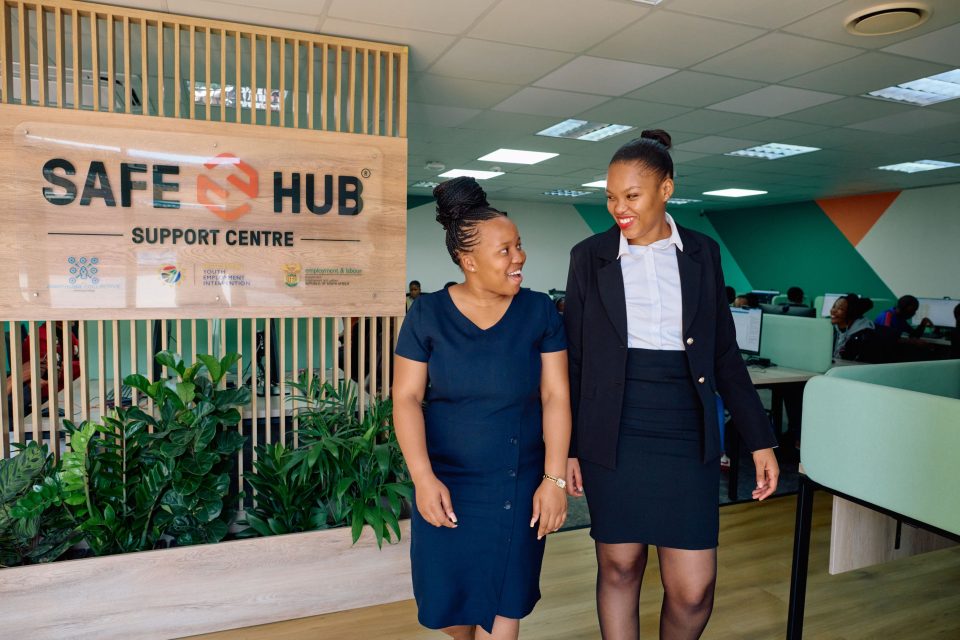
Safe-Hub’s peer support model is creating work experience for young agents while helping more than 1,500 alumni navigate employment challenges through consistent human connection and guidance.
The first cohort of agents at the Safe-Hub Support Centre in Soweto completed their contracts at the end of September, making way for a new group trained to take over from 1 October.
Over three months, the young agents provided peer support to more than 1,500 Safe-Hub alumni through weekly check-in calls while gaining practical experience that can strengthen their own pathways into employment.
Based at the Jabulani Safe-Hub, the Support Centre is funded by the Presidency Department of Employment and Labour’s National Pathway Management Network Innovation Fund, a programme of the Presidential Youth Employment Intervention managed by the Industrial Development Corporation, and delivered in partnership with Amathuba Collective.
The model responds to a challenge facing many young people entering the labour market: access to information does not necessarily translate into the confidence, resilience or practical support needed to remain on an employment pathway.
Search engines, social media and artificial intelligence can provide information almost instantly, but young people navigating unemployment, workplace challenges or decisions about their future can also benefit from someone who understands the communities and circumstances from which they come.
“These are young people who can relate to the challenges their peers are facing because they come from similar communities,” said Phillip Dürner, Director: Innovation, Digital & New Ventures at Safe-Hub.
“They are not robots following a script. They’re trained and they follow clear guidance, but there is still a very important human element to the support they provide.”
That human connection sits at the centre of the intervention.
Safe-Hub alumni receive a weekly check-in call for six months, creating a consistent point of contact as they navigate employment and personal development.
The approach draws on Amathuba Collective’s model of structured non-clinical support for young people moving through work and employment pathways.
Agents are trained to operate within defined boundaries, provide consistent peer support and identify situations where a young person should be referred to additional services within or outside the Safe-Hub network.
The objective is therefore not only helping young people find opportunities, but strengthening their ability to remain in them.
“Getting a job is only the beginning,” said Amathuba Collective founder Emily Rudolph.
“Through weekly calls, we create a consistent space for young people to reflect, work through challenges, recognise their strengths and build the confidence to navigate the world of work. When they feel supported, they are better equipped to learn, grow and stay in employment.”
The social impact model also creates opportunities for the young people making those calls.
Agents complete four weeks of training before entering a paid three-month work-integrated learning programme at the Support Centre.
Their training combines wellbeing, peer mentorship and support with technical skills required in a contact centre environment. They practise calls, learn the support process and examine their own experiences to develop greater empathy and self-awareness.
“The first four weeks are not just about teaching them what to ask on a call,” Dürner explained. “We also work through their own experiences because, to support someone else well, you need to be in a good space yourself.”
Agents continue receiving support during the three-month workplace programme while also gaining transition guidance, work-readiness assistance, job-search support and help developing professional tools such as LinkedIn profiles.
The model deliberately stops short of positioning the agents as counsellors or specialist psychosocial practitioners.
Instead, they are taught to recognise when a peer requires additional assistance and connect that person with an appropriate Safe-Hub team member or specialist service.
For the first cohort, that experience has developed skills extending beyond the Support Centre.
“The biggest lesson I learnt is that listening is so powerful and it is more powerful than giving advice. Many peers just need to be listened to without any judgment,” said Khanyisile, one of the agents who completed the programme in September.
She said the experience also reinforced the importance of taking care of her own wellbeing while supporting others.
Knowing that young people trusted her with their experiences gave the work a deeper sense of purpose.
“It felt so meaningful and humbling at the same time. It made me proud,” she said.
Her advice to the incoming cohort is to take the training seriously, use the available support and practise self-care after difficult conversations.
“Remember that even a small act of kindness can save someone’s day. Your work is important; take it seriously.”
Fellow first-cohort graduate Jetty said the experience helped her become more patient, empathetic and understanding while improving her ability to listen without judgement.
“The training I received helped me understand the importance of having someone who listens without judging,” she said.
“It gave me confidence and taught me how to handle difficult emotions, communicate better and support others with empathy.”
Those capabilities also have economic value.
Young South Africans frequently face the challenge of employers seeking candidates with previous work experience while entry-level job seekers struggle to find opportunities where they can gain that experience.
The Support Centre provides a practical response by giving participants paid workplace exposure and transferable client-service, communication and interpersonal skills.
For Jetty, the experience provides a foundation on which she hopes to continue building professionally.
Khanyisile plans to pursue a career as airline cabin crew and believes the communication and empathy skills developed through the programme can transfer directly into customer-facing work.
“I can use communication and empathy skills to make customers feel safe,” she said.
This dual-impact approach is what distinguishes the Support Centre model.
The young people receiving calls remain connected to an ecosystem of support as they navigate their employment journeys, while the young people making those calls acquire training, workplace experience, confidence and transferable skills that can strengthen their own employment prospects.
“We cannot expect young people to succeed at work if we do not create the conditions for them to be well,” said Rudolph.
“Investing in their mental wellbeing gives them the foundation to build confidence, realise their potential and succeed, at work and in life.”
Long-term outcomes from the Support Centre still need to be measured, but Dürner said early experiences are encouraging.
“It’s too early to validate long-term outcomes, but the anecdotal evidence shows that it works,” he said.
For South Africa’s youth employment challenge, the model demonstrates how social innovation can address more than one barrier simultaneously: creating work experience for young people while using their lived experience and newly developed skills to support others.
Its longer-term social impact will ultimately be measured not simply by the number of calls made, but by whether young people receiving and providing that support are better equipped to enter opportunities, remain economically active and build sustainable careers.
Key Focus: Youth employment pathways | Peer support programmes | Work integrated learning | Youth work experience | Employment retention | Youth wellbeing | Social innovation | Presidential Youth Employment Intervention
Tags: Safe-Hub, Amathuba Collective, youth employment, PYEI, Presidential Youth Employment Intervention, work experience, peer support, Jabulani, Soweto, social innovation, youth development
Meta Description: Safe-Hub’s Peer Support Centre combines paid work experience with human-centred support helping young agents build skills while supporting more than 1,500 alumni.
Caption: Safe-Hub’s Peer Support Centre is creating paid work experience for young agents while providing more than 1,500 alumni with consistent peer support as they navigate employment.
Title: Peer Support Creates Youth Pathways
Description: The Safe-Hub Support Centre combines work-integrated learning with peer support giving young agents practical workplace experience while helping alumni navigate employment and personal development.
Alt Text: Young Safe-Hub peer support agents gaining workplace experience while providing regular employment and wellbeing support to Safe-Hub alumni.