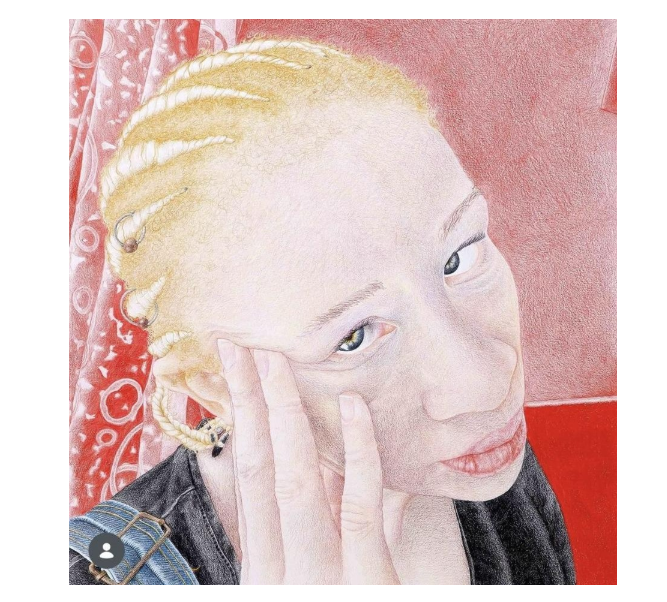
South African artist Athenkosi Kwinana is taking a powerful conversation about albinism, dignity and representation to Durban through her travelling exhibition Ndijongile this year, widening access.
The award-winning visual artist and activist is working to bring Ndijongile: I Have Looked to Durban, extending a body of work that challenges how people with albinism have historically been portrayed and understood within South African visual culture.
Through drawing and printmaking, Kwinana explores visibility, identity, dignity and representation while inviting audiences to reconsider stereotypes and think about how people with albinism want to be seen on their own terms.
For Kwinana, who is herself a person with albinism, the work is deeply connected to lived experience.
Her artistic practice examines representation within South African society, particularly within Black communities, and considers how images can either reinforce stigma or help create greater understanding and inclusion.
The Durban presentation is now being supported through a R130,000 crowdfunding campaign aimed at covering venue hire, transportation of artworks, framing, installation, curatorial and facilitator fees, public programming, printing and other production costs.
The fundraising effort gives the project an important social-impact dimension.
While the campaign will physically move artworks from one city to another, its wider purpose is to move conversations about albinism, disability and representation into spaces where more people can encounter them.
Ndijongile, which translates from isiXhosa as “I Have Looked”, first opened at Berman Contemporary in Johannesburg in September 2024.
The exhibition explored representations of people with albinism in South African visual culture between 2004 and 2024, examining how people with albinism have been depicted and how those representations have evolved.
It was accompanied by a group exhibition, timeline and panel discussion that expanded the conversation beyond individual artworks and into questions of social attitudes, identity and human rights.
The project has subsequently contributed to wider discussions on inclusion and albinism, including a presentation connected to the University of the Free State’s Albinism Beyond 2030 conference.
Taking the exhibition to Durban is part of Kwinana’s ambition to ensure these conversations are not confined to major art institutions or audiences already engaged with contemporary art.
Travelling exhibitions can play an important role in widening cultural access by allowing work created around specific social experiences to reach communities in different parts of the country.
In this case, the opportunity extends beyond viewing art.
The exhibition creates a platform where representation itself becomes part of the conversation: who is visible, who controls the narrative and whether marginalised people are given the agency to define how they are presented.
That is particularly significant for people with albinism, whose representation has often been shaped by misunderstanding, stereotyping and exclusion rather than by their own voices and experiences.
Kwinana’s work attempts to shift that balance.
Rather than positioning people with albinism simply as subjects to be observed, Ndijongile creates space for dignity, complexity and self-definition.
The exhibition also demonstrates the role that art can play as a form of social innovation.
Social change is not created only through policy, legislation or formal programmes. Culture can influence attitudes, question assumptions and create conversations that may otherwise never take place.
For artists working with issues of identity and exclusion, galleries and public programmes can therefore become spaces for advocacy as much as creative expression.
Kwinana was born in Mthatha in 1995 and is now based in Johannesburg.
She studied Fine Art at Walter Sisulu University and completed a Master of Fine Arts at the University of Johannesburg in 2022, where her research examined albinism within contemporary South African art.
Her work has since appeared on major platforms including the Investec Cape Town Art Fair and the 1-54 Contemporary African Art Fair in London and New York.
In 2026, Kwinana was also named among the Mail & Guardian 200 Young South Africans, recognising emerging leaders making an impact across different sectors.
The recognition reflects a career in which artistic practice and advocacy have increasingly become intertwined.
The Durban leg of Ndijongile represents the next opportunity to extend that impact.
If the crowdfunding target is reached, the money will enable the exhibition to travel, but the deeper investment is in making a conversation about representation accessible to more people.
For Kwinana, the project ultimately asks audiences to do more than look at images.
It asks them to consider who society chooses to see, how people are represented and whether those being represented have the power to define themselves.
Support for the Ndijongile Travelling Exhibition can be made through its BackaBuddy crowdfunding campaign.