
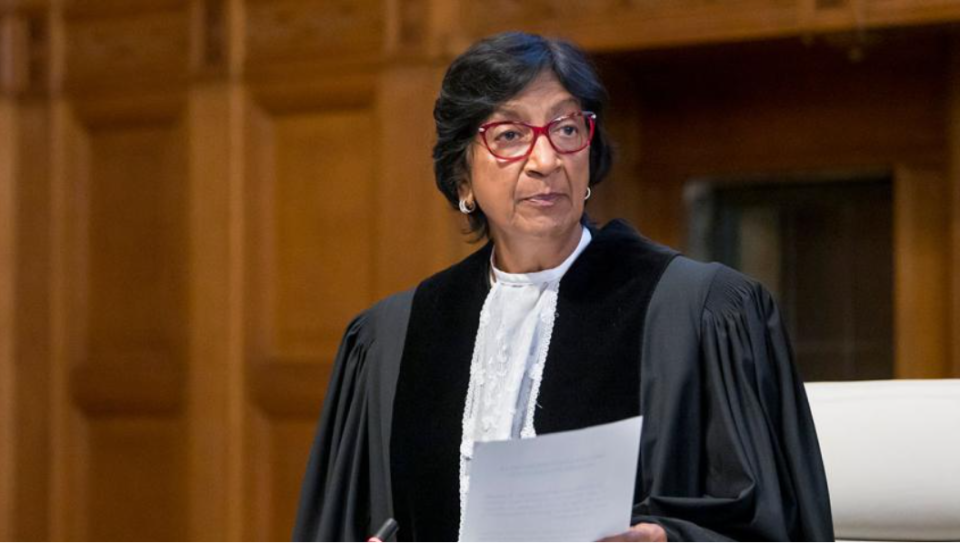
South African jurist Navi Pillay has won the 2026 Nobel Peace Prize. The award recognises her lifelong defence of human rights, justice and international law globally. Nobel Peace Prize
The Norwegian Nobel Committee announced the award on 9 October, recognising Navanethem “Navi” Pillay for her efforts to promote peace and international law. The Committee described her career as one defined by courage, integrity and a commitment to building a stronger international legal order. Nobel Peace Prize
For South Africa, the recognition celebrates a legal career that began under apartheid and ultimately reached some of the world’s most important human rights and international justice institutions. Pillay’s journey connects the country’s own struggle for equality with wider efforts to protect people from war crimes, crimes against humanity and genocide.
Born in Durban in 1941 into a family of Indian Tamil descent, Pillay experienced apartheid’s racial discrimination directly. She studied law and in 1967 became the first woman to establish her own law practice in Natal, using her legal skills to defend anti-apartheid activists and challenge abuses committed against political prisoners. Nobel Peace Prize
Her work included defending activists associated with the anti-apartheid struggle, including Nelson Mandela, and helping advance the rights of political prisoners. That early experience established a theme that would run through her career: using law not simply as a professional discipline, but as a means of protecting human dignity. The Presidency of South Africa
In 1995, Pillay was appointed to South Africa’s High Court, becoming the first Black woman to serve as a judge on the court. Her appointment came as South Africa was rebuilding its legal and constitutional institutions following the end of apartheid. United Nations
Her influence soon extended internationally when she joined the United Nations International Criminal Tribunal for Rwanda. Pillay later served as President of the tribunal, where her work contributed to significant developments in international criminal law. Nobel Peace Prize
One of the tribunal’s most important legal breakthroughs was establishing that rape and sexual violence could constitute genocide when committed with the intention of destroying a protected group. Pillay’s contribution helped expand international understanding of how sexual violence can be used as a weapon of conflict and persecution. Nobel Peace Prize
The significance of that development extends far beyond one court case. It strengthened the ability of international justice systems to recognise forms of violence that had historically been overlooked or treated as secondary consequences of war rather than serious crimes in their own right.
Pillay went on to serve as a judge at the International Criminal Court from 2003 to 2008 before becoming United Nations High Commissioner for Human Rights. She held the UN position from 2008 until 2014, advocating for equality, accountability and the protection of vulnerable communities across different regions of the world. Nobel Peace Prize
Her later work continued to place her at the centre of major international legal questions. She chaired the UN Independent International Commission of Inquiry on the Occupied Palestinian Territory from 2021 to 2025 and has served as an ad hoc judge at the International Court of Justice in the genocide case brought by The Gambia against Myanmar. Nobel Peace Prize
These roles have often required engagement with politically contested conflicts and powerful governments. The Nobel Committee said Pillay’s independence, legal expertise and willingness to hold both individuals and states accountable have made her one of the most respected international jurists of her generation. Nobel Peace Prize
The award also comes at a moment when international courts and institutions are facing increasing political pressure. The Norwegian Nobel Committee used Pillay’s recognition to emphasise that peaceful dispute resolution depends on countries respecting international law rather than relying solely on political or military power. Nobel Peace Prize
The Committee said lasting peace requires justice and accountability, particularly where serious violations of human rights have occurred. Pillay’s career provides an example of how courts and legal institutions can give victims a route towards recognition and accountability even when crimes cross borders or involve powerful political actors. Nobel Peace Prize
Her Nobel Peace Prize also adds another chapter to South Africa’s distinctive history within the award.
Pillay joins Chief Albert Luthuli, Archbishop Desmond Tutu, Nelson Mandela and FW de Klerk among South Africans who have received the Nobel Peace Prize. President Cyril Ramaphosa said the award allows the country to celebrate her contribution to peace, human dignity and justice both at home and internationally. The Presidency of South Africa
“She has served humanity with principle and the belief that the world can and should be a better place,” Ramaphosa said. The Presidency of South Africa
Her achievement also carries significance for women in law and public leadership. From becoming the first woman to open a law practice in Natal to breaking barriers in South Africa’s judiciary and occupying senior positions within global institutions, Pillay’s career has repeatedly challenged assumptions about who can hold positions of legal authority. Nobel Peace Prize
That legacy matters particularly for younger African lawyers, judges and human rights practitioners. Pillay’s journey demonstrates that expertise developed within African institutions and struggles can influence the development of international law and contribute directly to global systems of justice.
It also shows the longer-term social impact of building institutions capable of protecting rights. Courts, constitutions and international agreements can appear distant from everyday life, but their effectiveness determines whether people experiencing persecution, discrimination or violence have mechanisms through which to seek accountability.
The Nobel Committee said Pillay has been a driving force in developing an international system of law and order, highlighting her judicial rigour, integrity and courage. Her recognition therefore celebrates not only one individual, but the principle that law can be used as an alternative to violence and impunity. Nobel Peace Prize
For South Africa, the award brings global recognition to a jurist whose career began in a country where the law itself was once systematically used to discriminate against millions of people.
Pillay ultimately chose to spend her career demonstrating another possibility: that law can also challenge injustice, protect vulnerable people and hold those who abuse power accountable.
More than five decades after opening her law practice in apartheid-era Natal, Navi Pillay now receives one of the world’s most significant peace honours. Her journey from Durban to the highest levels of international justice reinforces a powerful idea — peace is strengthened not only through negotiation, but through institutions prepared to defend justice, dignity and the rule of law
