
Cape Town’s R5.2 billion Potsdam wastewater upgrade is strengthening treatment capacity, protecting waterways and expanding water reuse as the city prepares for future growth and resilience.
Cape Town Mayor Geordin Hill-Lewis has marked a major milestone in the City’s flagship Potsdam Wastewater Treatment Works upgrade, with the R5.2 billion project now around 80% complete.
The latest progress includes the installation of new membrane bioreactor filters capable of treating 65 million litres of wastewater a day, forming part of a wider upgrade that will more than double the plant’s capacity.
Once completed, Potsdam will be able to process approximately 100 million litres a day, up from its previous capacity of 47 million litres.
The investment represents more than an expansion of municipal infrastructure.
It connects service delivery, environmental protection and water security at a time when Cape Town continues to grow and climate pressures are increasing the importance of using water resources more efficiently.
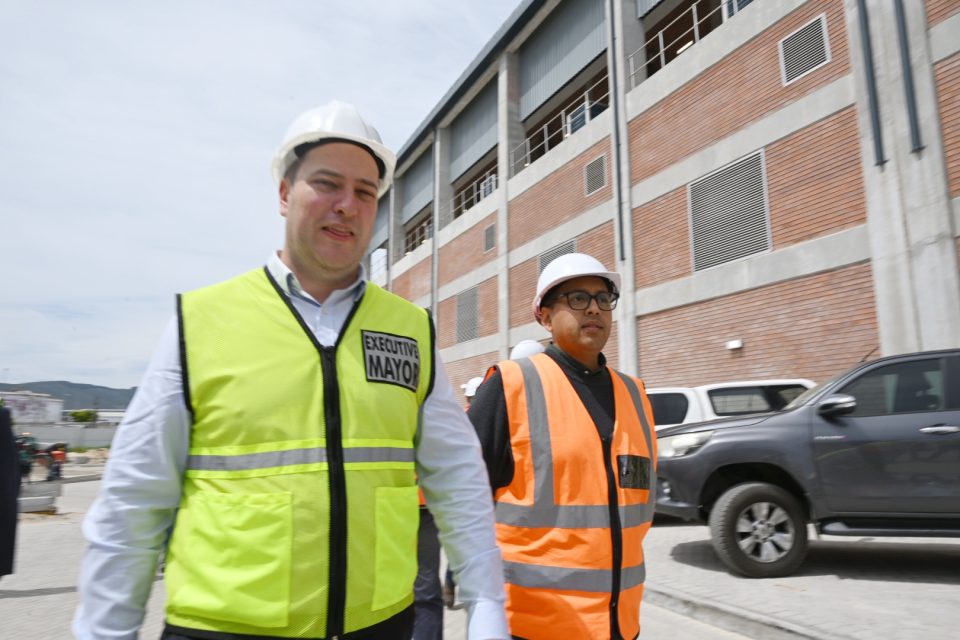
“The new reactor is on track for commissioning later this year ahead of full plant upgrade completion next year,” Hill-Lewis said during a site visit on 14 October.
“This major upgrade will more than double the plant’s capacity – from 47 to 100 million litres per day – to support the needs of a growing city.”
The Potsdam facility serves communities across the greater Milnerton area and has an important relationship with the environmental health of the Milnerton Lagoon and surrounding waterways.
Improving wastewater treatment therefore has a direct impact beyond the plant itself.
Better treatment can reduce pressure on natural ecosystems, improve the quality of discharged effluent and strengthen the long-term health of rivers, wetlands and coastal environments.
Hill-Lewis said improvements linked to the upgrade are already contributing to better environmental conditions at the Milnerton Lagoon.
He added that the City has invested more than R7 billion in wastewater treatment upgrades during the current term, including projects at Potsdam and Macassar, as well as the completed Zandvliet upgrade serving Khayelitsha and surrounding areas.
That scale of investment places wastewater infrastructure firmly within the ESG conversation.
Environmental performance is closely connected to social outcomes when cleaner waterways, stronger sanitation systems and more reliable municipal services improve the quality of life in communities.
The Potsdam upgrade also creates an important shared-value opportunity through treated effluent reuse.
Mayoral Committee Member for Water and Sanitation Alderman Zahid Badroodien said the expanded facility will increase the availability of treated wastewater for businesses, farmers and recreational facilities.
That allows suitable users to substitute treated effluent for drinking water in applications such as irrigation and certain industrial processes.
“Reaching the 80% completion milestone on this major infrastructure project is an important achievement for Cape Town,” Badroodien said.
“The upgrade will strengthen our wastewater treatment capacity, support the City’s growth and help protect our rivers and other natural environments, while creating more opportunities to use treated effluent instead of drinking water for suitable purposes.”
The reuse component is particularly important in a water-scarce city.
Every litre of treated effluent used for an appropriate non-potable purpose can reduce unnecessary pressure on potable water supplies.
That creates value for the municipality, businesses and the wider community.
Several major components of the Potsdam project are already operating.
A new ultrafiltration plant incorporates micro-screening, ultrafiltration membranes and ultraviolet disinfection to improve the quality of treated effluent released into the environment while increasing the quality of water available for reuse.
The treated effluent pump station has also been completed.
This allows users in areas including Milnerton and Century City to access treated water for irrigation and industrial purposes, helping reduce the use of drinking water where potable quality is not required.
A new dewatering plant has been operational since June 2025 and is helping remove solids from the treatment process, improving biological stability and effluent quality.
Commissioning of the new inlet works and raw sewage pump station is under way, with the membrane bioreactor treatment facilities expected to follow.
The use of membrane bioreactor technology is a significant element of the upgrade because it combines biological wastewater treatment with advanced membrane filtration.
For Cape Town, the technology supports the wider objective of improving the quality of treated water while increasing capacity within an existing urban environment.
The investment also demonstrates how infrastructure can become a form of social and environmental innovation.
Wastewater systems are often largely invisible to residents until they fail.
Yet they underpin public health, economic activity, environmental quality and the ability of cities to accommodate population growth.
When treatment systems are strengthened, the benefits flow across multiple areas.
Communities gain more reliable sanitation infrastructure.
Businesses gain access to alternative water sources.
Natural ecosystems face less pressure from poorly treated wastewater.
And the City improves its ability to respond to long-term water-security challenges.
The Potsdam project therefore illustrates how municipal investment can create several forms of value from a single intervention.
Rather than treating sanitation, water reuse and environmental protection as separate priorities, the upgrade connects them within one infrastructure system.
That is increasingly important for cities facing the combined pressures of urbanisation, climate change and constrained natural resources.
As Cape Town moves towards completion of the project in 2027, the ultimate measure of success will not simply be the size of the plant or the value of the investment.
It will be whether the upgraded system delivers cleaner waterways, more reliable wastewater treatment, increased water reuse and stronger environmental resilience for the communities and businesses that depend on it.
