
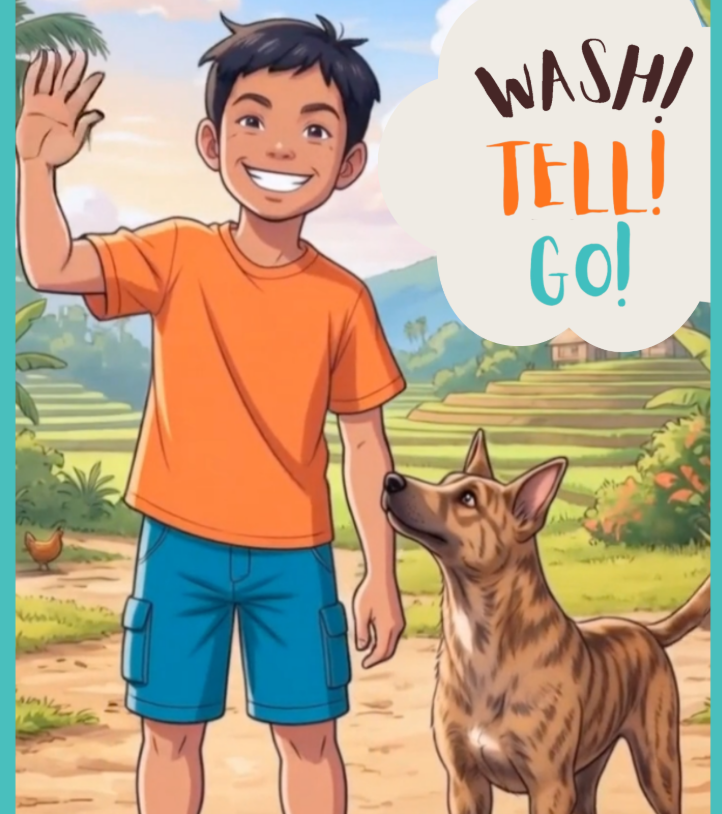
A new global campaign is teaching children three simple actions after animal bites or scratches, helping families respond quickly and prevent avoidable rabies deaths worldwide together.
The Global Alliance for Rabies Control has launched its Wash, Tell, Go campaign, using free educational resources, music and a global dance challenge to help children remember what to do after a possible rabies exposure.
The message is deliberately simple: wash the wound, tell a trusted adult and go to a healthcare facility.
Those three actions can be lifesaving.
Rabies is a viral disease transmitted mainly through the saliva of infected animals, usually through bites or scratches. Once clinical symptoms appear, the disease is effectively fatal, but prompt post-exposure treatment can prevent death.
Children are particularly vulnerable.
The World Health Organization says about 40% of people who die from rabies are children under 15, while the vast majority of human cases are linked to dog bites and scratches.
That makes simple health education especially important in communities where children regularly interact with dogs and other animals.
The Wash, Tell, Go campaign aims to make that information easier to remember through language and activities children can understand and share.
After a bite or scratch, the first step is to wash the wound immediately with soap and running water.
WHO recommends washing and flushing the wound thoroughly for at least 15 minutes before seeking medical attention.
The second step encourages children to tell an adult rather than hiding the injury or assuming that a small scratch is not serious.
The third is to go to a healthcare facility, where health professionals can assess whether rabies post-exposure prophylaxis is required.
That treatment can include rabies vaccination and, depending on the exposure, additional medication such as rabies immunoglobulin or monoclonal antibodies.
GARC is also using music and movement to spread the message.
Its Wash, Tell, Go Global Dance Challenge encourages children, families, classrooms and community groups to develop dance moves inspired by the three steps while using the campaign’s original song.
The intention is to turn a serious public-health message into something young people can remember and repeat.
GARC Community and Outreach Director Kerenza Vlastou said music and movement can help make important information more memorable and easier to share within communities.
The organisation has also produced a free education pack for teachers, parents, youth groups, health workers and community educators.
Resources include an animated video, audio material, lyrics and a teacher’s booklet designed to help adults explain rabies prevention to children.
The campaign arrives ahead of World Rabies Day on 28 September.
The 2026 theme, “Stronger Together”, emphasises collaboration between communities, health workers, veterinary professionals, educators, governments and other organisations working to prevent rabies.
In South Africa, the National Institute for Communicable Diseases has similarly emphasised vaccination, public awareness, rapid treatment after exposure and cooperation between human and animal health services.
Rabies remains disproportionately concentrated in Africa and Asia, particularly in communities where access to healthcare and veterinary services can be limited. WHO estimates that more than 95% of dog-mediated rabies deaths occur across the two regions.
That makes awareness itself a form of protection.
A child who knows to immediately wash a bite, tell someone and seek medical care has a better chance of receiving treatment before the virus can cause disease.
The campaign also reinforces a broader public-health lesson: preventing rabies requires action before symptoms appear.
Vaccinating dogs remains one of the most effective ways to stop transmission at its source, while accessible post-exposure treatment protects people who have already been exposed.
For GARC, Wash, Tell, Go turns that prevention message into three instructions simple enough for a child to remember.
And in the case of rabies, remembering those three actions could save a life.
