
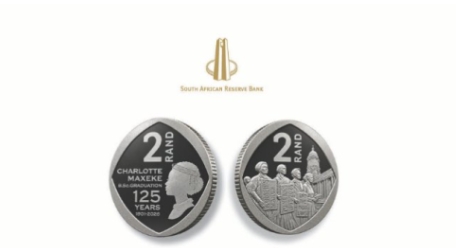
Two commemorative R2 coins will enter circulation in South Africa, recognising women whose leadership, courage and sacrifice helped shape the country’s struggle for freedom and equality.
The South African Reserve Bank launched the coins as part of the Milestones of Freedom campaign, which commemorates significant moments in South Africa’s history.
The first coin marks 125 years since Charlotte Maxeke became the first Black South African woman to graduate with a university degree.
The second commemorates 70 years since the historic 1956 Women’s March, when more than 20,000 women marched to the Union Buildings in Pretoria to protest against apartheid pass laws.
The Milestones of Freedom campaign was launched by President Cyril Ramaphosa in June 2026 to recognise important moments in South Africa’s democratic journey while promoting social cohesion.
Minister of Women, Youth and Persons with Disabilities Sindisiwe Chikunga described the launch as an opportunity to place women’s contributions more firmly within South Africa’s national story.
“For generations, women stood at the forefront of resistance, organised communities, sustained families during periods of oppression and made immeasurable contributions to the liberation struggle. Yet their contributions have too often been overlooked,” Chikunga said.
“Today, South Africa affirms that our national story cannot be told without recognising the central role played by women.”
Chikunga participated virtually in the launch held at the South African Reserve Bank Head Office in Pretoria.
Maxeke’s achievement in 1901 represented a significant breakthrough at a time when both racial and gender discrimination restricted opportunities for Black women.
“In 1901, Charlotte Maxeke, at a time when both racial discrimination and gender barriers sought to limit opportunity, she shattered expectations and expanded possibilities for generations of women to follow,” Chikunga said.
“Her achievement was far more than academic. It was a declaration that Black women were entitled to knowledge, dignity, leadership and equal participation in society.”
Chikunga said Maxeke understood education as a tool capable of challenging injustice, expanding economic participation and creating opportunities for personal and national development.
The second coin recognises one of the defining moments in the history of South African women.
On 9 August 1956, more than 20,000 women marched to the Union Buildings in opposition to pass laws, creating a legacy that continues to be commemorated through National Women’s Day.
Chikunga paid tribute to women associated with the march and broader liberation struggle, including Lilian Ngoyi, Helen Joseph, Rahima Moosa, Lillian Diedrickse and Sophia Williams-De Bruyn.
“Mama Lilian Ngoyi did not become extraordinary because she sought prominence. She became extraordinary because she organised,” Chikunga said.
“Mama Helen Joseph did not become a symbol because she pursued comfort. She became one because she embraced sacrifice.”
She also highlighted the contributions of Moosa, Diedrickse and Williams-De Bruyn, describing their activism as an example of the leadership and active citizenship that helped shape South Africa.
Unlike collector-only commemorative pieces, the new R2 coins are circulation coins, allowing the stories they represent to become part of everyday transactions across the country.
“As these coins circulate throughout our country, may they inspire reflection on our shared history and our collective future,” Chikunga said.
“May they remind us that freedom was won through struggle, that democracy is sustained through participation, and that equality requires action.”
The Minister said honouring the women represented by the coins should also encourage continued efforts to expand opportunities for women, young people, persons with disabilities and other vulnerable groups.
“As we honour their legacy, we must recommit ourselves to building an inclusive society where women, youth, persons with disabilities and other vulnerable groups are fully involved in governance, decision-making and development,” Chikunga said.
“The South Africa we seek cannot be built by a few; it must be shaped collectively by all its people.”
