
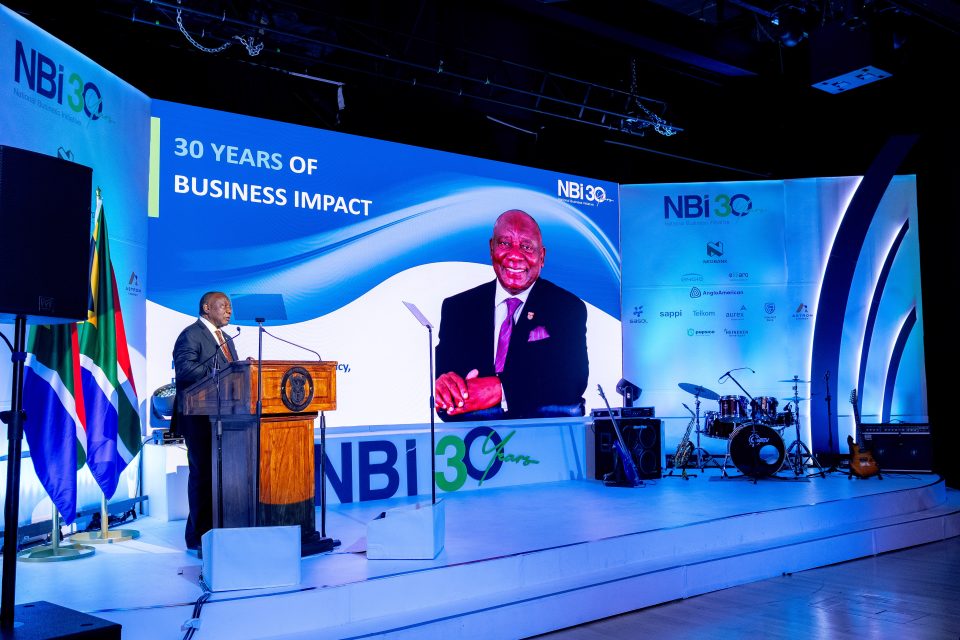
The National Business Initiative (NBI) marked its 30-year milestone in Johannesburg with a renewed focus on implementation, bringing together leaders from government, business and civil society to accelerate inclusive economic growth.
The milestone moment signals a broader shift in South Africa’s development landscape, where collaboration is increasingly being translated into delivery, impact, and measurable outcomes.
President Cyril Ramaphosa reaffirmed the importance of stronger public-private collaboration, positioning it as critical to unlocking growth. He also welcomed the integration of the NBI’s Technical Assistance and Mentorship Development unit into Operation Vulindlela Phase 2, reflecting a more execution-focused approach to reform.
NBI CEO Shameela Soobramoney said the scale of South Africa’s challenges requires a more active role from business in driving outcomes.
“Systemic constraints require systemic collaboration,” she said. “Business must move from being an observer to an active partner in delivery, working alongside government to strengthen the foundations for growth.”
Reflecting on the organisation’s journey, she added:
“Business, you have built us. We are you and you are us. Government, you have trusted us to partner in delivery and together we have driven impact, sometimes visibly and sometimes quietly, but always with purpose.”
Since its founding in 1995, the NBI has worked at the intersection of business and government to address unemployment, inequality, energy security and the climate transition — positioning itself as a platform for collective action.
Looking ahead, the organisation is placing stronger emphasis on scaling solutions that deliver measurable impact.
“Success looks like a young person moving from unemployment into meaningful work. It looks like a small enterprise entering a value chain that was once closed to it. It looks like dignity restored through participation in the economy,” Soobramoney said.
NBI Chairperson Cas Coovadia reinforced the organisation’s long-standing commitment to responsible business.
“Sustainability has been championed by the NBI long before it became the focus it is today,” he said, noting that this includes not only environmental responsibility, but also inclusive economic participation and market development.
President Ramaphosa also described the NBI as “a respected voice of responsible business action and a powerful agent for change,” highlighting its role in shaping partnerships over the past three decades.
As South Africa navigates a complex economic environment, the event reinforced a shared understanding: deeper, more practical collaboration between business and government will be essential to unlocking growth and expanding opportunity.
After 30 years, the NBI’s role remains focused on enabling partnerships, driving social innovation, building social capital, and supporting a more inclusive and competitive economy.
