
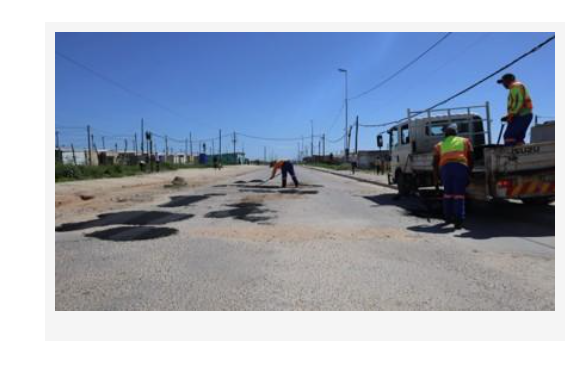
Nelson Mandela Bay’s pothole campaign has repaired 5,944 potholes while creating work opportunities, improving drainage and strengthening road infrastructure to support safer communities and economic growth.
The Nelson Mandela Bay Municipality’s “Fill Up the Bay” campaign is accelerating road repairs across the metro as the municipality tackles years of maintenance backlogs and infrastructure damage caused by flooding.
Launched by Executive Mayor Babalwa Lobishe in the Perseverance Industrial Area in August 2026, the programme has since expanded into communities including Veeplaas and Ward 30.
The municipality has allocated R61 million towards road maintenance, with R30 million specifically ring-fenced for accelerated pothole repairs.
The investment forms part of a broader effort to rebuild a road network capable of supporting residents, businesses, public transport and the wider Nelson Mandela Bay economy.
According to the municipality, 5,944 potholes have already been repaired since the campaign began.
Lobishe said the work should be understood as part of a wider infrastructure programme rather than simply a pothole-patching exercise.
“This work is about more than just patching holes; it is about elevating our road infrastructure to align with our economic growth strategy,” Lobishe said.
“A dependable road network is the absolute backbone of a thriving local economy.”
Road conditions can have a direct impact on economic activity, affecting commuting times, vehicle maintenance costs, logistics, public transport and businesses that rely on the movement of goods and customers.
The municipality is therefore combining surface repairs with work on some of the underlying infrastructure problems that contribute to road deterioration.
Broken stormwater drains, blocked drainage systems and damaged canals can cause water to flow across roads instead of being properly channelled away.
Over time, repeated flooding and standing water can weaken road surfaces and contribute to the formation of potholes.
“Fixing potholes without concurrently addressing stormwater drainage and canals would be an exercise in futility,” Lobishe said.
“A major root cause of our road damage is stormwater running across the tarmac instead of being channelled through functional drains and canals.”
The campaign has consequently incorporated stormwater maintenance alongside road repairs.
Over the past three months, 400 participants from the Expanded Public Works Programme have worked with municipal teams to clear approximately 4,700 stormwater drains.
They have also removed debris from 3.4 kilometres of stormwater canals and completed one kilometre of jet-vac cleaning.
The use of EPWP participants adds an employment component to the infrastructure programme, providing temporary work opportunities while addressing maintenance needs across the metro.
The municipality has also required contractors working on the campaign to employ at least three local community members in every ward where repairs are undertaken.
This approach allows infrastructure spending to generate some immediate local economic benefit while longer-term road improvements support broader mobility and economic activity.
Weather conditions, however, remain a challenge.
Persistent rainfall has affected both the pace and quality of repairs, with contractors sometimes required to suspend operations until road surfaces dry sufficiently for asphalt work.
Heavy rainfall has also damaged some newly repaired sections, highlighting the importance of addressing drainage systems alongside resurfacing.
Despite the disruption, municipal teams and appointed contractors continue operating across multiple clusters of Nelson Mandela Bay.
Lobishe said encouraging progress is being recorded, with contractors active in almost every cluster of the metro.
She credited Member of the Mayoral Committee for Roads and Transport Yolisa Pali-Jongilanga with maintaining oversight of the programme as repairs continue.
The campaign demonstrates how municipal road maintenance can connect several social and economic priorities at once.
Improved roads can make communities safer, reduce transport disruption and support businesses, while infrastructure projects can simultaneously create employment and skills opportunities.
The inclusion of drainage maintenance also shifts the intervention away from repeatedly repairing visible damage towards addressing some of its underlying causes.
For Nelson Mandela Bay, sustaining that approach will be important if the municipality is to reduce its pothole backlog while protecting repaired roads from further deterioration.
As the campaign continues, the long-term measure of success will not only be the number of potholes filled, but whether the metro develops a more resilient road and stormwater network capable of supporting communities and economic growth.
