
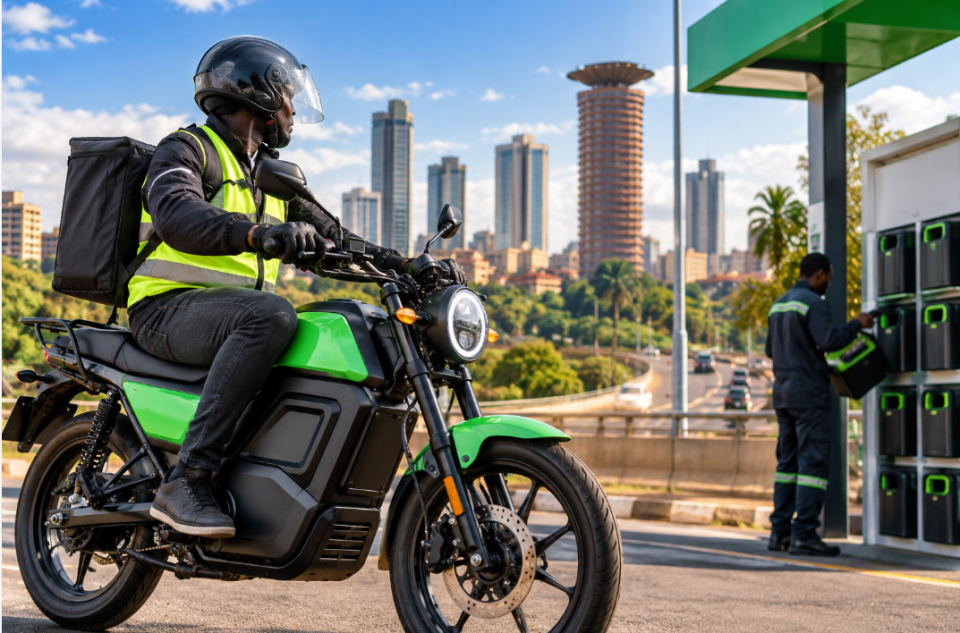
Kenya’s rapidly expanding electric vehicle market is creating new opportunities for local manufacturing, jobs and cleaner transport as electric mobility moves into the mainstream.
Official data from Kenya Power shows just how quickly the sector is growing. Electricity consumed to charge electric vehicles reached 8.43 million kWh in 2025, up 188% from 2.92 million kWh a year earlier.
The momentum has continued into 2026. Kenya Power says revenue from electricity sold for EV charging reached KSh382 million between July 2023 and April 2026, while monthly revenue climbed from less than KSh1 million in July 2023 to a peak of KSh35.25 million in February this year.
The growth is increasingly visible on Kenya’s roads. Government-backed reporting in May put the number of electric vehicles at more than 35,000, compared with approximately 1,200 in 2023. By June, figures presented at Kenya’s annual E-Mobility Conference and Expo indicated the number was approaching 40,000.
Electric motorcycles are playing a particularly important role in that transition.
Data presented at the 2026 E-Mobility Conference indicated that electric motorcycles and e-bikes accounted for more than 90% of registered electric vehicles, making Kenya’s large two-wheeler transport economy a significant driver of adoption.
For the country, however, the opportunity extends beyond replacing petrol vehicles with electric alternatives.
Kenya is increasingly positioning electric mobility as an emerging industrial sector capable of supporting manufacturing, technical skills, infrastructure development and employment.
Local electric mobility company Roam, for example, has increased the proportion of locally manufactured components in its second-generation Roam Air electric motorcycle to 36%. Components produced locally include body panels, wiring, connectors, battery compartments and other mechanical parts.
The company says greater localisation can shorten supply chains, reduce maintenance costs and support employment within Kenya’s growing clean-technology manufacturing sector.
For boda boda riders, who form an important part of Kenya’s transport system and informal economy, electric motorcycles also present an opportunity to reduce daily operating costs.
Roam says its latest motorcycle was developed with direct input from boda boda riders, with more than 40 improvements designed around the conditions in which Kenyan riders work. The company estimates that Kenya has more than three million boda boda riders supporting approximately five million livelihoods.
Kenya’s electricity mix gives the transition another advantage.
More than 90% of the electricity procured and dispatched by Kenya Power comes from renewable sources, meaning expansion of electric transport can be connected to the country’s broader clean-energy economy.
Government is also building policy around the emerging industry. Kenya launched its National Electric Mobility Policy in February 2026, creating a framework intended to accelerate adoption through regulation, infrastructure development and fiscal support.
Infrastructure will become increasingly important as more vehicles enter the market.
Kenya Power has introduced a dedicated e-mobility tariff, offering discounted electricity during off-peak periods, and is moving EV-charging customers onto the specialised tariff. The utility projects that annual electricity revenue from the sector could reach KSh5.9 billion by 2030.
The expansion is already moving beyond Nairobi. While the capital currently dominates EV electricity revenue, uptake has also been recorded across the Coast, North Eastern and Western Kenya regions.
For Kenya, the emerging EV economy therefore represents more than a shift in how vehicles are powered.
It creates an opportunity to build a wider value chain around African electric mobility — from locally assembled motorcycles and components to charging infrastructure, technical jobs, affordable transport and renewable electricity.
As adoption accelerates, Kenya’s experience could provide an important example of how Africa’s transition to electric transport can simultaneously support cleaner mobility, industrial development and new economic opportunities.
