
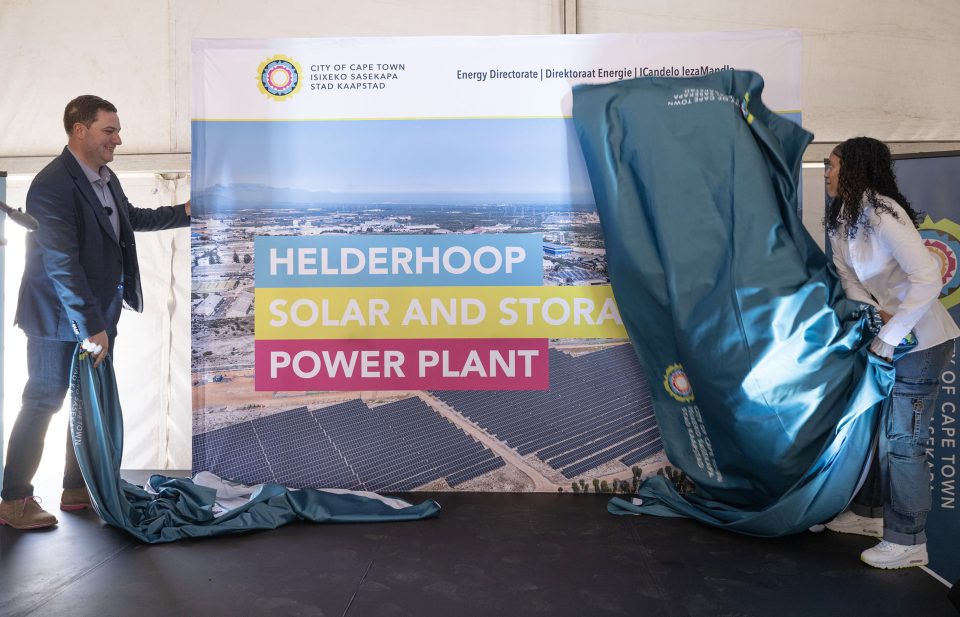
Cape Town has launched South Africa’s first metro-built hybrid power plant, combining solar and battery storage to cut energy costs, strengthen resilience and create local opportunity.
The R220 million Helderhoop Solar and Storage Power Plant in Atlantis represents another step in Cape Town’s strategy to diversify its electricity supply and reduce dependence on Eskom.
The facility combines 12,850 solar panels with two utility-scale batteries across approximately 15 hectares, an area roughly equivalent to 21 rugby fields.
Construction has now been completed, with the plant operating under controlled test conditions as part of the commissioning process.
Cape Town Mayor Geordin Hill-Lewis said the biggest long-term benefit for residents would be the cost of the electricity generated by the facility.
“The key benefit of this new power plant is that the power it generates is much cheaper than Eskom,” Hill-Lewis said.
The City estimates that Helderhoop could save Cape Town residents at least R400 million over the next 20 years as the municipality works to reduce exposure to Eskom electricity prices and annual tariff increases.
The project also demonstrates how municipalities can increasingly participate directly in electricity generation rather than relying solely on the national utility.
The City recently became the first South African municipality to purchase electricity on the open market at rates it says are approximately 20% below Eskom prices through its initial 200MW Independent Power Procurement Programme.
For Atlantis, the new power station also carries a local economic development dimension.
Approximately 305 jobs were created during construction, while workers and local businesses gained experience connected to renewable-energy infrastructure.
Alderman Xanthea Limberg, Cape Town’s Mayoral Committee Member for Energy, said the project had required collaboration between City officials, contractors, businesses and the Atlantis community.
The plant’s name also came directly from the community.
Helderhoop, meaning “Bright Hope”, was proposed through a public competition by Vinolio Cloete, who was a matric learner at Saxonsea High School at the time.
Cloete said the name combined the ideas of light and energy with hope for a better future for Atlantis.
“Solar power brings clean energy, jobs, opportunities, and progress for Atlantis,” Cloete said in motivating the name.
The launch comes as Atlantis marks its 50th anniversary and follows other investments in the area, including the R31 million upgrade of Wesfleur Stadium, improvements to MyCiTi infrastructure and continued investment in the Atlantis Special Economic Zone.
Cape Town’s wider energy strategy increasingly combines municipal generation, independent producers, rooftop solar, electricity trading and energy-efficiency programmes.
The City says its Municipal Energy Efficiency Programme has already saved more than 427 gigawatt hours of electricity and generated approximately R625 million in savings through interventions including building upgrades, streetlight retrofits and rooftop solar.
Municipal sites have also installed 2.2MW of solar generation as part of a target to reach 25MW within the next two years.
Residents and businesses are increasingly becoming part of the energy system as producers as well as consumers.
Since June 2024, Cape Town residents and businesses have earned around R67 million by selling approximately 150 gigawatt hours of excess solar power back to the City through municipal bill credits and cash payments.
More than 250 MVA of rooftop solar capacity has now been installed across Cape Town, helping reduce pressure on the electricity grid and strengthening local energy resilience.
The City has also introduced electricity wheeling, allowing power producers to sell electricity to customers using Cape Town’s grid.
More than 1,700 megawatt hours of electricity have been traded through the system since 2024.
Further municipal generation is planned, including a proposed 70MW hybrid solar and battery storage facility at Paardevlei targeted for development by 2029.
Cape Town also intends procuring up to 500MW from energy traders and aggregators, alongside further generation from waste-to-energy projects.
Taken together, the projects point towards a municipal energy model that combines lower-cost electricity, diversified supply, private investment, household generation and locally built infrastructure.
For residents, the longer-term test will be whether these investments translate into more affordable electricity, greater reliability and protection from the financial impact of rising national electricity costs.
For Atlantis, Helderhoop adds another dimension: a major clean-energy asset that has already created employment and skills while positioning the community within South Africa’s expanding renewable-energy economy.
