
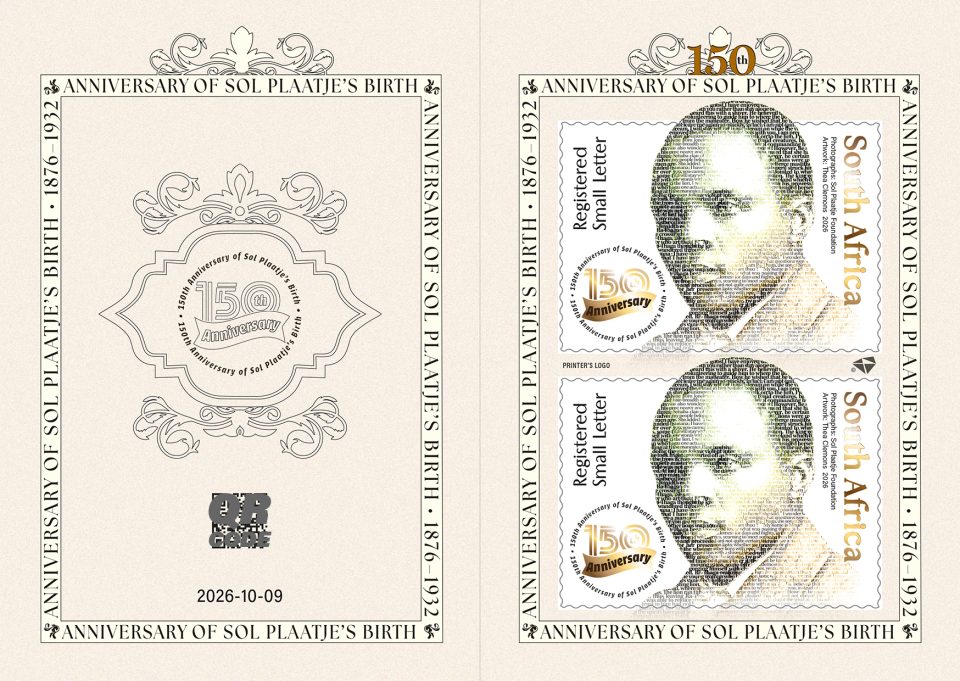
The South African Post Office is marking Solomon Plaatje’s 150th anniversary with commemorative stamps that preserve his literary, linguistic and political contribution for future generations nationally.
Issued to coincide with World Post Day, the commemorative collection recognises Solomon Tshekisho Plaatje as one of South Africa’s significant intellectual, literary and political figures, while creating an opportunity for a new generation to engage with his work.
Plaatje’s contribution extended across journalism, literature, language, history and political activism. His work documented the experiences of Black South Africans during a period of profound social and political change and contributed to preserving African perspectives within South Africa’s historical record.
At the centre of the commemorative issue is Plaatje’s landmark novel, Mhudi, widely recognised as the first novel written in English by a Black South African.
First published by Lovedale Press in 1930, the novel follows Mhudi and Ra-Thaga against the historical backdrop of the Difaqane or Mfecane, exploring displacement, conflict, survival and human relationships while presenting African communities and histories through an African literary perspective.
The South African Post Office has incorporated this literary legacy directly into the design of the stamps.
Created by Thea Clemons of the Post Office’s Philatelic Services, Plaatje’s portrait is constructed from words taken from Mhudi, with the text forming the highlights and shadows of his face.
The design links Plaatje’s physical image with the writing through which much of his contribution continues to be remembered.
The commemorative issue consists of a mini-booklet containing two registered small-letter-rate stamps and a stamp sheet featuring four stamps of the same rate.
Beyond its value to collectors, the issue highlights the role commemorative stamps can play in preserving national memory and introducing important historical figures to audiences who may not encounter their work through traditional historical or literary channels.
“For the South African Post Office, commemorative stamps provide more than a means of postage. They create small, enduring records of people, events and moments that have helped shape South Africa’s history,” Clemons said.
Plaatje was born in 1876 into a Barolong family and developed a career that moved between public service, journalism, literature, translation and political organisation.
He worked as a court interpreter before establishing himself as a journalist, editor and commentator on the political and social conditions affecting Black South Africans.
His writing became an important vehicle for recording experiences that were frequently marginalised within official accounts of South African society.
His 1916 book Native Life in South Africa documented the effects of the 1913 Natives Land Act and remains an important contemporary account of the legislation’s impact on Black communities.
Plaatje’s contribution to language was equally significant.
As a multilingual writer and translator, he demonstrated the capacity of African languages to carry literature, ideas and cultural knowledge across generations.
He became the first African to translate works by William Shakespeare into Setswana, creating an important bridge between English literature and African-language literary traditions.
That aspect of his legacy remains relevant as South Africa continues to consider how indigenous languages can be strengthened across education, publishing, media and cultural institutions.
Preserving language is closely connected to preserving identity, history and access to knowledge, making Plaatje’s work particularly significant beyond its literary value.
South African Post Office Acting CEO Fathima Gany said the anniversary provides an opportunity to reflect on the enduring importance of his contribution.
“Sol Plaatje’s legacy reminds us of the power of words to record history, preserve culture and give expression to the experiences of people whose stories might otherwise be lost,” Gany said.
The commemorative stamps extend that principle into a public form of remembrance.
By placing Plaatje’s portrait and writing on an everyday object designed to circulate, the Post Office is helping move his legacy beyond books, classrooms and archives and into a broader public space.
The initiative also demonstrates how heritage can be preserved through creative forms that connect history with contemporary audiences.
For younger South Africans in particular, the stamps provide an entry point into the life of a writer whose work intersected with questions of representation, language, political participation and cultural preservation.
As South Africa marks 150 years since Plaatje’s birth, the commemorative issue recognises not only an individual life, but the wider importance of recording the experiences, languages and histories that shape the country’s collective identity.
Through the stamps, Plaatje’s words continue their journey as part of South Africa’s living cultural heritage.
