South Africa’s iconic Rooibos plant is preparing for an extraordinary journey into space, with more than 17,000 seeds set to travel to the International Space Station (ISS) as part of a pioneering scientific experiment that will also create valuable learning opportunities for young South Africans.
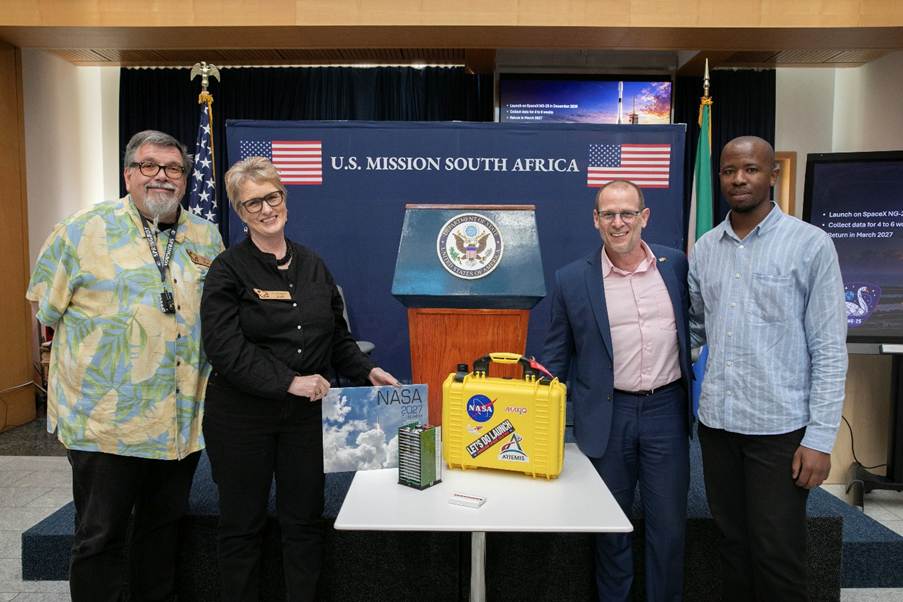
The Rooibos in Space project has reached another milestone following a farewell event hosted by Allison Areias, United States Consul General in Cape Town, for South African school and university science experiments bound for the United States. The Rooibos seeds will travel alongside these experiments aboard the same spacecraft to the ISS.
A total of 17,346 Rooibos seeds, weighing approximately 74.2 grams, will be transported to Voyager Technologies in Texas, where the experiment will be prepared for spaceflight. The seeds have been divided into three batches: untreated, scarified, and scarified seeds treated with a protective agricultural coating.
The experiment will be housed inside a specialised Nanolab, a compact research module designed to accommodate scientific experiments in space. These standardised laboratories allow researchers to conduct investigations aboard the ISS without requiring large, custom-built equipment.
The Rooibos Nanolab is scheduled to travel to the ISS aboard the Cygnus NG-25 commercial resupply spacecraft, with the mission currently expected to launch between December 2026 and January 2027.
The revised timeline follows changes to the Voyager and NASA flight schedules, including adjustments to crew and resupply arrangements, which resulted in the postponement of the October flight originally allocated to the experiment.
“This is an exciting milestone for Rooibos and for South Africans who have followed this project from the beginning,” said Dawie de Villiers, Director of the South African Rooibos Council (SARC).
“The scientific objective is to explore what will happen to the Rooibos seeds when they are exposed to conditions beyond Earth, opening up new opportunities to learn more about this uniquely South African plant.”
The seeds are expected to spend between four and six weeks in space, where they will be exposed to microgravity and space radiation before returning to Earth for further scientific investigation.
Once the seeds return, researchers will collaborate with schools in the Cederberg region, the natural growing area of Rooibos, and Parklands College to plant the space-exposed seeds alongside control seeds that remained on Earth.
Over 18 months, learners and researchers will monitor germination rates, growth patterns and plant development, comparing how the space-exposed seeds perform against those that were not sent into orbit.
Beyond its scientific significance, the project offers an opportunity to introduce South African learners to practical space research while strengthening their knowledge of Science, Technology, Engineering and Mathematics (STEM).
Learner participation is central to the initiative, allowing young people to contribute to an authentic scientific investigation while developing research, observation, measurement and analytical skills.
The broader Rooibos in Space programme has also included school engagement activities, STEM education initiatives and a national Mission Patch competition that challenged young people aged 12 to 18 to design a unique emblem representing the mission.
For Rooibos seed technician Cyril Ngqwala, preparing the experiment has provided an opportunity to combine traditional knowledge of Rooibos seed preparation with advanced space science.
“Working with the seeds from preparation through to assembling the Nanolab has been an incredible experience,” said Ngqwala.
“We have prepared the seeds in different conditions so that, when they return, we can compare their performance with seeds that have remained on Earth. It’s exciting to think that something as uniquely South African as Rooibos is now part of a space experiment.”
The initiative was conceived by the South African Rooibos Council and developed in collaboration with MaxIQ Space, a South African and United States space education company specialising in STEM learning and applied scientific research.
Through its educational programmes, MaxIQ Space helps learners, educators and institutions participate in practical space missions, providing exposure to scientific research, engineering, data analysis and problem-solving.
The Rooibos mission is expected to mark the first time an indigenous South African plant seed has been sent into space for this type of research.
The experiment could provide new insights into how Rooibos, a plant naturally adapted to the unique environmental conditions of the Cederberg, responds to the extreme conditions encountered beyond Earth.
It also demonstrates how collaboration between industry organisations, scientific institutions and educational partners can create opportunities for young people to participate in internationally relevant research.
By connecting an indigenous South African plant with advanced space technology, the project highlights the potential for local knowledge, scientific innovation and education to contribute to global research.
For participating learners, the experience extends beyond the classroom, offering a rare opportunity to develop practical scientific skills while contributing to a project with international significance.
As the seeds prepare for their journey to the ISS, Rooibos in Space represents more than a scientific experiment. It is an opportunity to inspire the next generation of South African scientists, researchers and innovators while showcasing the country’s potential to participate in the growing global space economy.
Updates on the mission will be available through the South African Rooibos Council’s website at www.sarooibos.co.za and its social media platforms.