
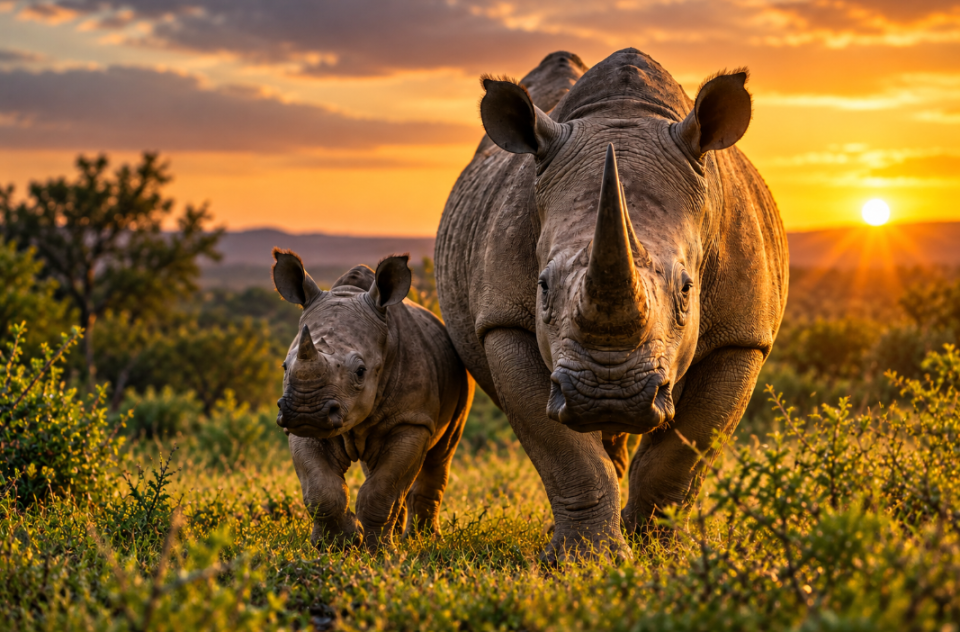
South Africa’s rhino population grew 4.9% by the end of 2025, while conservation and law-enforcement efforts continue protecting animals from persistent poaching pressure nationwide in 2026.
South Africa remains home to the world’s largest rhino population, with the minimum national population estimated at 15 096 animals at the end of 2025.
The total includes at least 2 565 black rhinos and 12 531 white rhinos, representing a 4.9% increase compared with 2024 and providing an encouraging sign for conservation efforts.
The population growth comes despite rhino poaching remaining a significant threat.
Between January and the end of August 2026, 230 rhinos were poached nationally, compared with 248 during the same period in 2025.
Kruger National Park recorded 114 rhinos lost to poaching during the first eight months of the year, down from 123 during the corresponding period in 2025.
The figures highlight the challenge facing conservation authorities: growing rhino populations while simultaneously reducing the number of animals being killed.
Poaching does not only remove individual animals from the population. The loss of breeding animals can slow recovery, while calves can be orphaned and the structure of rhino populations disrupted.
Protection efforts increasingly combine security, biological management and law enforcement rather than relying on a single intervention.
Kruger National Park has strengthened its field capacity through additional field rangers and rhino monitors under the Rhino Renaissance Initiative.
Other interventions include dehorning, layered security systems, technology, ranger skills development and stronger integrity management designed to reduce opportunities for criminal networks operating around protected areas.
South Africa recorded 352 rhinos poached during 2025, a 16% decline from the 420 animals killed in 2024, according to the Department of Forestry, Fisheries and the Environment.
The reduction has been accompanied by continued dehorning programmes, improved protection measures, intelligence-led operations and cooperation between conservation and law-enforcement agencies.
Long-term rhino recovery is also being supported through a new national conservation framework.
In April 2026, government published the Biodiversity Management Plan for Black and White Rhinoceros in South Africa for the period 2025 to 2035.
The plan combines previous black and white rhino management frameworks into one national strategy aimed at strengthening conservation, improving coordination and supporting collaboration between government, conservation authorities, private landowners and communities.
Its long-term vision is for thriving black and white rhino populations that contribute to conservation while also creating benefits through inclusive and sustainable use.
A National Rhino Conservation Coordination Committee is expected to help coordinate implementation of the plan, with the Department of Forestry, Fisheries and the Environment overseeing implementation until the structure is fully established.
South Africa is also continuing implementation of the National Integrated Strategy to Combat Wildlife Trafficking, which targets criminal activity across the illegal wildlife trade.
The approach seeks to disrupt not only poachers operating on the ground, but also traffickers, financiers and organised criminal networks involved in moving and selling illegal wildlife products.
Successful prosecutions during 2026 have included substantial prison sentences for people convicted of rhino-related offences, reflecting an increasing focus on ensuring arrests translate into consequences within the criminal justice system.
Conservation authorities have also emphasised that protecting rhinos cannot be achieved by government agencies alone.
Private reserves, conservation organisations, researchers, local communities, financial institutions, prosecutors and international partners all form part of the wider effort required to protect populations and disrupt trafficking networks.
The revised rhino management plan specifically adopts a whole-of-society approach, recognising that long-term conservation depends on cooperation across the public, private and community sectors.
World Rhino Day, observed internationally on 22 September, focuses attention on all five surviving rhino species and the conservation work required to protect them from threats including poaching and habitat loss.
For South Africa, this year’s population growth provides measurable evidence that recovery is possible.
However, the loss of 230 animals in eight months demonstrates why continued investment in rangers, technology, biological management, prosecution and community participation remains critical.
The objective is not simply to keep poaching below a level at which populations can survive, but to continue reducing losses while allowing black and white rhino populations to recover and expand.
South Africans who witness suspicious wildlife-related activity can report it to the Department’s environmental crime hotline on 0800 205 005 or to SAPS on 10111.
