
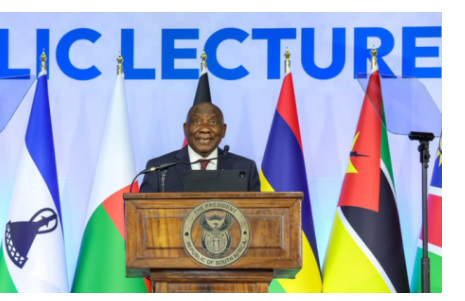
President Cyril Ramaphosa has called for greater investment in Southern Africa’s young people, saying they will ultimately determine whether the region achieves its Vision 2050 ambitions.
Addressing a public lecture at the University of KwaZulu-Natal’s Westville Campus, Ramaphosa placed human development at the centre of the Southern African Development Community’s (SADC) long-term future.
More than half of SADC’s population is under the age of 30, a demographic Ramaphosa described as the region’s “greatest strategic asset” and the engine of its future.
However, he warned that the size of the youth population would not automatically translate into economic growth and development.
Youth unemployment remains one of the region’s most significant obstacles, particularly as increasing numbers of young people complete their education without finding corresponding opportunities in the economy.
“Across this region are young people who did everything that was asked of them. They stayed in school. They passed. They borrowed money to study. Many graduated, but now too many young people sit at home with a qualification and no employment,” Ramaphosa said.
He called for schools, universities, technical and vocational colleges and research institutions to play a stronger role in developing the capabilities required by the future economy.
But investment in human capital, he argued, must begin considerably earlier.
Ramaphosa highlighted maternal health, early childhood nutrition and access to basic services as fundamental to building the region’s future workforce.
“A child whose growth is stunted carries that loss for a lifetime. No university can adequately undo it. No industrial policy can properly compensate for it,” he said.
Under the Human and Social Capital Development pillar of Vision 2050, he called for children to have access to food, water, shelter and safe environments that support their development.
Digital literacy and adolescent healthcare would also need greater attention, alongside efforts to address child marriage, teenage pregnancy and the digital divide affecting young people, particularly in rural communities.
“Each of the barriers we remove adds to the productive capacity of our economies,” Ramaphosa said.
Healthcare was another major component of his vision for a more integrated Southern Africa.
Ramaphosa called for a harmonised regional health system where access to quality healthcare would not be determined by national borders.
He urged SADC Member States to strengthen health financing and referred to the Abuja Declaration commitment to allocate at least 15% of national budgets to healthcare.
Lessons from the COVID-19 pandemic and changes in international development assistance have, he said, reinforced the importance of greater regional health security and sovereignty.
Women’s economic participation was similarly positioned as essential to achieving Vision 2050.
Ramaphosa said regional integration could not succeed while women continued to face barriers to productive assets, finance, markets and procurement opportunities.
He also linked women’s economic empowerment directly to their safety.
“Yet there can be no equality between women and men for as long as women are not safe,” he said.
The President called for stronger laws, improved prosecutions, greater survivor support and economic empowerment as part of the region’s response to gender-based violence and femicide.
He said prevention must also address the behaviour and attitudes of men and boys in homes, schools, churches, workplaces and other social environments.
Regional integration, Ramaphosa added, must also influence how Southern African countries approach migration.
“We cannot preach integration at summits and practise exclusion in our streets,” he said.
He expressed concern about discrimination against foreign nationals in South Africa and called for the region to address the conflict, instability, poverty and governance failures that can force people to migrate.
“We seek a region where people move out of choice, not out of desperation,” he said.
Peace and political stability remain fundamental to delivering the region’s economic and social ambitions.
Ramaphosa described the conflict in the eastern Democratic Republic of Congo as the “gravest test” of SADC’s collective resolve, while also pointing to processes in Mozambique and Madagascar.
Without peace, he said, investment, infrastructure development and the provision of basic social services become increasingly difficult.
Climate resilience represents another significant component of the region’s development agenda.
With Southern Africa increasingly exposed to droughts, cyclones and floods, Ramaphosa called for resilience to be incorporated across regional development planning.
He advocated strengthening the SADC Humanitarian and Emergency Operations Centre to improve the region’s ability to anticipate and respond to disasters.
“We must act before a disaster strikes, rather than scramble for assistance after it,” he said.
Despite the scale of the issues addressed, Ramaphosa concluded by returning to the region’s young people and the opportunity represented by Vision 2050.
Drawing on Pixley ka Isaka Seme’s 1906 speech, The Regeneration of Africa, he connected the historic vision of African renewal with practical ambitions around manufacturing, infrastructure, entrepreneurship, education and human development.
The young people currently studying across Southern Africa, he said, will ultimately inherit responsibility for implementing and sustaining that vision.
“Vision 2050 is not our document. It is yours, and you are entitled to demand an account of what we did with it,” Ramaphosa said.
For the President, Southern Africa’s demographic advantage therefore comes with an immediate responsibility: investing in young people now so they have the health, education, skills and economic opportunities required to lead the region in 2050.
For the President, Southern Africa’s demographic advantage therefore comes with an immediate responsibility: turning Vision 2050’s youth commitments into measurable actions and deadlines so young people can hold leaders accountable.
