
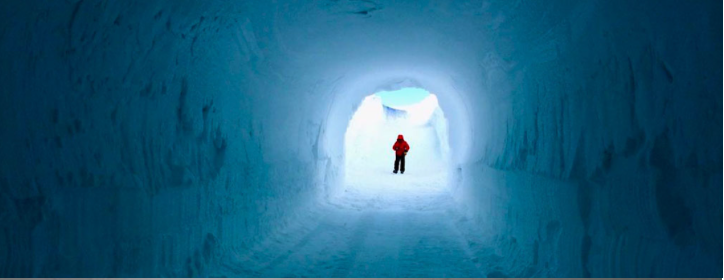
The Ice Memory Foundation has officially opened the world’s first sanctuary dedicated to preserving mountain ice cores in Antarctica, marking a major milestone in global efforts to safeguard critical climate records for future generations.
The sanctuary, located at the French-Italian Concordia Station on the Antarctic Plateau, stores ice cores in a naturally stable environment at temperatures close to minus 52 degrees Celsius year-round. Designed to function without mechanical refrigeration or permanent construction materials, the facility provides long-term protection for ice samples that contain irreplaceable records of Earth’s past atmosphere.
The opening follows the successful arrival of the first two heritage ice cores collected from endangered Alpine glaciers. Extracted from Mont Blanc in France and Grand Combin in Switzerland, the cores completed a journey of more than 50 days from Europe to Antarctica. Transported aboard the Italian research vessel Laura Bassi and later flown across the Antarctic interior under strictly controlled temperature conditions, the samples were placed inside a specially excavated ice cave now known as the Ice Memory Sanctuary.
Launched in 2015, the Ice Memory project is led by an international scientific consortium including CNRS, IRD, the University of Grenoble-Alpes, Italy’s CNR and Ca’ Foscari University of Venice, and the Paul Scherrer Institute in Switzerland, with coordination by the Ice Memory Foundation. The project aims to preserve ice cores from glaciers threatened by rapid melting, ensuring that the scientific information they contain remains available even if the original glaciers disappear.
Scientists say the stored ice cores act as time capsules, trapping ancient atmospheric gases, aerosols, pollutants and dust that allow researchers to reconstruct past climate conditions and improve future climate projections. The preservation of these samples supports long-term scientific research and evidence-based decision-making related to climate change.
The Ice Memory Sanctuary itself measures 35 metres in length and five metres in height and width and is carved into compact snow layers beneath the Antarctic surface. Its design was developed to minimise environmental impact and complies with the Antarctic Treaty System’s environmental protection requirements. The facility received formal approval in 2024 and has been funded with support from the Prince Albert II of Monaco Foundation.
Prince Albert II, Honorary President of the Ice Memory Foundation, said the initiative reflects a responsibility to preserve glacial heritage for future generations, describing the sanctuary as a long-term legacy for science and humanity.
Glaciers worldwide are retreating at unprecedented rates, with studies showing that global ice loss has reached approximately five percent since 2000, and much higher levels in certain regions. This rapid decline threatens to erase centuries of climate information that has historically contributed to global climate assessments, including work undertaken by the Intergovernmental Panel on Climate Change.
Since its inception, the Ice Memory Foundation has coordinated or supported 10 ice-core drilling campaigns across multiple continents, engaging scientific teams from more than 13 countries. Additional heritage ice cores from regions including the Andes, the Pamirs, the Caucasus and Svalbard are expected to be added to the Antarctic sanctuary in the coming years.
Looking ahead, the foundation plans to establish an international governance framework to manage access to the stored ice cores. This framework, aligned with the United Nations Decade of Action for the Cryospheric Sciences, aims to ensure that the samples are treated as a global public good, accessible for scientific research based on transparent and ethical criteria.
The Ice Memory Foundation has called on governments, scientific institutions and funding partners to accelerate efforts to collect ice cores from endangered glaciers before they are lost, warning that the current generation may be the last with the opportunity to preserve these critical climate archives.
The opening of the Ice Memory Sanctuary represents a significant example of international scientific cooperation, environmental stewardship and long-term thinking in response to the accelerating impacts of climate change.
