
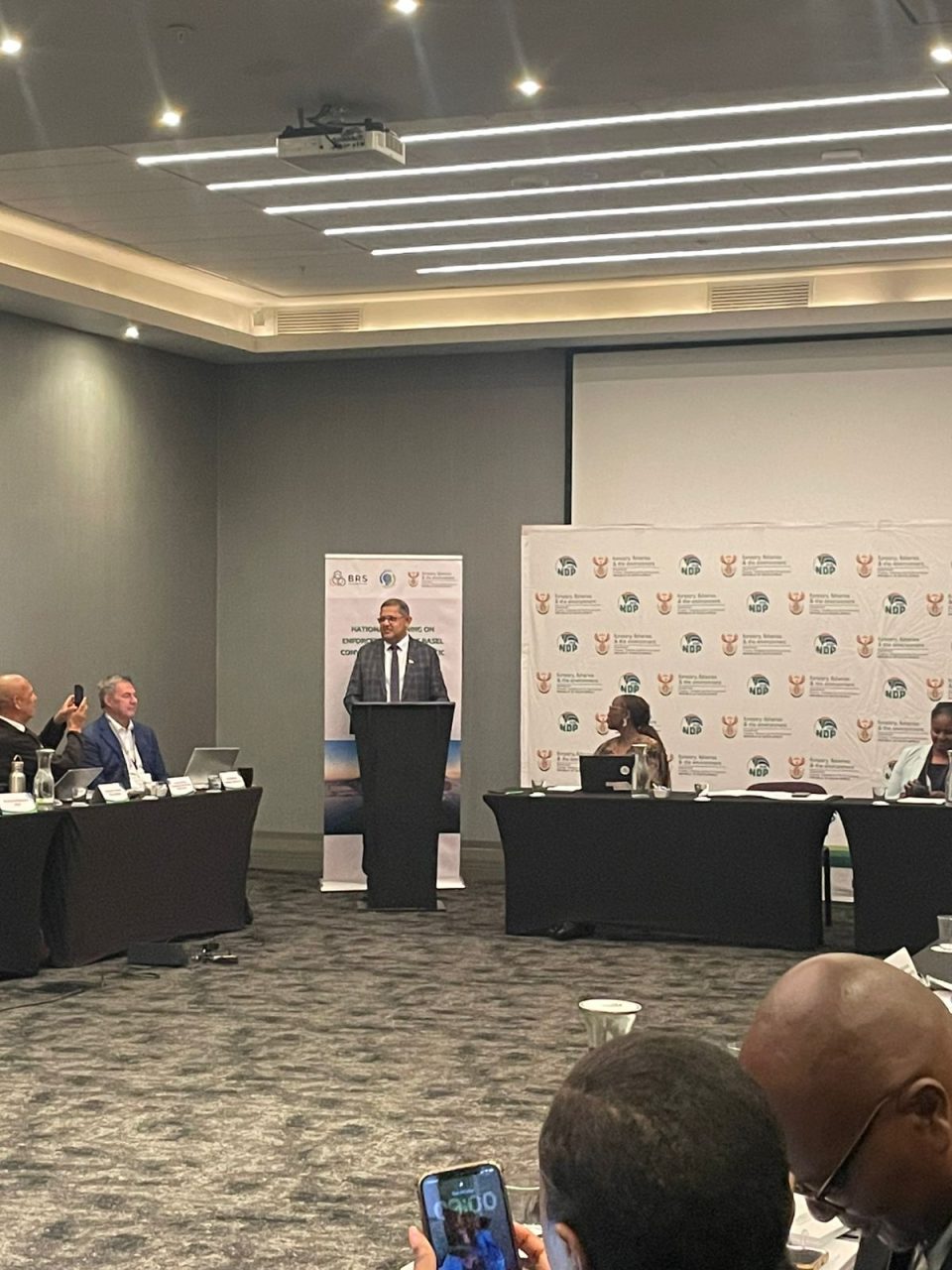
South Africa hosted the first-ever international training on hazardous waste trade and plastic pollution at sea. The initiative was organised in partnership with the Secretariat of the Basel, Rotterdam and Stockholm Conventions, the Africa Institute, and the Basel and Stockholm Conventions Regional Centre South Africa.
Deputy Minister of Forestry, Fisheries and the Environment, Narend Singh, delivered the opening address.
The Deputy Minister highlighted the importance of partnerships and collective commitment, stating:
“Initiatives of this calibre do not occur by chance. They are the result of deliberate commitment by institutions and individuals who understand that effective environmental governance rests on three pillars: well-capacitated officials, strong partnerships, and sustained investment in regulatory, implementation and institutional capability.”
The Deputy Minister stressed that while legislation and policy frameworks may be well designed, they are not sufficient to address current environmental challenges.
“Real impact depends on skilled, knowledgeable and committed officials who can translate legal requirements into practical action. It depends on competent authorities correctly administering prior informed consent and other transboundary controls. It depends on customs officers and Border Management Authority officials who can identify suspicious shipments, apply appropriate risk management, and facilitate legitimate trade while intercepting illegal waste movements. It depends on Environmental Management Inspectors who possess both legal acumen and technical understanding. And it depends on seamless collaboration among regulators, scientists, investigators and prosecutors.”
The Deputy Minister also referred to the recently concluded large-scale international operation targeting organised crime networks involved in waste and pollution-related crimes.
The global operation, code-named Custos Viridis, took place between January and December 2025 across five continents and was led by Europol in collaboration with partners from 71 countries and international organisations.
Environmental crime has been identified as the fourth-largest organised crime activity globally, with annual losses estimated at between €80 billion and €230 billion.
The report further reveals deepening links between waste trafficking, organised criminal networks, document fraud, illicit financial flows and other forms of transnational crime.
“A particularly pressing dimension of our work is the implementation of the Plastic Waste Amendments to the Basel Convention. Plastic pollution has emerged as one of the defining environmental crises of our time. Our oceans, rivers, estuaries, coastlines and terrestrial ecosystems are under growing pressure from plastic waste and microplastics.
“The consequences extend far beyond environmental degradation: marine plastic pollution threatens fisheries, biodiversity, tourism, coastal livelihoods and, ultimately, human health and food security.
“With its extensive coastline and vibrant ocean economy, South Africa is acutely aware of these risks. Government has therefore intensified efforts to curb plastic pollution through stronger waste regulation, Extended Producer Responsibility schemes, waste diversion and recycling programmes, and the promotion of circular economy principles.”
The training brought together officials and specialists working in environmental regulation, customs collaboration, compliance oversight and enforcement, with a strong emphasis on implementing the Basel Convention Plastic Waste Amendments and advancing measures to address the escalating global challenge of marine plastic pollution.
The Deputy Minister underscored the importance of ongoing training initiatives, stating:
“I sincerely hope this is not the final training of its kind hosted in South Africa. On the contrary, I envisage this programme as the foundation for a sustained partnership aimed at strengthening capacity not only nationally but across the African continent.”
by Jos-lene Benekema
