
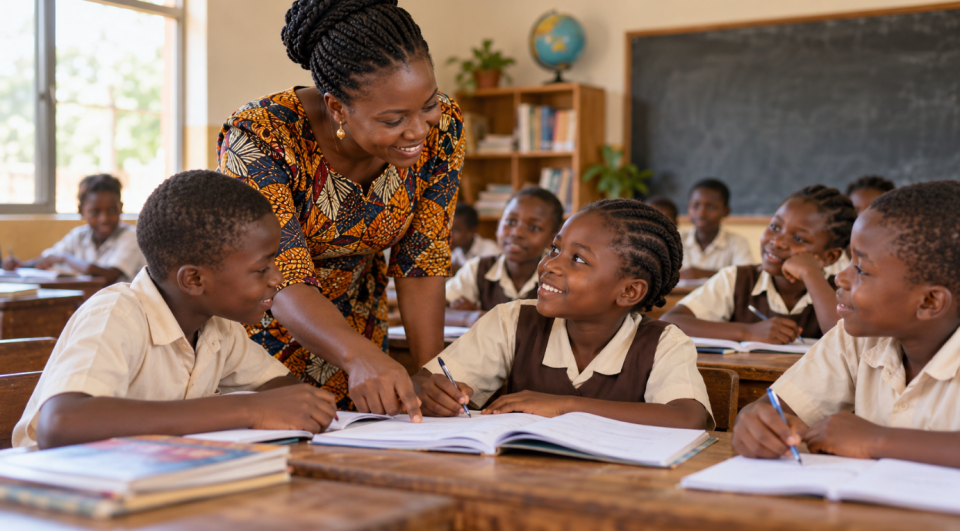
World Teachers’ Day 2026 calls for stronger protection, recognition and support for educators, marking 60 years since global standards for the teaching profession were adopted internationally.
Observed globally on 5 October, World Teachers’ Day is placing the status of teachers at the centre of the conversation this year under the theme, “Standing with teachers: 60 years of protecting the profession, advancing its status and shaping our futures.” UNESCO
The theme marks the 60th anniversary of the 1966 ILO/UNESCO Recommendation concerning the Status of Teachers, which established international principles covering teachers’ rights and responsibilities, professional preparation, recruitment, employment and working conditions.
Six decades later, the fundamentals remain important, but the environment in which teachers work has changed dramatically.
Teachers are navigating digital technologies, artificial intelligence, climate-related disruption, increasingly diverse classrooms, migration and displacement, new approaches to inclusion and changing expectations about how children should learn. UNESCO says these pressures are affecting the symbolic, professional and material status of teachers around the world. UNESCO
The message behind World Teachers’ Day 2026 is therefore not simply to thank teachers for the work they do.
It is a call to build education systems in which teachers are properly prepared, supported and valued enough to do that work well.
That distinction matters because the world is simultaneously asking more of teachers while struggling to recruit enough of them.
UNESCO estimates that an additional 44 million primary and secondary teachers will be required globally by 2030 if universal primary and secondary education is to be achieved. Sub-Saharan Africa alone is estimated to require around 15 million additional teachers, representing roughly one-third of the global need. UNESCO
The challenge is not simply increasing the number of people standing in classrooms.
Education systems also have to attract capable people to the profession, prepare them properly, retain experienced educators and create conditions in which teachers can continue developing throughout their careers.
That means teacher development cannot stop when a qualification is awarded.
New technology, changing labour markets and increasingly complex social environments mean educators require ongoing professional development that allows them to respond to what is happening around their learners.
The rise of artificial intelligence provides a clear example.
Technology can provide teachers with new tools for lesson preparation, administration, assessment and personalised learning, but its value depends heavily on how confidently and responsibly educators are able to use it.
The future classroom is therefore unlikely to be defined by technology replacing teachers. It will increasingly depend on whether technology can strengthen what skilled teachers already do: understand learners, recognise when someone is struggling, create curiosity, explain difficult ideas and build confidence.
UNESCO has repeatedly emphasised that well-trained, motivated and supported teachers remain essential to quality education. The organisation says many working educators, particularly in sub-Saharan Africa and Southern Asia, still lack access to the qualifications and training required to keep pace with changes in education. UNESCO
World Teachers’ Day also provides an opportunity to reconsider what society means when it says it values teachers.
Recognition matters, but professional status is also reflected in whether teachers have a voice in decisions affecting classrooms, whether they have access to development opportunities, whether workloads are sustainable and whether working environments allow them to concentrate on teaching.
The 2026 theme deliberately connects those conditions to the future.
Every engineer, healthcare worker, entrepreneur, scientist, artist, journalist and community leader begins their development somewhere in a classroom.
Teachers are often among the first people outside a family to recognise an ability a child has not yet recognised in themselves.
In communities where young people have limited exposure to opportunity, that influence can become even more significant.
A teacher may be the person who introduces a learner to a career they did not know existed, identifies an aptitude for mathematics, encourages a reluctant reader, supports a creative talent or simply communicates that a difficult beginning does not have to determine an entire future.
That human relationship is difficult to measure, but its consequences can last decades.
The solutions required are therefore not confined to government.
Universities and teacher-training institutions can strengthen preparation and continuous learning. Technology companies can design tools alongside educators rather than simply delivering products into classrooms. Businesses can support teacher development, literacy, mathematics and STEM programmes. Civil society organisations can help reach educators and learners in communities where resources are limited.
Teachers themselves must also be included in conversations about education reform.
Policies designed to improve classrooms are more likely to work when the people implementing them every day have an opportunity to shape them.
The 2026 commemoration comes as the original international recommendation on teachers reaches its 60th anniversary and is itself being reconsidered against the realities of a profession that has changed significantly since 1966. UNESCO
Yet one principle has remained remarkably consistent.
Education systems ultimately depend on people.
Buildings, connectivity, textbooks, devices and curriculum reforms all matter, but their impact is multiplied when a capable, supported teacher can turn those resources into learning.
That is why standing with teachers should mean more than recognising them once a year.
It means investing in their development, listening to their experience, protecting the dignity of the profession and creating conditions that allow talented people to choose teaching, remain in teaching and continue getting better at it.
World Teachers’ Day is a celebration of educators, but the 2026 theme also asks a more important question about the future.
If societies expect teachers to help shape the next generation, how much are they prepared to invest in the people doing the shaping?
