
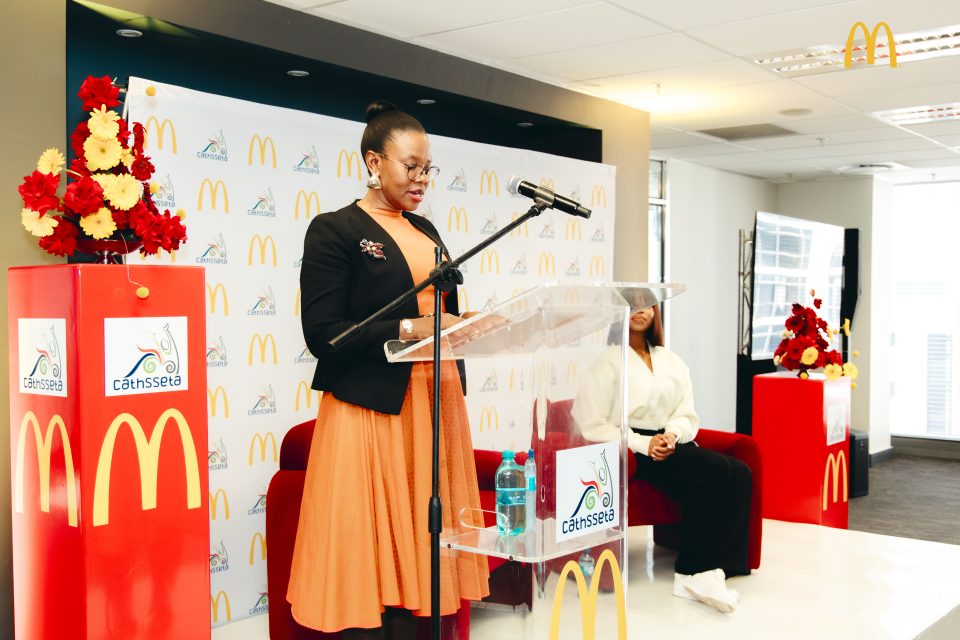
McDonald’s South Africa is strengthening its investment in youth skills development, combining workplace training with additional learner support as a new group enters an accredited programme.
The investment forms part of a partnership with CATHSSETA, the Department of Higher Education and Training and Harambee Youth Employment Accelerator that will ultimately see 2,307 young South Africans enter 12 months of accredited training through staggered intakes.
For McDonald’s, the latest programme builds on an earlier cohort while responding directly to some of the challenges that prevented young people from completing their training.
Dr Mamello Masia, Chief People Officer at McDonald’s South Africa, placed the challenge of youth unemployment at the centre of the company’s participation, describing the partnership as an opportunity to help close the gap between young people seeking opportunities and the experience required to enter the working world.
McDonald’s contribution extends beyond providing workplaces in which learners can complete the practical component of their qualification.
The company is providing additional resources, including uniforms and transport support, while the financial support available to learners has also been increased. The changes follow lessons from the previous programme, particularly around learner attrition and the financial pressures young people can experience while completing a year-long learnership.
CATHSSETA CEO Marks Thibela said the partners had deliberately examined what had not worked during the earlier programme before designing the expanded initiative.
He said McDonald’s had demonstrated its commitment to the partnership by continuing to invest resources and support rather than simply providing workplace placements.
“What McDonald’s commits when we discuss with them, they are really meaning that commitment,” Thibela told those attending the launch.
The restaurants themselves are a significant part of that investment.
Higher Education and Training Minister Buti Manamela said approximately 70% of the programme takes place through workplace learning, with 30% dedicated to formal learning.
That means learners are not simply studying how a hospitality business operates. They are gaining experience inside functioning restaurants, learning to work with customers, colleagues, managers, operating systems and the demands of a commercial environment.
For Manamela, this type of employer participation is critical if South Africa is to build stronger pathways between education and employment.
He argued that government can invest in education, qualifications and training infrastructure, but workplace-based learning requires companies to make their businesses available as places of learning.
“This is not just an isolated programme. This is a programme which we want to expand,” Manamela said, pointing to the need for similar partnerships across other parts of the economy.
While McDonald’s provides the workplace environment, the qualification itself is not limited to employment with the company.
Thibela stressed that participants are completing an accredited, industry-recognised qualification that can be used to pursue employment across the broader fast-food and hospitality industry.
That distinction means the value of the investment is not measured only by how many learners eventually become McDonald’s employees.
It can also be measured by whether young people leave with recognised skills, practical experience and a stronger chance of securing work elsewhere.
The experience of Frans Mahlaba, a graduate of the earlier programme, provides one example of that progression.
Mahlaba entered the programme as a learner and has subsequently progressed to a point where he is helping to train others.
Manamela singled out his development during the launch, noting the difference between the young person who originally entered the programme and the confident graduate now helping other people develop their skills.
A second graduate also spoke about how the opportunity had changed her circumstances, describing the transition from struggling to establish herself financially to being able to work, support her children and approach the future with greater confidence.
Her experience also highlighted why retaining learners matters.
She encouraged the incoming group not to abandon the programme when workplace pressures become difficult, describing the confidence and independence she had developed through completing her own journey.
The first intake of the expanded programme comprises 500 young people and forms part of the overall 2,307 learners who will enter through a staggered process, with the final intake expected in January 2027.
Harambee played a key role in connecting those first 500 young people to the opportunity through SAYouth, completing the process in less than a month. Approximately 63% of this first group of 500 are young women.
McDonald’s is also using its restaurant network to extend access beyond the programme itself.
Harambee said McDonald’s displays signage in its restaurants directing people looking for work to SAYouth. Once registered, those jobseekers can access opportunities from other employers as well as learnerships, training and support services.
The SAYouth network reaches more than five million young people and has enabled more than 2.3 million opportunities across formal employment, self-employment and public employment pathways.
For McDonald’s, the expanded programme therefore operates at two levels.
It gives the company an opportunity to develop young people inside its own operating environment and potentially build a future talent pipeline. At the same time, those learners are working towards an accredited qualification and experience that can have value across the wider industry.
The approach also shifts the conversation around corporate investment in youth development. Instead of simply funding an external intervention, McDonald’s is putting parts of its own business infrastructure into the programme: restaurants, workplace experience, operational knowledge and additional learner support.
With 2,307 young people ultimately expected to enter the programme, scale will be one measure of its success.
The more important measure will come later: how many young people complete the full 12 months and are able to turn that opportunity into employment, further education or longer-term career progression.
For graduates such as Frans Mahlaba, that progression has already begun.
