
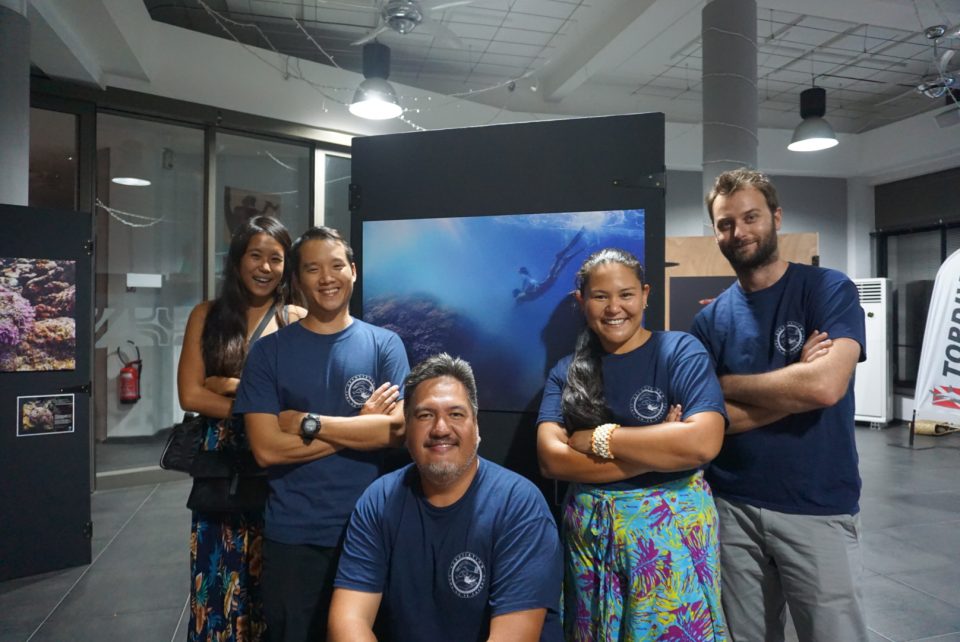
French Polynesia has emerged as a global leader in marine citizen science, with a locally founded organisation now sitting at the centre of one of the most significant coral research breakthroughs in recent history. In 2025, the Polynesian association Tama nō te Tairoto (“Children of the Lagoon”) achieved international scientific recognition for coordinating the world’s largest citizen-led observation of coral spawning — a milestone that is reshaping how coral reefs are studied and protected worldwide.
Founded to preserve lagoon ecosystems and transmit environmental knowledge, Tama nō te Tairoto’s work reached a turning point this year through its flagship global initiative, Connected by the Reef – Te Firi A’au. The project revealed, for the first time, that a coral species can spawn in perfect synchrony across two oceans and both hemispheres.
A global biological clock revealed
In January 2025, Tama nō te Tairoto coordinated an unprecedented international mobilisation to observe the spawning of Porites rus, a reef-building coral species found across the Indo-Pacific. What appeared underwater as a milky fog was, in fact, millions of reproductive cells released simultaneously — the moment when new coral life begins.
For the first time in recorded history, Porites rus spawning was observed on the same day across more than 18 000 kilometres, from French Polynesia and New Caledonia in the Pacific Ocean to Réunion, Tanzania and the Maldives in the Indian Ocean. Observations confirmed that spawning occurred with extraordinary precision: five days after the full moon and approximately 90 minutes after sunrise.
On 18 January 2025, spawning was recorded just one minute apart in Tahiti and Chumbe Island, Tanzania — a discovery pointing to the existence of a cross-ocean biological clock in corals.
More than 400 observers from 20 countries contributed real-time data using Tama nō te Tairoto’s newly developed mobile application, turning local observation into a global scientific network.
“I’ve never heard of a citizen-science project dedicated to corals of this scale anywhere in the world,” said coral researcher James Guest.
Scientific recognition at the highest level
The findings culminated in the publication of a peer-reviewed scientific paper titled Shining a Light on Daytime Coral Spawning Synchrony Across Oceans, published in the international journal Global Ecology and Biogeography.
Authored by Charlotte Moritz (CMOANA Consulting) alongside ten co-authors from academia, the private sector and the Polynesian non-profit community, the study draws on ten years of observations across 104 reefs on 15 islands. It confirms that light, temperature and depth influence spawning timing — and crucially documents synchronized reproduction across oceans for the first time in any coral species at this scale.
The research was made possible by more than 300 volunteer observers, validating the citizen-science methodology developed by Tama nō te Tairoto over a decade.
A resilient coral with global importance
Porites rus plays a critical role in reef ecosystems. Found in more than 50 countries across the Pacific, Indian Ocean and Red Sea, it forms large coral structures that provide habitat for diverse marine life. Unlike more fragile species, it has shown resilience to temperature changes, turbidity and some bleaching events, making it a key species for understanding how reefs may adapt to climate change.
Citizen science changing culture
The project is rooted in community engagement. Marine biologist Vetea Liao, who co-founded Tama nō te Tairoto after first observing the phenomenon in 2014, has built a network that includes teachers, divers, scientists and schoolchildren.
“When people witness a spawning event, they realise corals are living beings, not rocks,” Liao says. “It changes how they see the ocean.”
The impact now extends beyond education. Maritime professionals increasingly consult the organisation to avoid construction and maintenance during coral reproductive periods, showing how science is influencing real-world decision-making.
“You can’t protect what you don’t know,” adds Moevai Roche, a biology teacher and board member of the association.
Technology connecting reefs and people
Central to the project’s success is the Tama nō te Tairoto mobile app, which enables real-time reporting of coral and marine animal reproduction events worldwide. The platform has become a powerful tool for participatory science, strengthening conservation through shared data and collective awareness.
With Porites rus present in dozens of countries, the organisation is now expanding its global observer network, inviting scientists, divers, educators and coastal communities to participate.
Recognition on the world stage
In June 2025, Tama nō te Tairoto was invited to present its work at the United Nations Ocean Conference in Nice. Its immersive exhibition Les récifs du temps and the student-created film Moana tō’u ora showcased a unique fusion of science, Polynesian culture and youth engagement — reinforcing the global relevance of locally led conservation.
Founded in Tahiti in 2021 by Vetea Liao, Anne-Marie Trinh and Marguerite Taiarui, Tama nō te Tairoto has become a powerful example of how Indigenous knowledge, citizen science and modern research can work together to protect ecosystems.
In a world facing accelerating biodiversity loss, this Polynesian-led initiative offers a hard, hopeful truth: when communities are empowered to observe, understand and act, even the most fragile ecosystems can inspire global collaboration — and meaningful change.
