European rail investment is expanding cleaner, safer and more accessible travel, as FS Group advances new trains, cross-border routes and digital maintenance technologies across the continent.
Italian transport group FS used InnoTrans 2026 in Berlin to outline a wider strategy built around passenger experience, safer infrastructure, international connectivity and technology designed to make rail services more reliable.
The international transport technology exhibition ran in Berlin from 22 to 25 September, bringing together railway operators, manufacturers and public institutions from around the world. InnoTrans
FS Group CEO and General Manager Gianpiero Strisciuglio said a new business plan will be completed before the end of 2026, with passengers, service quality and investment in innovation expected to form central priorities.
The strategy comes as rail operators across Europe face pressure to provide alternatives to road and air travel while improving accessibility, reliability and connections between cities.
FS Group is already expanding internationally through operations in France, Germany, Greece, the Netherlands, Spain and the United Kingdom.
One of its most significant developments will begin in summer 2027, when Trenitalia plans to launch Frecciarossa services connecting Milan and Rome with Munich in partnership with Deutsche Bahn and Austria’s ÖBB.
Test runs are already taking place on German and Austrian rail networks as part of the international approval process. FS Italiane
The expansion will make it possible for more passengers to travel between major European cities by high-speed rail without relying entirely on air travel.
FS says further growth is planned from December 2028, including extensions towards Naples and Berlin.
The project forms part of a wider effort to improve interoperability between national railway systems and make cross-border train travel easier for passengers.
“Following France and Spain, the introduction of Frecciarossa services in Germany and Austria expands the Group’s international network and strengthens cooperation among operators to connect Europe’s major cities,” FS said in its InnoTrans programme.
Innovation is also being directed towards the trains themselves.
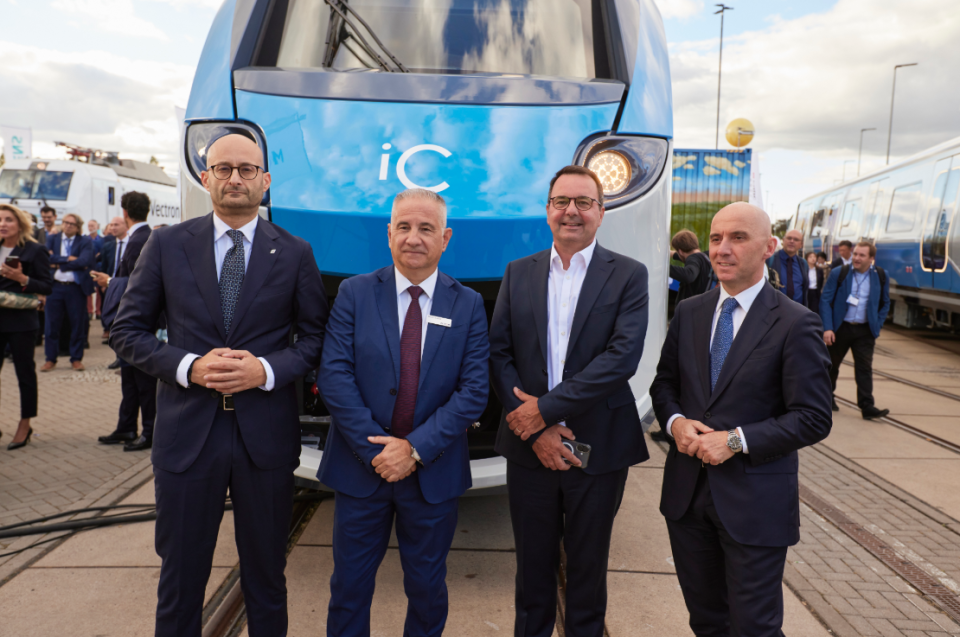
Trenitalia and Alstom unveiled the new Intercity 200 at InnoTrans, a train capable of operating at speeds of up to 200 kilometres per hour.
The train has 403 seats, three dedicated spaces for passengers with reduced mobility and eight bicycle spaces, including facilities for electric bicycles. Alstom
Its environmental performance is also significant.
Alstom says the Intercity 200 can reduce energy consumption by up to 30% compared with previous models, while up to 94% of the train is recyclable and 96% recoverable at the end of its life. Alstom
The trains form part of an approximately €500 million Trenitalia investment programme, funded through Italy’s National Recovery and Resilience Plan, for 38 new Intercity trains. Alstom
The investment is intended to improve medium- and long-distance rail services, including routes serving areas that historically have had less access to modern rolling stock.
That gives the programme a social-development dimension beyond simply introducing newer trains.
More reliable regional transport can improve access to employment, education, tourism and economic activity, particularly when smaller cities and regions are better connected with major metropolitan centres.
Alstom says the investment is specifically intended to help reduce infrastructure disparities between Italian regions and strengthen territorial cohesion, particularly in central and southern Italy and on non-electrified lines. Alstom
Digital technology is also increasingly being used to reduce disruptions.
The Intercity 200 includes systems capable of continuously monitoring train performance and identifying potential maintenance requirements before failures occur.
Predictive maintenance can help operators repair equipment earlier, reduce unexpected breakdowns and keep more trains available for passengers.
FS Group showcased similar technology across other parts of its operations at InnoTrans.
A next-generation virtual-reality simulator developed by Trenitalia, FS Technology and Leonardo allows train drivers to practise dealing with faults and complex operating situations in a simulated cab environment.
The technology provides workers with an opportunity to train for difficult scenarios without placing passengers, infrastructure or equipment at risk.
FS Logistix is meanwhile developing digitally connected freight trains.
Its Digital Automatic Coupling system automates parts of the process of linking rail vehicles while allowing electricity and data to move through a train.
Smart Train technology uses sensors and wireless communications to monitor freight wagons and support predictive maintenance, with around 750 wagons already digitalised according to FS Group.
Infrastructure inspection is also changing.
FS Engineering operates 20 drones equipped with sensors that can inspect construction sites and railway infrastructure, feeding information into digital models used by engineers and control centres.
Rete Ferroviaria Italiana is developing TINO, an autonomous inspection vehicle capable of travelling along high-speed railway lines before passenger services begin.
The prototype combines automation, computer vision and artificial intelligence to identify infrastructure problems and can operate autonomously or through remote control.
These technologies may appear highly technical, but their value ultimately depends on what passengers experience.
Fewer equipment failures can mean fewer delays. Better monitoring can improve safety. More accessible trains can make travel easier for people with disabilities. Cross-border services can connect cities more directly, while lower-energy trains can reduce the environmental impact associated with mobility.
FS Group’s presence at InnoTrans therefore points towards a broader transformation of rail transport.
The future railway is increasingly being designed not simply around faster trains, but around interconnected networks, lower energy use, accessible services, better-trained workers and technology capable of identifying problems before passengers experience them.
For communities, the measure of that investment will be whether those innovations ultimately translate into safer journeys, stronger regional connections and more reliable access to the places where people work, study, trade and live.