
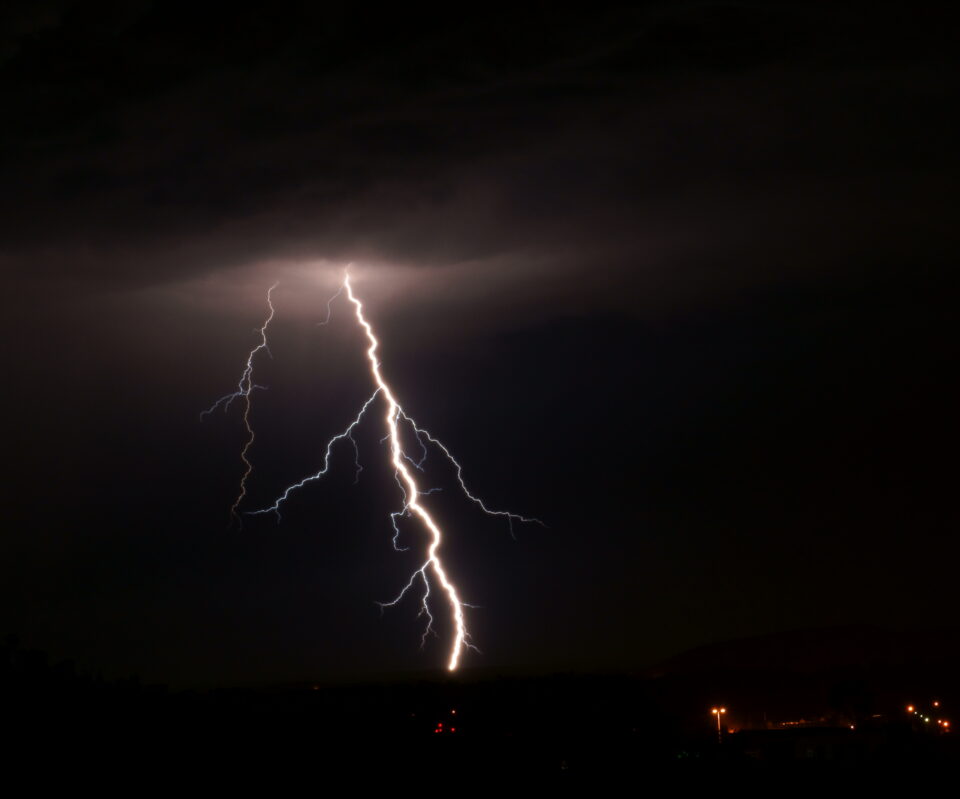
Up to 100 lightning-related fatalities occur annually in South Africa, and at least four or five times
as many survivors of lightning strikes present for clinical treatment, says Professor Ryan Blumenthal of the
Faculty of Health Sciences at theUniversity of Pretoria (UP). “As a forensic pathologist, lightning-related deaths make up most of our weather-related fatality cases.”
For Prof Blumenthal and his colleagues, these statistics represent the need for an awareness campaign similar
to that of National Lightning Safety Awareness Week (19 to 25 June) in the US, which was initiated in 2001 to
call attention to the fact that lightning is an under-rated killer. Since then, lightning fatalities in the US have dropped from about 55 a year to less than 30. A local equivalent would be an opportune time for South
Africans to learn more about the fatal consequences of lightning and how to protect themselves and their pets
against its effects.
At any given moment, about 2 000 thunderstorms occur worldwide, producing about 100 lightning strikes
each second, or 8 million strikes each day. With the exception of incidental catastrophes and disasters,
lightning causes more deaths than any other natural event or phenomenon, claiming about 24 000 lives each
year. It is estimated that, globally, about 240 000 people a year will survive a lightning strike.
“Most of the signs of lightning are located externally on clothing, shoes, jewellery and the belt of the victim,” Prof Blumenthalsays. “This becomesimportantin cases where no clinical history is available. Almost any organ system could be involved in lightning strikes, and prognosis depends on multiple factors. Physical injuries may resolve completely or be associated with long-term effects, including psychological effects, for survivors.
The four main energy components of lightning – light, heat, electricity and barotrauma [an injury caused by a
change in air pressure, typically the ear or lungs] – account for most of the pathology.” Victims of lightning strikes must receive immediate medical assistance. “Clinical management involves diagnosis, initial first aid and triaging,” Prof Blumenthal explains. “All patients should be assessed systematically according to the Advanced Trauma Life Support approach, which includes airway management with C-spine support, breathing and circulation management.” Once stabilised, laboratory tests and radiographic examination should be performed. Treatment involves fluid therapy, cardiovascular therapy,burn treatment, assessing and managing central nervous system injuries, managing eye injuries, ear injuries
and assessing foetal viability in pregnant women.
Prof Blumenthal stresses that lightning injuries and deaths are entirely preventable if proper precautions are
taken during thunderstorms. He offers the following protective guidelines:
• Building structures – especially thatch structures – should have a lightning conductor near to but not
touching the building. Ensure that installers are accredited by the Earthing and Lightning Protection
Association.
• Stay indoors during a thunderstorm. If you are travelling, stay inside the vehicle (this does not include
motorbikes). An open stoep with a metal roof is not considered an enclosed area – you are not safe
under the open roof, so be sure to make your way into a fully enclosed metallic structure.
• While indoors, try to stay away from corded electrical appliances. Unplug electrical appliances when
you hear thunder rumble. While surge protectors are advised for expensive electrical equipment, it is
better to unplug these devices. Avoid using a corded phone; cellphones, iPads and cordless phones
are safe.
• Taking a bath is considered marginally safer than taking a shower during a thunderstorm.
• If you are caught in the open, seek shelter inside a fully enclosed building. Avoid hilltops and do not
shelter under lone trees nor in isolated sheds.
• Do not swim during a thunderstorm and seek shelter if you are in a boat. Get out of the water when
you hear thunder, especially if there is a 30-second delay between a lightning flash and a clap of
thunder. If the delay is 30 seconds or less, you are in danger. Before resuming your activity, wait until
there has been no lightning or thunder for 30 minutes.
• If you are in the open playing sport or fishing, seek any fully enclosed metallic shelter. Rather
discontinue the match and go indoors until the storm is over.
• Managing your pet’s safety and anxiety during electrical thunderstorms is vital. A Thunder-Blanket or
Thunder-Shirt is good for most types of dog and cats with anxiety and fear issues. These items apply a
gentle, constant pressure to your dog or cat’s torso. Research on both animals and humans suggests
that this type of pressure can release a calming hormone-like effect.
As part of current efforts to raise awareness about lightning safety, between 2 and 7 October 2022, South
Africa will play host to the 36th International Conference on Lightning Protection (ICLP), which will be held at
the Cape Town International Convention Centre. Since its inception in 1951 in Germany, the ICLP has become
the largest biennial conference of its kind and forms a global platform where academic and industry leaders
of lightning protection exchange scientific and technological knowledge through presentations, discussion,
workshops and exhibitions. This is significant for South Africa as it will be the first time that the ICLP is hosted on African soil. Typically, the ICLP has an attendance of more than 300 participants representing more than 40 countries.
Prof Blumenthal and his colleagues will be attending the conference, where they plan attending the conference, where they plan to put forward their proposition for a National Lightning Safety Awareness Week for South Africa.
For more information about lightning safety, go to http://lightningsafetycouncil.org/ and
https://www.weather.gov/safety/lightning.
