
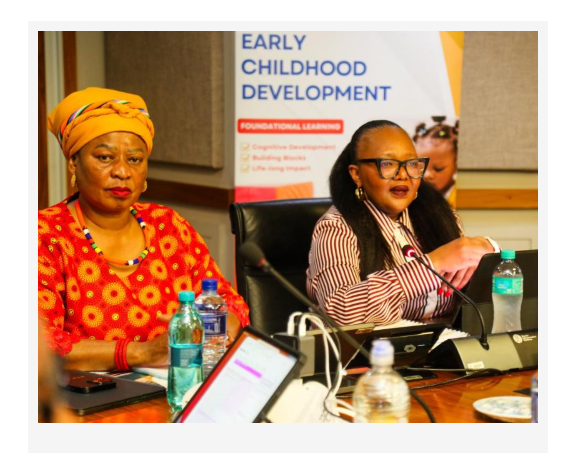
South Africa’s 485,000 educators were honoured on World Teachers’ Day as government highlighted teacher development, literacy and the classroom work shaping children’s futures nationwide every day.
The Department of Basic Education used the annual commemoration to recognise the role teachers play in translating national education priorities into learning, confidence and opportunity for children across the country.
World Teachers’ Day, marked on 5 October, also provided an opportunity to reflect on the profession following the 2026 National Teacher Awards, where educators were recognised for professionalism, leadership, innovation and commitment to their learners.
Basic Education Minister Siviwe Gwarube said teachers remain central to South Africa’s development because their work reaches children in every part of the country.
“Every day, in classrooms across the length and breadth of our nation, in townships, rural communities and farms, teachers unlock potential, expand opportunity and give our children the foundations they need to succeed,” Gwarube said.
She said recognising educators must also be accompanied by practical support that enables teachers to concentrate on teaching, inspiring learners and preparing young people for the future.
That support is increasingly being focused on the earliest stages of learning, where literacy and numeracy form the foundation for everything that follows.
The Department’s priorities include strengthening Early Childhood Development, Foundation Phase literacy and numeracy, teacher development, inclusion and school safety.
This year, 10,000 Foundation Phase teachers are receiving targeted literacy and numeracy training as part of efforts to strengthen teaching quality during the years when children first learn to read, write and work confidently with numbers.
The Department is also continuing work around the National Reading Literacy Strategy and Mother Tongue-based Bilingual Education.
Deputy Minister of Basic Education Dr Reginah Mhaule said continuous professional development is essential because teachers are ultimately responsible for turning policies and curriculum changes into experiences learners can understand.
“Teachers are the professionals through whom curriculum, policy and educational reform ultimately reach the learner,” Mhaule said.
“Supporting their development must therefore remain central to our work. When we strengthen the knowledge, skills and professional confidence of teachers, we strengthen the classroom and improve the prospects of every child.”
The focus on teacher development reflects a wider challenge within education systems: improving outcomes depends not only on curriculum, infrastructure or technology, but on whether teachers have the skills, confidence and support to use those resources effectively.
The Department also wants successful teaching practices to move more widely across the education system.
Rather than allowing strong approaches to remain isolated within individual classrooms, outstanding educators can become sources of professional knowledge for colleagues, helping effective methods reach more learners.
As Gwarube told educators at the National Teacher Awards, “Excellence should travel. Knowledge should travel. This is how a system becomes stronger.”
That principle places teacher recognition within a broader system of professional learning.
An educator who develops an effective way of teaching reading, managing a classroom, explaining a difficult concept or supporting struggling learners potentially holds knowledge that can benefit far more children when shared with colleagues.
World Teachers’ Day also recognises that much of the profession’s impact happens away from awards ceremonies and public attention.
The Department highlighted everyday moments when a learner finally understands a difficult concept, begins reading with confidence or receives encouragement from a teacher at a moment when giving up might have seemed easier.
“These moments are the substance of education and remind us all why the teaching profession remains fundamental to South Africa’s development,” the Department said.
For many learners, teachers are among the first people outside their families to identify ability, build confidence and introduce possibilities that may shape later choices about study and work.
That influence becomes particularly important in communities where young people may have limited access to additional academic support or career exposure.
The Department therefore called on learners, parents, communities and the wider public to recognise teachers not only on World Teachers’ Day, but through ongoing support for the work they perform throughout the school year.
“To South Africa’s teachers: thank you for your professionalism, your resilience and your commitment to our children,” the Department said.
“Strong teachers build strong foundations. Strong foundations create strong futures.”
For South Africa, the message behind World Teachers’ Day is ultimately that stronger education outcomes begin with stronger teachers, and strengthening teachers means continuing to invest in their knowledge, confidence and ability to help every learner progress.
