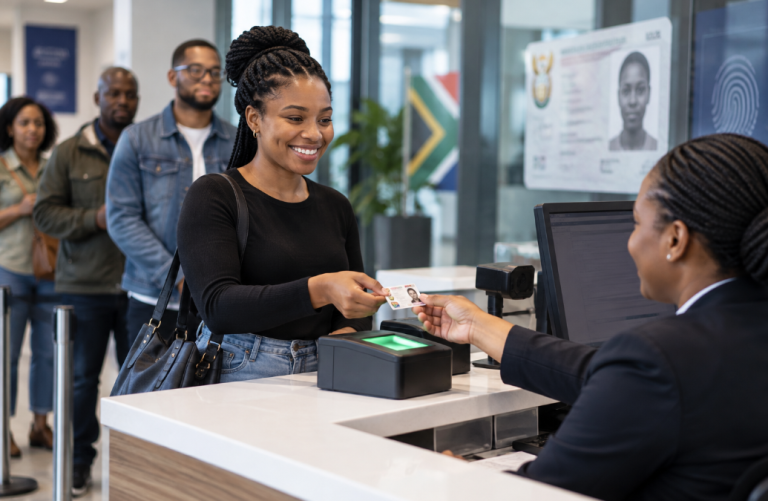
The Department of Home Affairs has expanded its banking partnership with Absa, bringing Smart ID services closer to underserved communities through South Africa’s first bank-based mobile unit.
Launched in Tembisa, the partnership forms part of the department’s Home Affairs @ Home reform programme, which aims to make essential identity services more accessible while reducing the time and cost associated with visiting traditional Home Affairs offices.
Absa becomes the fourth banking partner to join the Digital Partnership, extending the network of locations where South Africans can apply for Smart ID Cards.
The introduction of a mobile Home Affairs unit represents a further development in the programme, with services intended to reach remote, peri-urban and previously underserved communities.
For residents who live far from government service centres, obtaining an identity document can involve transport expenses, time away from work and lengthy queues.
Home Affairs Minister Dr Leon Schreiber said the reforms are designed to change that experience.
“For far too long, accessing Home Affairs meant taking a taxi or a bus, missing a day of work, standing in long queues, and spending hours simply to apply for an identity document. Our Home Affairs @ Home reform programme is changing that forever by bringing Home Affairs to where people live, work and bank,” Schreiber said.
The expansion builds on the Digital Partnership, which began operating on 9 March 2026.
According to figures announced by the department, the programme expanded to 327 participating bank branches within four and a half months.
Combined with 214 modernised Home Affairs offices, this increased the number of Smart ID service locations to 541, compared with 214 before the banking partnership began.
The figures represent an increase of more than 150% in the number of locations available to citizens.
Schreiber described the expansion as the fastest increase in access to Home Affairs services since the beginning of South Africa’s democracy.
“This is the fastest expansion of access to Home Affairs services since the dawn of democracy, with the Digital Partnership already adding more Smart ID service points than the entire modernised Home Affairs network that existed when the reform programme began,” he said.
The department has outlined plans to increase the number of participating bank branches to approximately 750 by the end of 2026.
Together with existing Home Affairs offices, this would create a network of around 1,000 locations offering Smart ID services.
The expansion is particularly significant for communities where access to identity documentation can influence participation in education, employment, financial services and government support programmes.
An identity document is often required when opening a bank account, applying for work, registering for certain services or completing administrative processes.
Improving access to documentation can therefore reduce practical barriers that affect everyday participation in the economy and society.
The department also plans to expand the Digital Partnership to include adult and minor passport applications, first-time Smart ID applications and the delivery of identity documents directly to citizens’ homes.
These additional services remain planned developments rather than confirmed services available at every participating location.
Schreiber said the reforms would also support the transition away from the green barcoded identity book towards the more secure Smart ID Card.
“Through Home Affairs @ home, we are making it easier than ever before for South Africans to replace the fraud-prone green barcoded ID book with the secure Smart ID Card. Together, we are closing the chapter on the fraud-prone green barcoded ID book and opening a new chapter of secure, digitalised identity services that delivers dignity for all,” he said.
The introduction of Absa’s mobile unit adds another dimension to the partnership by extending the potential reach of identity services beyond fixed banking and government facilities.
While the programme’s success will depend on the accessibility and reliability of services as the network expands, the initiative represents a shift towards delivering essential government services closer to the communities that need them.
For South Africans who have traditionally travelled long distances or sacrificed working hours to obtain identity documents, the expansion could make an important difference to how they access public services.