
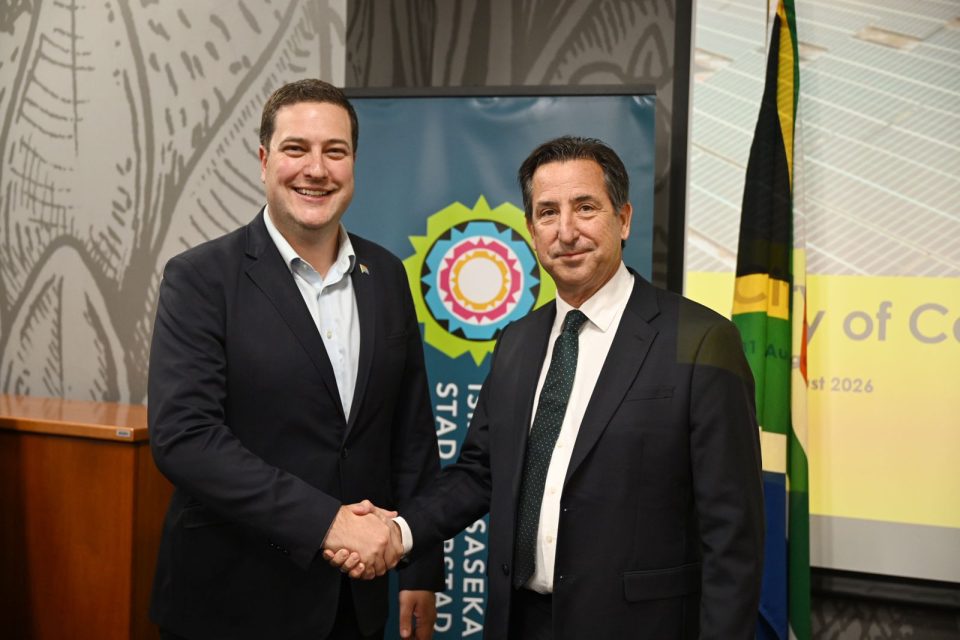
Cape Town has signed its first power purchase agreements with independent electricity producers, securing 70MW of solar power at rates below current Eskom prices.
The agreements form part of a competitive procurement programme through which the City plans to purchase up to 200MW of electricity, with further agreements expected in the coming months.
The first two 20-year Power Purchase Agreements will source 30MW from a JEMPEC solar plant connected to the City’s grid in Atlantis and 40MW from Make A Difference LLC in Philippi.
Cape Town Mayor Geordin Hill-Lewis said the agreements mark the first time a South African city has reduced its reliance on Eskom by purchasing electricity directly from independent producers on the open market.
“Families cannot be expected to absorb endless Eskom price increases forever – that’s why we are working to end reliance on expensive Eskom power to make electricity more affordable for Capetonians,” Hill-Lewis said.
“We are pleased to have sealed the first two power purchase agreements with solar plants here in Cape Town – a first for any South African city – with plans to buy up to 700MW of independent power over time.”
According to the City, electricity purchased through the two agreements will cost between 19% and 21% less than current Eskom rates.
Future price increases under the agreements will also be linked to the Consumer Price Index rather than Eskom tariff increases.
Approximately R8 billion worth of electricity is expected to be procured through the two agreements over their 20-year duration, with the contracts requiring the electricity to remain below Eskom rates throughout the period.
The City estimates the projects will also avoid almost two million tonnes of carbon emissions.
Cape Town Mayoral Committee Member for Energy Xanthea Limberg said the resulting carbon credits could be traded to generate additional funding for infrastructure investment.
The City has already generated R36 million from carbon credits linked to municipal waste-to-energy initiatives that reduce emissions at landfill sites.
“With these initial power purchases, we are laying the foundations for a more sustainable and scalable generation programme,” Limberg said.
“This is all made possible by the diligent creation of an entirely new procurement framework for independent power to ensure robust, bankable, successful execution and long-term power delivery to the City.”
The agreements form part of a broader strategy to diversify Cape Town’s electricity supply and improve energy security.
Since June 2024, residents and businesses have earned R67 million by selling 150 gigawatt hours of excess solar electricity back to the City through municipal bill credits and cash payments.
More than 1,700 megawatt hours of electricity have also been traded between producers and consumers through the City’s energy wheeling programme since 2024.
Cape Town has completed its first municipally built solar and battery storage facility in Atlantis, comprising 7MW of solar photovoltaic generation and 10MWh of battery storage.
Further renewable energy projects and refurbishment of existing generation facilities are planned, while the City is also procuring electricity from energy traders and independent power producers using technologies including waste-to-energy.
The City said these initiatives form part of its longer-term plan to secure more affordable and diversified electricity supplies while reducing dependence on Eskom.
