
There is a particular energy that fills a room when people gather to talk about the future of a country.
You feel it before anything is said — in the conversations over coffee, in the way people lean into each other between sessions, in the quiet understanding that what is being discussed carries weight far beyond the room.
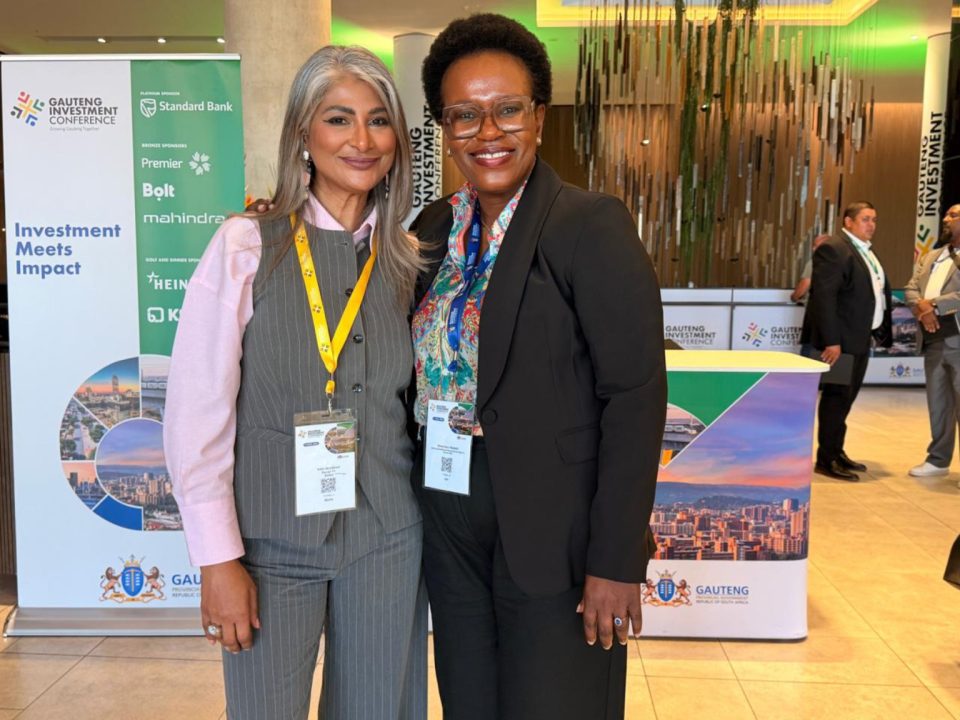
That was the feeling walking into the Gauteng Investment Conference.
There was ambition in the air. A sense that Gauteng is not just positioning itself as an economic hub, but as a gateway for something far more consequential. The conversations reflected that — infrastructure, innovation, industrialisation, investment. The scale was right.
And in moments, it felt genuinely hopeful.
When Premier Panyaza Lesufi spoke, a clarity stood out. Not just in ambition, but in urgency. A recognition that economic growth cannot be delayed, and that Gauteng has a responsibility to lead from the front. It was not framed as a possibility — it was framed as a necessity.
That distinction matters.
Deputy President Paul Mashatile reinforced something equally important: the idea that growth must be translated into real, investable outcomes. His emphasis on implementation — on turning commitments into projects that move, land, and deliver — spoke directly to one of South Africa’s biggest challenges.
We know what needs to be done.
The question is whether we do it.
And then there was Sthembiso Dlamini, GCEO of the Gauteng Growth and Development Agency, who brought it even closer to the ground. His focus on execution — on building credible pipelines, on ensuring that investment is not just announced but realised — carried a different kind of weight. It felt operational. It felt accountable.
It felt real.
Standing in that space, and later capturing a moment with him, what stayed with me was not just the conversation, but the symbolism: leadership that is present, accessible, and engaged. And for me, as a woman working to advance opportunities for women and youth, those moments matter more than we often acknowledge.
Because representation at that level is not just about visibility.
It signals possibility.
And yet, sitting in that room, I found myself holding two truths at the same time.
The first was pride. Pride in the level of leadership, in the seriousness of the conversations, in the fact that we are not avoiding the complexity of what needs to change. There is no shortage of vision.
The second was quieter.
It was the distance between what is said on stage and what is experienced on the ground.
In the work we do through ChangeHub, through W-Suite, through the ecosystems we continue to build, I see every day that the real barrier is not talent. It is access.
Access to funding.
Access to markets.
Access to networks that allow people to move forward.
That gap is not always visible in rooms like this.
We are seeing more women in leadership, more diverse voices contributing to the conversation. That is progress, and it matters deeply. But representation without access is not transformation. It is visibility without movement.
What stood out most were the quieter moments — the conversations between sessions, the reflections that happened when the microphones were off. There was a growing awareness that we need more depth.
More intention in how investment is structured.
More clarity in how impact is measured.
More inclusion in who gets to participate in the economy being built.
Because meaningful change is not abstract.
It is a young person moving from learning to earning.
It is a woman entrepreneur scaling beyond survival.
It is a local business becoming part of a value chain, not just adjacent to it.
That is what impact looks like.
I left the conference challenged.
Challenged to keep building the bridges between intention and action.
Challenged to ensure that strategy translates into something people can feel.
Challenged to keep asking who is included, and who is still waiting.
Because the future we are speaking about is already unfolding.
And it will not be defined by what was said in the room.
It will be defined by who that future makes space for, and who it moves forward.
ABOUT THE AUTHOR:
Katie Mohamed is the CEO of BrandFusion, W-Suite, and ChangeHub. A storyteller, strategist, and advocate for women’s empowerment, she uses her platforms to advance dialogue, shift narratives, and drive social transformation. Her award-winning book Brave Today explores courage, identity, and healing, reminding women that even in silence, their stories matter.
