
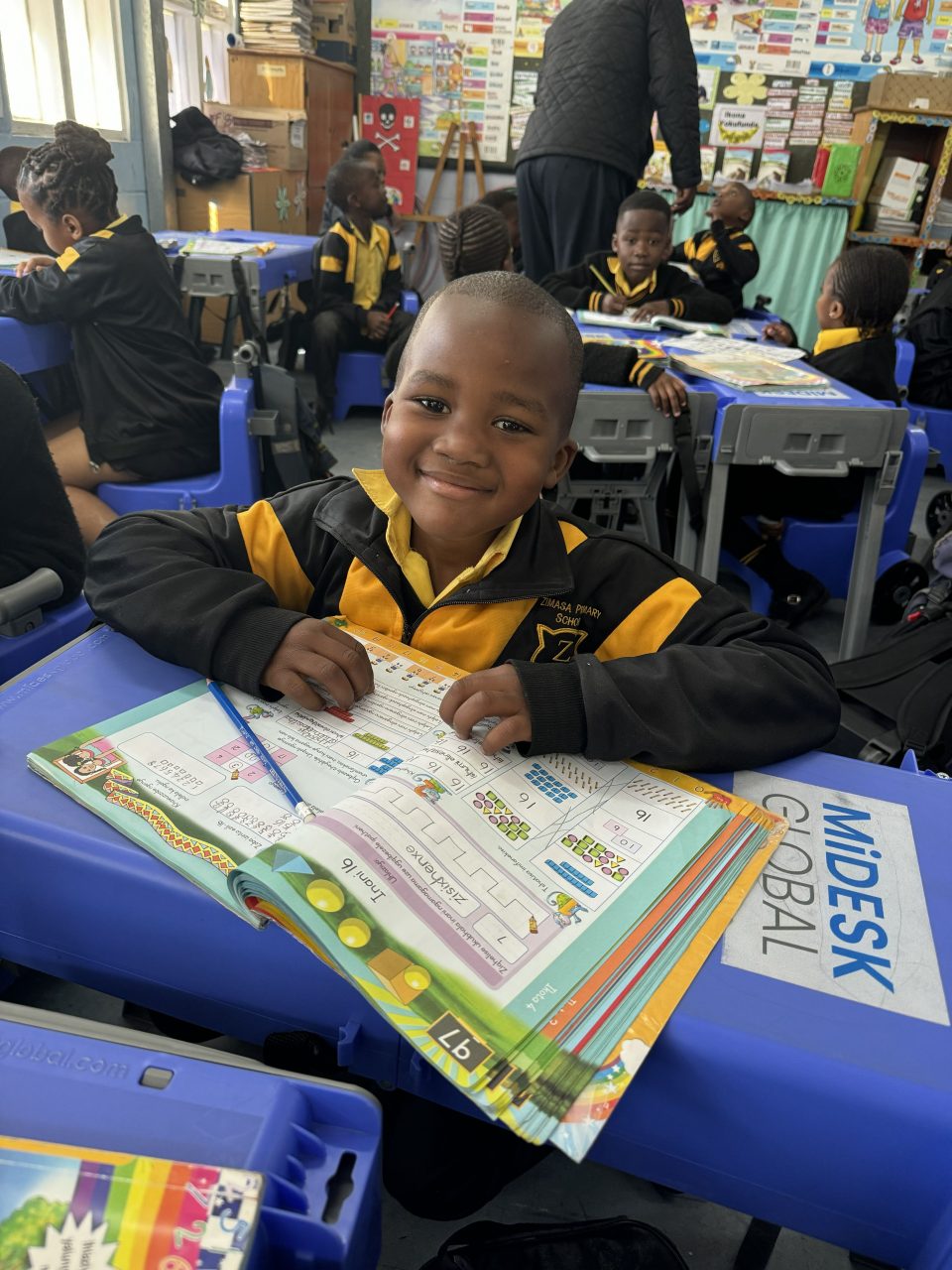
Efforts to improve classroom conditions in South Africa are gaining momentum, as new solutions emerge to support the more than 2.3 million learners still without desks.
Across the country, over 10,600 schools continue to face shortages of desks and chairs, leaving millions of learners seated on classroom floors. While the challenge remains significant, organisations and partners are increasingly stepping forward with practical interventions aimed at closing this gap.
At the centre of this effort is MiDesk Global, which is working to address one of the most overlooked barriers to learning — access to a proper place to sit, write and focus.
Small change, measurable impact
Research shows that something as simple as a desk can have a meaningful effect on learning outcomes. Studies indicate improvements of up to 20% in academic performance when learners have access to a dedicated workspace.
Data from MiDesk Global programmes reflects similar trends:
-
100% of schools reported improved learner focus
-
90% reported better attendance and mathematics performance
-
70% saw improvements in handwriting
In many classrooms, learners currently balance books on their knees or write directly on the floor — conditions that make concentration and consistency difficult.
From classroom to community
Education experts highlight that early exposure to structured learning environments can influence behaviour beyond the classroom.
When learners are given the tools to engage properly with their education, it not only improves individual performance but also builds confidence, routine and a sense of ownership over learning.
Innovation supporting access
To address the shortage at scale, MiDesk Global has introduced mobile desk solutions — schoolbags that transform into desks and chairs, complete with solar-powered lighting for use at home.
The model is designed to support both classroom learning and after-school study, particularly in under-resourced communities.
To date, the initiative has reached more than 5,200 learners, with a long-term goal of impacting one million learners by 2030.
A shared responsibility
While government continues to recognise the scale of the challenge, stakeholders say collaboration across sectors will be key to accelerating progress.
Private sector partners, civil society organisations and education stakeholders are increasingly being called on to support scalable solutions that can be deployed quickly and sustainably.
Building forward
As South Africa reflects on more than three decades of democracy, the focus is shifting toward practical interventions that strengthen the quality of education — not only access to it.
Efforts now underway suggest that change is possible, and that even simple interventions can unlock meaningful improvements in how learners experience the classroom.
