
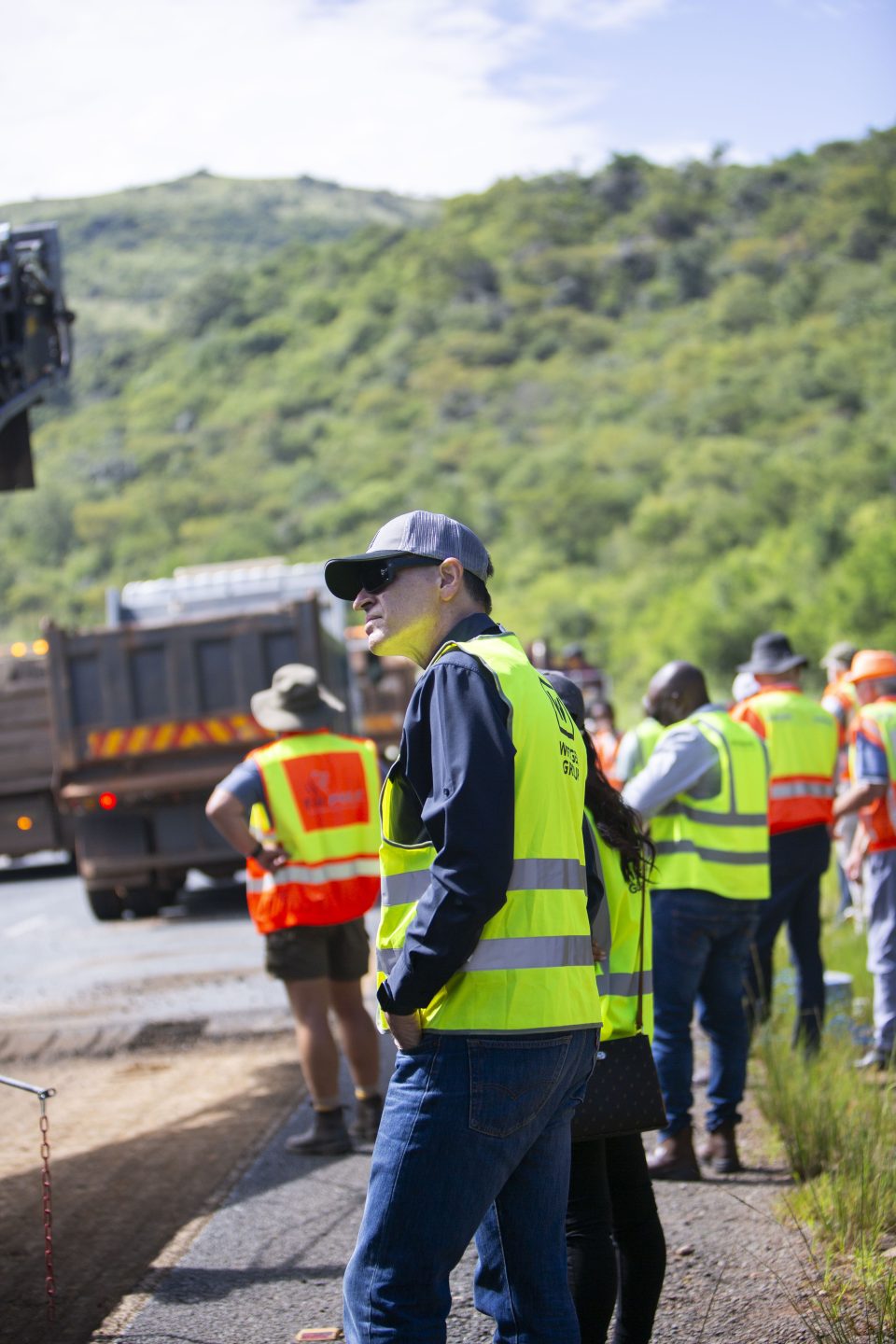
Tau Pele Construction has deployed Africa’s first cold in-place recycling train on the N4 Schoemanskloof upgrade, introducing faster, greener road rehabilitation technology to South Africa.
In a pioneering move for the continent’s construction sector, Tau Pele Construction has taken delivery of the advanced system from Wirtgen South Africa, marking a milestone in infrastructure innovation.
The deployment follows collaboration between Tau Pele, Trans African Concessions (TRAC), and KBK Engineers, after the technology was first seen at Bauma 2025 in Germany.
Wimpie Janse van Rensburg, Executive Manager: Engineering and Technical at TRAC, emphasised the urgency of modernisation within the sector.
“The construction industry must move fast to adopt new technologies to overcome chronic productivity, safety, and efficiency challenges, with the aim of reducing project delays, material waste, and cost overruns,” he said.
TRAC manages the 580-kilometre N4 Toll Route from Tshwane to the Port of Maputo in Mozambique — a vital trade artery carrying more than 2 000 heavy vehicles daily. Minimising traffic disruption was a decisive factor in adopting the system.
The cold in-place recycling train combines milling, mixing and paving in a single pass. At its core is the W 380 CR cold recycler, capable of processing up to 800 tonnes per hour. The system reuses existing asphalt on site using foamed bitumen as a binding agent, producing a stabilised base layer before paving and compaction.
Heinrich Schulenburg, Managing Director of Wirtgen South Africa, explained the time-saving advantage:
“Given that this technology is not just a train but a process plant in its own right; by combining milling, mixing and paving in one pass, the rehabilitation process is accelerated.”
He added that the newly stabilised layer allows the road to be reopened almost immediately after compaction, reducing traffic congestion and delays.
Joe Deetlefs, Director at Tau Pele Construction, highlighted cost efficiency as another major driver, while Waylon Kukard, Sales Manager at Wirtgen South Africa, noted that material savings can reach up to 50% depending on the project.
Jaco Markam, Contract Engineer at KBK Engineers, described reuse of existing materials as “the next big thing” in road rehabilitation.
“All project stakeholders in the construction value chain must work together to use what we have,” he said. “The technology is already available and I am glad that, together with TRAC and Tau Pele, we have made a pioneering decision to deploy the first ever Wirtgen cold in-place recycling train in Africa.”
The Schoemanskloof project now stands as a benchmark for collaborative, technology-driven infrastructure delivery — demonstrating how innovation can improve efficiency, sustainability and long-term cost effectiveness on one of Southern Africa’s most important trade routes.
