
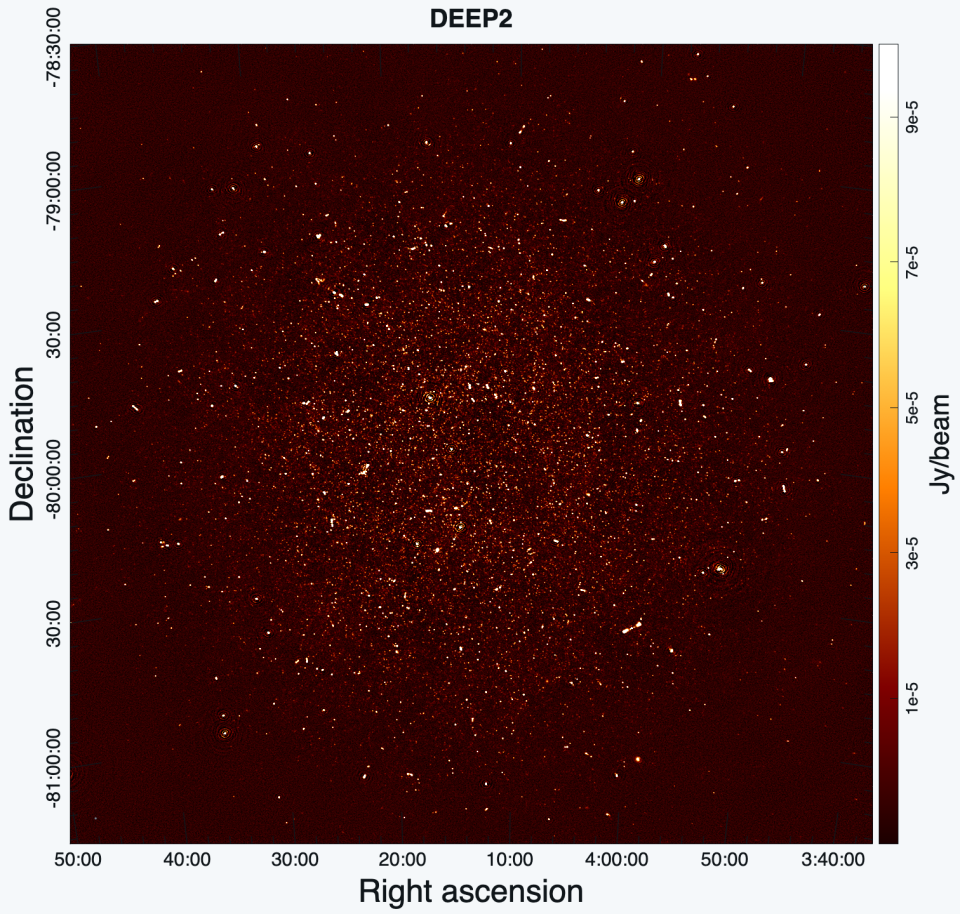
South Africa’s MeerKAT radio telescope has directly detected faint hydrogen signals that travelled billions of years through space, opening new possibilities for mapping the Universe.
An international team from the University of the Western Cape and University of Manchester used MeerKAT to detect radio emission from neutral hydrogen dating from a period when the Universe was several billion years younger than it is today.
The research, published in The Astrophysical Journal Letters, demonstrates the potential of a technique known as hydrogen intensity mapping to study the three-dimensional structure of the Universe across enormous distances.
Neutral hydrogen produces a naturally occurring radio signal known as the 21-cm line. As the Universe expands, this signal is stretched to longer wavelengths, allowing astronomers to trace hydrogen from different periods in cosmic history.
Instead of attempting to identify individual galaxies, hydrogen intensity mapping measures the combined radio emission from large numbers of unresolved galaxies. This enables researchers to survey much larger areas of the Universe.
Previous robust detections at these distances have typically depended on combining radio observations with information from optical galaxy surveys. The new research detected the hydrogen intensity mapping signal directly from MeerKAT radio observations alone.
Researchers analysed approximately 96 hours of observations and detected signals corresponding to redshifts of about 0.32 and 0.44.
The emissions travelled for roughly four to five billion years before reaching Earth.
“This is a very exciting milestone,” said lead author Dr Sourabh Paul.
“Hydrogen intensity mapping has long been seen as a promising way to map the Universe efficiently, but the signal is extremely faint and difficult to isolate from foreground emission, human-made radio-frequency interference, and instrumental effects.”
Paul said successfully extracting the signal directly from MeerKAT demonstrated that the technique was becoming a practical tool for cosmology.
The project was conceived at UWC in 2021 while Paul was a postdoctoral researcher in the group of Professor Mario Santos.
Significantly, the observations analysed by the researchers were collected in 2018, when MeerKAT had only recently begun science operations, and were not originally intended for this particular experiment.
“This was a challenging data analysis process, requiring a detailed understanding of the many sources of contamination that can affect such a faint measurement,” Santos said.
“This result opens a new window for measuring neutral hydrogen over cosmological distances.”
The research could also provide astronomers with another way to investigate how galaxies developed and how matter is distributed throughout the Universe.
Co-author Dr Zhaoting Chen said neutral hydrogen was an important component in understanding galaxy formation and evolution.
“With intensity mapping, we do not need to detect every individual galaxy. Instead, we can measure the collective signal from hydrogen across large cosmic volumes,” Chen said.
The breakthrough is also significant for the future Square Kilometre Array Observatory, with MeerKAT serving as a precursor telescope for the project.
University of Manchester co-author Professor Laura Wolz said extracting the signal from observations that were not specifically designed for hydrogen intensity mapping demonstrated the scientific potential contained within existing MeerKAT data.
Future observations covering larger areas of the sky and longer observation periods could enable scientists to map hydrogen with greater precision.
Researchers believe this could ultimately provide new information about galaxy formation, the influence of dark matter on the cosmic web and how the Universe has evolved over billions of years.
