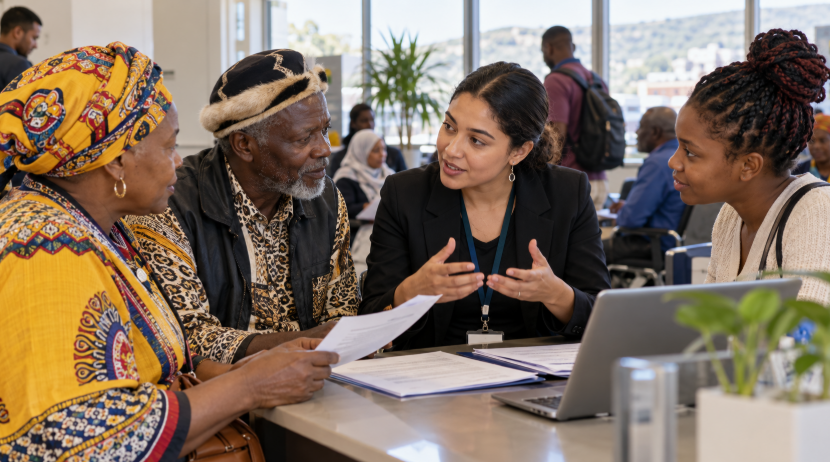
South Africa is marking International Translation Day by highlighting how translators, interpreters and terminologists help citizens access government information, public services and language rights nationwide today.
The Department of Sport, Arts and Culture is using this year’s global observance to draw attention to language practitioners whose work allows information to move across South Africa’s diverse languages and communities.
International Translation Day is observed annually on 30 September. The 2026 celebration is being held under the theme “Linguistic Diversity and Language Rights”, with the subtitle “The Power of Being Understood”.
For South Africa, the focus places language access within a much wider discussion about participation in public life.
Translators, interpreters and terminologists help ensure that people can understand government information, access services and communicate with institutions even when English is not their preferred language.
“The role of translation and language practice in general is invaluable in fostering social cohesion and promoting nation-building by ensuring that communities access quality governmental information and services irrespective of the language they speak,” the department said.
It added that greater language access also enables communities to hold government accountable.
That gives translation a practical social-impact role.
A person who understands information about a government programme, healthcare service, legal process or public benefit is better positioned to make decisions and exercise their rights.
Interpreters perform a similar function where communication happens in real time, including in courts, healthcare settings, public meetings and other environments where misunderstanding can have serious consequences.
Terminologists contribute by developing and standardising terminology so that specialised concepts in fields such as science, law, government and technology can be communicated accurately across languages.
This year’s theme also reflects a growing international focus on protecting linguistic diversity as technology changes the way information is produced and shared.
Artificial intelligence and automated translation tools are making it possible to translate information faster, but professional language practitioners remain important where accuracy, cultural meaning and context are critical.
For multilingual countries such as South Africa, the challenge is not simply recognising different languages but ensuring that people can actually use them when interacting with institutions and accessing services.
International Translation Day was formally recognised by the United Nations in 2017 and is celebrated on 30 September because the date is associated with St Jerome, traditionally regarded as the patron saint of translators.
The Department of Sport, Arts and Culture says the occasion provides an opportunity to recognise professionals whose work often happens behind the scenes but enables communication across linguistic and cultural boundaries.
The social impact is ultimately contained in this year’s subtitle.
Being understood can determine whether someone is able to participate, receive information, access a service or make their voice heard.
In a multilingual society, translation is therefore not simply about changing words from one language into another.
It can be the difference between information being available and information actually being accessible.
Language Access Strengthens Public Inclusion
LIKE THIS STORY? SHARE IT.
Help important stories travel further.