
South African public servants are gaining specialist water-management skills through a new international training programme designed to strengthen state capacity and improve service delivery across communities.
The National School of Government and the Russian Presidential Academy of National Economy and Public Administration have launched a four-day programme in Pretoria focused on water resources management and water quality management.
The programme brings South African officials together with specialists in areas including water monitoring, pollution management, hydrological science, geoinformation technologies and mathematical modelling.
Its objective is to strengthen the practical knowledge available within government institutions responsible for managing one of South Africa’s most important public resources.
The programme responds directly to concerns around state capacity and water management highlighted by President Cyril Ramaphosa earlier this year.
Reliable water infrastructure depends not only on physical investment in pipes, treatment plants, reservoirs and distribution networks, but also on having public servants capable of planning, maintaining, monitoring and managing those systems effectively.
The course forms part of a cooperation agreement signed between the National School of Government and RANEPA in November 2025.
That agreement created a framework for scientific and educational collaboration between the two institutions, including short-term training programmes, academic exchanges, joint research, conferences and the sharing of scientific publications and expertise.
For the National School of Government, the partnership provides an opportunity to expose South African officials to international technical knowledge while ensuring that lessons are adapted to local conditions.
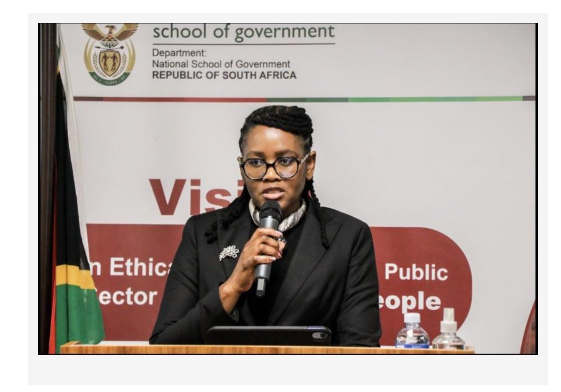
Acting NSG Principal Phindile Mkwanazi said international cooperation becomes particularly valuable when knowledge can be translated into stronger capability within South African institutions.
“International cooperation is most valuable when it strengthens our ability to address our own challenges,” Mkwanazi said.
“The NSG’s role is to ensure that the knowledge shared through this programme is translated into practical learning that officials can apply in their respective institutions and spheres of government.”
The training is not intended to end with the officials attending the four-day course.
Mkwanazi said the National School of Government wants the knowledge acquired through the programme to contribute to wider institutional learning within departments and municipalities.
“We want this engagement to contribute to sustained institutional learning,” she said.
“The knowledge gained must ultimately support better planning, better-informed decisions and improved service delivery, particularly for communities that depend on reliable and safe water services.”
The course also provides space for South African practitioners to share their own experiences and challenges with international experts.
That exchange is important because water management challenges vary considerably between countries and regions, meaning international expertise needs to be considered alongside South Africa’s infrastructure, environmental conditions, governance systems and municipal realities.
Municipalities remain particularly important because they are responsible for delivering water and sanitation services directly to millions of households.
Municipal Infrastructure Support Agency CEO Mapatani Kgomo said sustainable water services require capable municipalities, effective governance and funding that considers the entire lifecycle of infrastructure.
MISA works with municipalities to strengthen infrastructure planning and implementation, particularly where technical capacity remains limited.
Kgomo said the objective should increasingly be to move municipalities away from repeatedly responding to infrastructure failures and towards building systems capable of providing reliable services over the long term.
That shift requires officials who can anticipate maintenance needs, interpret technical information, understand water-quality risks and make informed decisions before infrastructure reaches crisis point.
The training therefore connects skills development directly with service delivery.
Better technical capacity can strengthen how water resources are monitored, how pollution risks are identified, how infrastructure investment is planned and how municipalities respond to changing environmental pressures.
Technology will also form part of the programme, with experts sharing knowledge around geoinformation systems and mathematical modelling that can improve how water resources are understood and managed.
These tools can help authorities analyse patterns, forecast demand, identify risks and make more evidence-based decisions about infrastructure and resource allocation.
The National School of Government said it will continue working with partners to strengthen public-sector capability across national, provincial and local government.
Water management is one area where that investment can have an immediate effect on everyday life.
For communities, the success of programmes such as this will ultimately be measured beyond the training room.
The real test will be whether stronger skills among public servants translate into better planning, more reliable infrastructure, safer water and fewer communities experiencing repeated service disruptions.
