
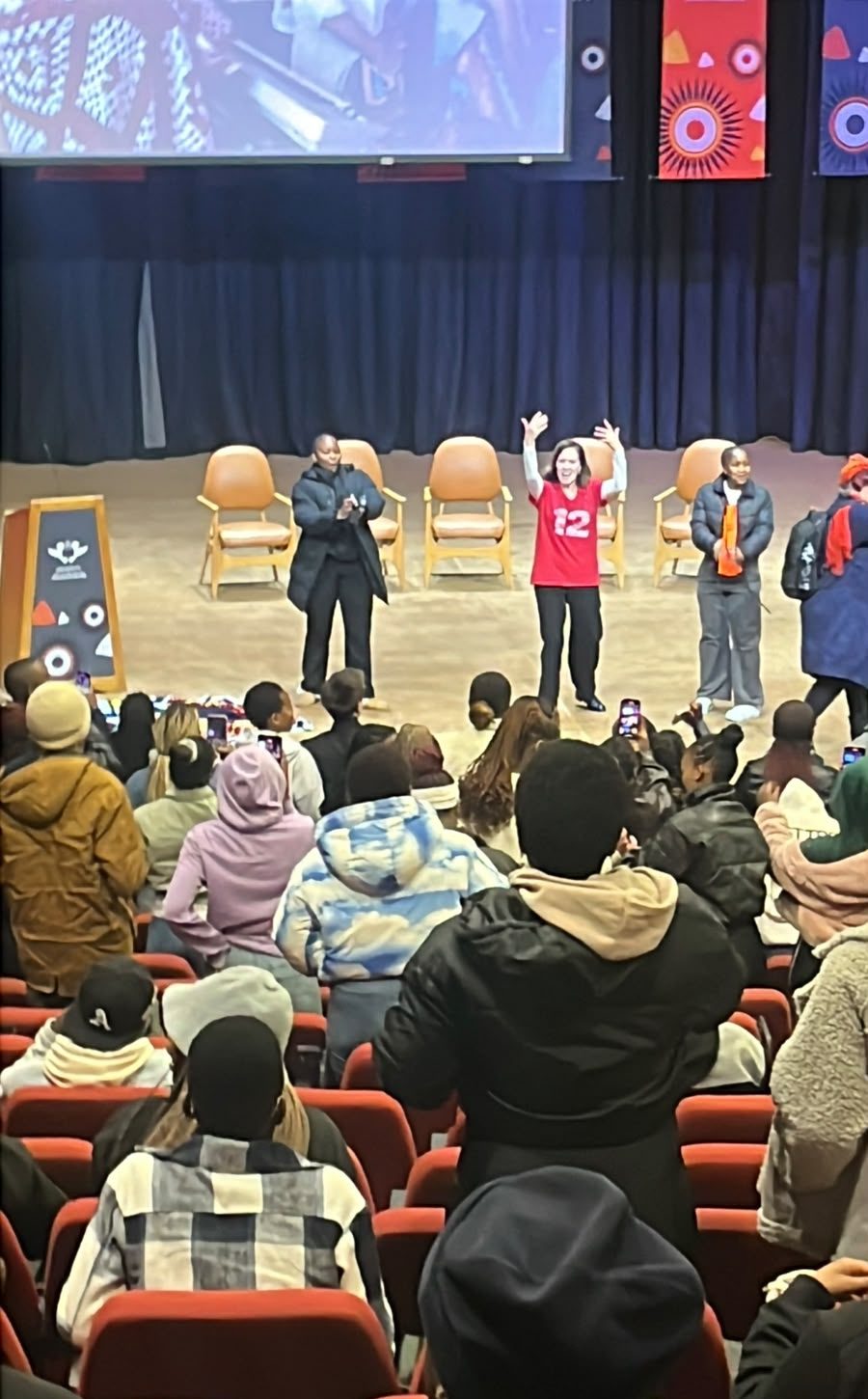
Education, leadership and social innovation shaped BRAG 2026 as organisations shared practical successes showing young South Africans how skills, collaboration and opportunity can build future careers.
Hosted at the University of Johannesburg, the Best Results and Achievements Gathering (BRAG) brought business, civil society, academia and community organisations together around three themes: Education, Digital Inclusion & Future Skills; Corporate Leadership & Workforce Readiness; and Collaboration, Social Innovation & Systems Change.
Presented by Social TV in partnership with the University of Johannesburg (UJ) and the Public Relations Institute of Southern Africa (PRISA), BRAG continues to prioritise examples of what organisations are getting right and the programmes already creating measurable impact.
Steyn shows how one idea scales
Carolyn Steyn, founder of 67 Blankets for Nelson Mandela Day, opened the programme by taking attendees through the organisation’s origin story and how one challenge developed into an international social-impact movement.
Steyn recalled how Zelda la Grange, Nelson Mandela’s former personal assistant, challenged her in December 2013 to make 67 blankets for Mandela Day.
Realising she could not achieve the task alone, Steyn turned to friends and social media. The response transformed what began as 67 blankets into a movement involving thousands of people in South Africa and internationally. The organisation’s own history confirms the initiative grew directly from la Grange’s challenge.
That growth eventually produced a series of record-breaking achievements.
In 2015, 67 Blankets established a Guinness World Record after covering the grounds of the Union Buildings with a crochet blanket measuring 3,377 square metres.
After the record was taken by a group in India, South Africa responded.
In April 2016, 67 Blankets, the Department of Correctional Services and the Nelson Mandela Foundation produced a blanket measuring 17,188.57 square metres at Drakenstein Correctional Centre, reclaiming the Guinness World Record. Around 1,500 inmates from 30 correctional centres participated.
Steyn’s story provided a practical demonstration of how an idea can scale when communities, institutions and individuals are mobilised around a shared purpose.
Young people join community change
Melusi Khumalo, Chairperson of the Jozi My Jozi Student Chapter, brought a youth perspective to the programme and the role young people can play in building stronger communities.
His participation placed young people inside the conversation about social change rather than positioning them solely as beneficiaries of programmes.
The session also featured George Wood, Director of Customer Operations and Head of GoHelp SSA at DHL Express Sub-Saharan Africa; Sithembile Ndaba, Chief Marketing Officer at South African Tourism; and Simthembile Sibhayi, PM: Strategy, Partnerships, Communications and Advocacy at Funda Wande.
Their participation connected the future-skills conversation with corporate leadership, tourism, education and community development, illustrating the range of sectors that will influence how young South Africans prepare for future opportunities.
Workforce readiness goes beyond qualifications
The focus then shifted towards Corporate Leadership & Workforce Readiness and what young people require to successfully transition into employment and build sustainable careers.
Dinesh Ramsamujh, Executive Leader & Well-Being at D.R Wellness, brought wellbeing into the workforce conversation, broadening the discussion beyond qualifications and technical capabilities.
He was joined by Dr Fortunate Masvinge, Business Lead: Tabula Rasa at Rhiza Holdings, Kagiso Rangaka, Founder of Dr Let Me Talk, and Rali Mampuele, Founder of the Mampuele Foundation.
The mix of speakers reflected the increasingly broad definition of workforce readiness, where employability involves not only education but personal development, leadership, adaptability and access to networks and opportunities.
UJ’s Philosophy contribution added an academic dimension to the session, connecting university learning with the wider questions young people face as they prepare to enter the workplace.
Collaboration becomes the multiplier
The final programme expanded the discussion from individual readiness towards the organisations and systems surrounding young people.
Lauren Hartzenberg of H&M and Heidi Edson, CSI Manager at Sun International, brought corporate perspectives to the conversation around collaboration and social impact.
Nkosinathi Moshoana, Chief Executive Officer of Primestars, added the perspective of an organisation working directly across youth development and education.
Independent media and information ecosystems were represented by Chris Mcinga, Publisher of Student Living and a member of the Association of Independent Publishers, alongside Laurice Taitz-Buntman of Johannesburg In Your Pocket.
Technology and entrepreneurship also formed part of the conversation through Botshelo Baloyi, Founder of Umkho AI, before UJ Strategic Communication contributed to the closing programme.
Bringing such different sectors onto one platform reinforced one of the central ideas emerging from the programme: preparing South Africa’s future workforce cannot be the responsibility of universities or employers alone.
Education develops knowledge, businesses create economic opportunities, social-impact organisations connect with communities, entrepreneurs develop new solutions and technology continues to reshape both existing jobs and the creation of entirely new ones.
Showing young people what is possible
Now in its third year, BRAG continues to distinguish itself by asking organisations to focus predominantly on achievements rather than building every conversation around South Africa’s challenges.
The approach gives participating organisations an opportunity to explain what they have implemented, where they are seeing results and what lessons can be shared with others.
For young attendees, it also provides exposure to organisations they may otherwise know primarily as brands, employers or service providers.
Hearing directly from the people behind those organisations creates a broader understanding of their contribution to education, communities, entrepreneurship, skills and employment.
That aligns with Social TV’s wider objective of encouraging a more conscious consumer — one who considers not only what an organisation sells, but how it contributes to the society and economy in which it operates.
From an initiative that started with a challenge to create 67 blankets and grew into a record-breaking movement, to conversations spanning education, wellbeing, tourism, youth development, retail, independent media and artificial intelligence, the programme demonstrated the breadth of experiences that can contribute to workforce development.
The underlying message was that preparing young South Africans for the future is about more than preparing them for their first job.
It is about building the skills, confidence, networks, exposure and opportunities that enable them to participate in — and ultimately help shape — South Africa’s future economy.
READ | BRAG Puts Success Centre Stage
The article shows that BRAG treats workforce development as a shared ecosystem, with each programme theme linked to the specific roles speakers played in expanding opportunity across education, employment and social impact.
