
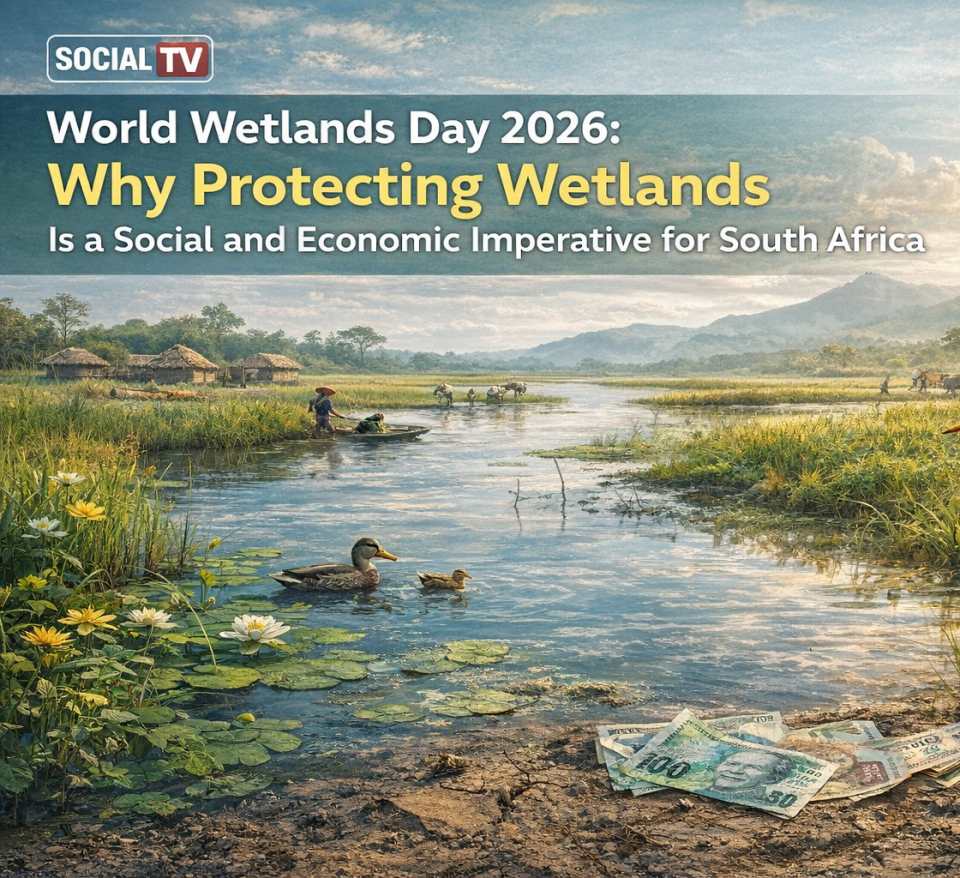
Every year on 2 February, the world marks World Wetlands Day, a moment to recognise the critical role wetlands play in sustaining life on Earth. In South Africa, this day carries particular urgency.
Wetlands are among the country’s most valuable natural assets, yet they remain some of the most threatened ecosystems. Often overlooked or misunderstood as wastelands, wetlands are in fact vital infrastructure — quietly supporting water security, food systems, biodiversity, and climate resilience.
In a water-scarce country like South Africa, wetlands act as natural sponges. They absorb excess rainfall, reduce flooding, recharge groundwater, and release water slowly during dry periods. When wetlands are destroyed or degraded, communities face increased flood risks, water shortages, and declining agricultural productivity.
The social consequences are profound. Rural and peri-urban communities rely on healthy wetlands for livelihoods such as fishing, grazing, small-scale farming, and harvesting natural resources. When wetlands disappear, so do income streams, food security, and resilience against climate shocks. Women and children, in particular, are often the most affected.
Wetlands are also biodiversity hotspots, supporting birds, amphibians, fish, and plant species found nowhere else. Their loss accelerates species decline and disrupts ecosystems that humans depend on for clean water, pollination, and natural disease regulation.
Despite their importance, South Africa has already lost a significant portion of its wetlands to mining, agriculture, urban expansion, pollution, and poorly planned infrastructure. Climate change now adds further pressure, increasing the frequency of droughts, extreme rainfall events, and ecosystem stress.
World Wetlands Day is therefore more than a symbolic observance. It is a call to action for government, business, civil society, and communities to prioritise wetland protection and restoration as part of broader development, climate adaptation, and ESG strategies.
Protecting wetlands is not a barrier to development — it is a foundation for sustainable growth. Investment in wetland conservation delivers measurable returns: reduced disaster costs, improved water quality, enhanced food security, and healthier communities.
At Social TV, we believe environmental issues are inseparable from social and economic outcomes. By amplifying stories that connect ecosystems to people’s daily lives, we aim to keep critical issues like wetland protection visible, relevant, and actionable — not just on awareness days, but throughout the year.
As South Africa navigates climate uncertainty and growing development pressures, wetlands offer natural solutions that work with nature rather than against it. Protecting them today is an investment in the country’s future resilience.
For continued coverage on environmental sustainability, social impact, and ESG-driven solutions, visit www.socialtv.co.za.
