
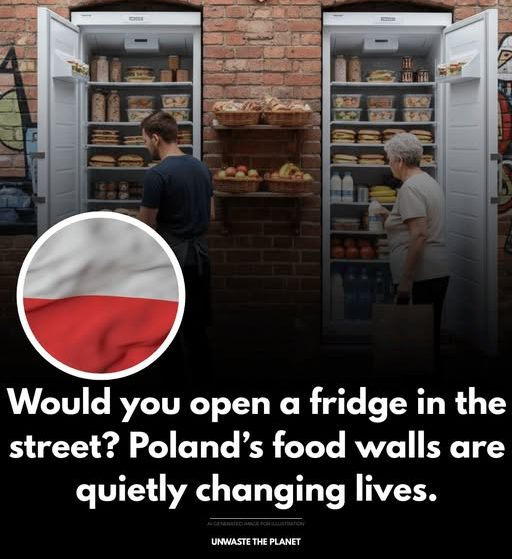
Community-run “food walls” are emerging in cities across Poland as a practical response to food insecurity and rising living costs, offering free access to food and essential items for anyone in need.
The initiative involves the installation of publicly accessible shelves or wall-mounted units where residents and local businesses place surplus food and basic supplies. Items typically include bread, packaged food, bottled water and hygiene products. Anyone can take what they need without registration or formal oversight.
The food walls operate on a simple principle displayed at many sites: “If you need it, take it. If you can, leave it.”
According to community organisers, the initiative is designed to provide immediate assistance while preserving dignity, particularly for people who may not qualify for formal social support or who are reluctant to seek traditional food aid.
Reducing Waste While Supporting Communities
Local bakeries, cafés and small retailers have become regular contributors, placing unsold but edible food on the walls instead of discarding it. This has helped reduce food waste while extending the lifespan of surplus products.
Food waste remains a significant environmental challenge across Europe, with millions of tonnes of edible food discarded annually. By redirecting surplus food to communities, the food wall model addresses both social and environmental concerns.
Grassroots Social Innovation
Unlike food banks or soup kitchens, the food walls are not centrally managed. They rely on volunteer maintenance and community participation, making them low-cost and easily replicable.
Municipal authorities in some cities have acknowledged the initiative, allowing walls to remain in public spaces while monitoring health and safety standards. In other cases, the walls operate entirely informally, sustained by local trust.
Strengthening Social Capital
Community members say the initiative has strengthened relationships within neighbourhoods, encouraging shared responsibility and mutual support. The walls are accessible around the clock, offering assistance during times when formal services may be unavailable.
Social development practitioners note that initiatives like food walls contribute to social cohesion by removing barriers between those who give and those who receive support.
Implications for CSR and ESG Strategies
The food wall model is increasingly being cited as an example of community-driven shared value, aligning with environmental, social and governance (ESG) principles. It demonstrates how small-scale, decentralised solutions can complement formal welfare systems and corporate social responsibility efforts.
As economic pressure continues to affect households across Europe, community-led solutions such as Poland’s food walls highlight the role of social innovation in addressing basic needs while fostering inclusive, resilient communities.
image on https://web.facebook.com/unwastetheplanet
