
Communities are urging energy regulators to prioritise affordability, expand Free Basic Electricity and support locally owned renewables as South Africans confront rising household energy costs nationwide.
Community organisations from Gauteng, the Eastern Cape and Limpopo are preparing to address the National Energy Regulator of South Africa during public hearings on Eskom’s Sixth Multi-Year Price Determination.
Earthlife Africa Johannesburg and partner organisations are calling on NERSA to reject proposed tariff increases of 8.83% for residential customers and 8.84% for municipalities for the 2027/28 financial year.
Their argument is centred on affordability.
Households are already managing rising costs across food, transport, housing and other essentials, while electricity remains fundamental to studying, running small businesses, refrigerating food, accessing digital services and meeting health needs.
For community organisations participating in the hearings, the concern is not simply whether tariffs rise, but how South Africa balances the financial sustainability of its electricity system with the ability of households to afford basic energy.
Earthlife Africa’s Thabo Sibeko said the debate should examine whether consumers should face further increases at a time when many households already struggle to maintain electricity access.
“At the heart of communities’ concerns is a simple question – if Eskom made a profit last year, why should households have to pay more for electricity?” Sibeko said.
He argued that NERSA has an important responsibility to consider the social consequences of pricing decisions, particularly for households forced to make difficult choices between electricity and other necessities.
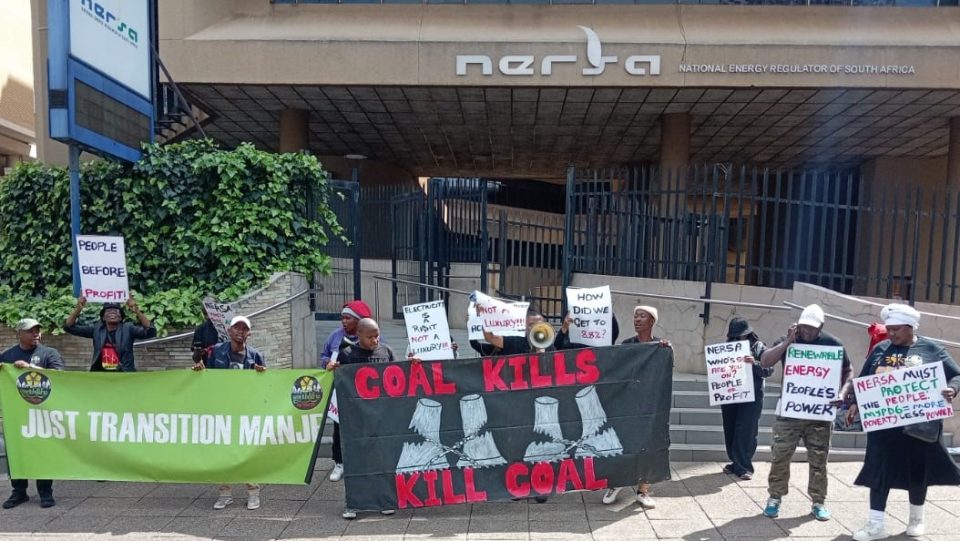
The submissions follow a demonstration outside NERSA’s Pretoria headquarters on 2 October involving Earthlife Africa Johannesburg, the Women in Energy and Climate Change Forum, Grassroots for Climate Action and the Climate Justice Action Group.
Participants submitted written comments addressing electricity tariffs and the Free Basic Electricity programme.
The organisations say high electricity prices are already affecting household livelihoods and small enterprises.
Women operating businesses including chicken farms and sewing enterprises have reported that higher energy costs reduce already limited margins, while families increasingly depend on electricity for education, connectivity and essential household services.
The Women in Energy and Climate Change Forum said affordability challenges often have wider consequences for women, who frequently manage household budgets while also operating small businesses from their homes or communities.
The organisation is calling for stronger support for socially owned renewable-energy projects that could create local economic opportunities while improving access to electricity.
A major focus of the campaign is Free Basic Electricity.
Qualifying households currently receive an allocation of 50 kilowatt-hours, but community organisations argue that this is insufficient for the realities facing low-income families and that access to the benefit remains inconsistent.
Zodwa Rannyadi of Soweto Cultural Senior Citizens has called for the allocation to increase to at least 350 kilowatt-hours per household for people facing severe energy poverty.
“For unemployed people, 50 kilowatt-hours is too little,” Rannyadi said.
The organisations are also asking government and municipalities to improve how eligible households are identified and informed about Free Basic Electricity.
Earthcare Action Network said greater transparency about who receives the benefit is necessary if the programme is to become an effective tool for addressing energy poverty.
The debate also extends beyond subsidies and tariffs.
Several organisations are calling for a wider shift towards communities participating directly in electricity generation rather than remaining solely consumers of power.
Mokgethi Khumalo of Ezamathole said rooftop solar and locally owned renewable-energy projects could give communities a greater stake in the energy system while supporting employment and energy security.
“Our communities should not be seen only as consumers who must continually pay more,” Khumalo said.
“We want communities to become producers of clean energy through rooftop solar and locally owned renewable-energy projects.”
That approach connects electricity affordability with South Africa’s broader transition towards cleaner and more decentralised energy.
Community-owned generation could potentially allow schools, municipalities, households and local organisations to produce some of their own electricity while reducing pressure on the national system.
Earthlife Africa’s Ulrich Steenkamp said greater accountability should accompany any tariff increase.
He argued that Eskom should clearly demonstrate how additional revenue would translate into infrastructure maintenance, improved reliability, pollution reduction and environmental compliance.
The organisations are therefore calling for the public hearings to examine not only what consumers are being asked to pay, but what outcomes communities can expect in return.
Their proposed solutions include stronger Free Basic Electricity provision, transparent use of tariff revenue, greater accountability from utilities and expanded access to decentralised renewable energy.
The hearings provide NERSA with an opportunity to weigh Eskom’s financial requirements against the economic circumstances of millions of households and small businesses.
For communities participating in the process, affordable electricity is closely linked to education, health, entrepreneurship and household security.
Their broader message is that South Africa’s future energy system should not only produce enough electricity.
It should also ensure that electricity remains affordable, reliable and accessible while creating opportunities for communities to participate in, produce and benefit from the country’s transition towards cleaner energy.
