
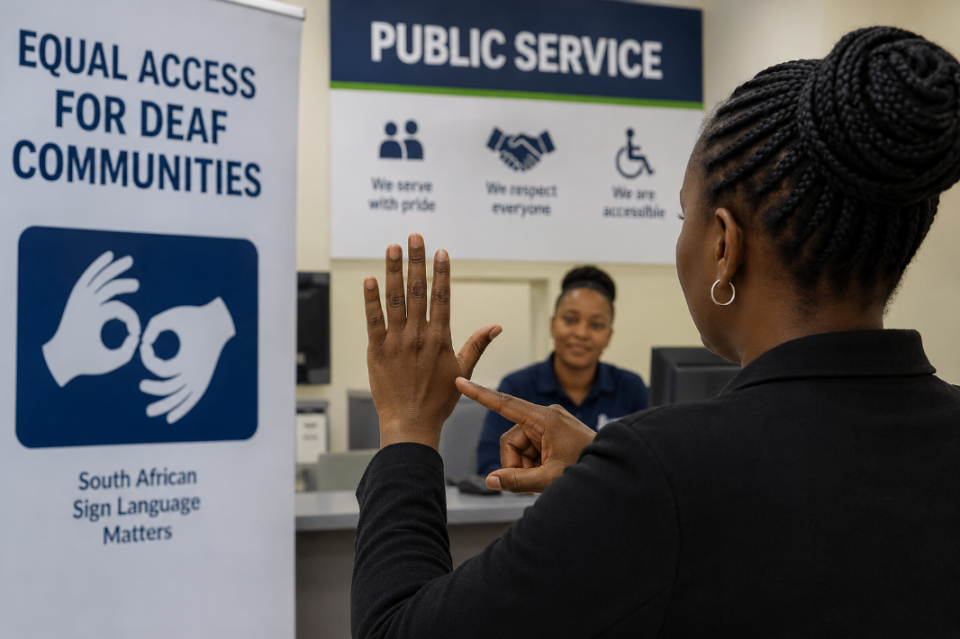
Deaf and hard-of-hearing South Africans are at the centre of a renewed push to make government services, healthcare, justice and public information more accessible.
The issue was highlighted during the virtual launch of Deaf Awareness Month, with calls for South African Sign Language (SASL), captioning and other communication support to become a standard part of public service delivery.
Phuthi Mabelebele, Chief Director for Advocacy and Mainstreaming, Rights of Persons with Disabilities at the Department of Women, Youth and Persons with Disabilities, said communication barriers continue to prevent Deaf and hard-of-hearing people from participating fully and independently in society.
“Planning for accessible communication should be normalised in government planning, budgeting, procurement, monitoring and accountability systems,” Mabelebele said.
“When Deaf and hard-of-hearing persons cannot access basic information that enables independent living, we directly violate their human rights and make it impossible for them to exercise those rights.”
The focus extends across some of the most important services people may need during their lives.
Healthcare facilities should have mechanisms to enable effective communication, while police stations, courts and other justice services need appropriate communication support for Deaf and hard-of-hearing people.
Emergency and disaster information also needs to be accessible.
Mabelebele said communication accessibility should be considered from the beginning when government plans public meetings and consultations, rather than sign-language interpretation or captioning being introduced only after a participant requests it.
“We cannot claim that a participation process is inclusive when Deaf people cannot understand or contribute to it, because they are excluded from the communication,” she said.
The same principle applies to access to justice.
Communication barriers can affect whether a Deaf person is able to report a crime, provide evidence or understand legal proceedings.
“We cannot claim that justice is accessible when communication barriers prevent Deaf and hard-of-hearing persons from reporting a crime, giving evidence, or understanding legal proceedings,” Mabelebele said.
South African Sign Language became the country’s 12th official language in 2023, but the push is now to ensure that recognition translates into practical accessibility across institutions and services.
The department wants the White Paper on the Rights of Persons with Disabilities to include indicators that establish minimum service delivery standards for Deaf and hard-of-hearing people.
Digital accessibility is another important part of the intervention.
Government websites and digital platforms should be designed to accommodate people with different communication needs, while television and digital media have been encouraged to expand captioning and sign-language access.
Public servants should also receive training in Deaf awareness and communication, supported by greater availability of assistive communication technologies.
Mabelebele said improving services will require better disaggregated data to help institutions understand the needs of different communities and plan appropriate interventions.
She also called for an environment in which people feel comfortable disclosing disabilities, including deafness, without fearing stigma, discrimination or negative attitudes.
“If Deaf and hard-of-hearing persons are unable to disclose their disabilities, and disclosure is not normalised, accessible services and information will remain out of reach because we will not be able to provide what their communities need,” she said.
The approach places disability within a human rights framework, focusing on removing institutional, social and communication barriers that prevent equal participation.
Mabelebele said achieving that goal would require action beyond government, including changes within businesses, institutions, communities and other public spaces.
“For effective mainstreaming, we must all ask ourselves an important question. How must our systems change so that Deaf and hard-of-hearing persons can participate equally?”
For Deaf and hard-of-hearing South Africans, the objective is ultimately to ensure that communication accessibility is built into services from the outset, rather than treated as an additional accommodation after barriers have already been encountered.
