
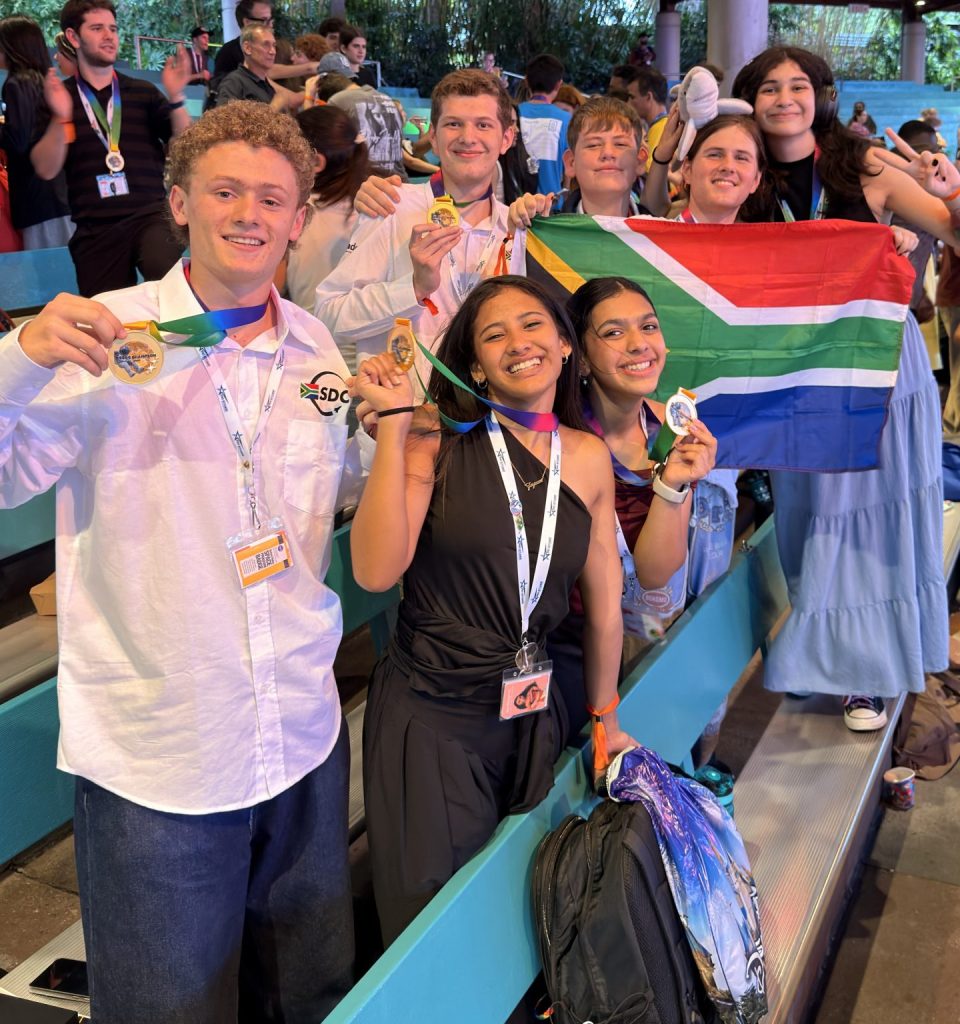
Seven South African high school learners have made history by winning an international space engineering competition on the country’s first attempt, showcasing South Africa’s emerging STEM talent.
The Western Cape learners won the International Space Settlement Design Competition, described by the Western Cape Government as the world’s longest-running space engineering competition for schools, during the international finals held at NASA’s Kennedy Space Center in Florida.
It was South Africa’s first entry into the international competition, with Team ZA also the only African team represented at the finals.
The seven learners were Zayaan Abdurahman from Mondale High School, Joseph Allderman from Westerford High School, Benjamin Honigwachs and Dean Weich from Bishops Diocesan College, Alaya Kaplen and Qayalah Omar from Cannons Creek Independent School, and Ethan Schoombee from Fairmont High School.
Their journey to the international stage began much closer to home.
The learners were selected through the inaugural South Africa Space Design Competition, hosted at the University of Cape Town. Earlier in the process, 109 learners from nine schools participated in the national competition, which challenged high school learners to design futuristic space settlements.
South Africans Join Global Team
At the international finals, the South African learners joined participants from the United Kingdom, Australia, Brazil, China and the United States to form a team called Rockdonnell.
According to the Western Cape Government, it became the first team in the competition’s history to include representatives from every inhabited continent.
Their challenge required considerably more than imagining life in space.
The winning proposal, called Hermes, envisioned a futuristic spacecraft capable of transporting 3,000 people across the inner Solar System.
Learners were required to collaborate, develop their proposal and defend their ideas before judges.
South Africans played key roles in that process, with Qayalah Omar serving as a presenter while Benjamin Honigwachs, Joseph Allderman and Ethan Schoombee were among those who defended the team’s proposal.
South African Receives Individual Honour
The victory also produced an individual achievement for Team ZA.
Joseph Allderman received the Anita Gale Creative Genius Prize, one of only four presented during the competition.
Allderman, however, attributed the recognition to the strength of the South African contingent.
“Team ZA worked so cohesively together that we all deserved this award. I was just the one who got picked to represent it,” he said.
Acting Western Cape Provincial Minister for Education Anton Bredell said the achievement demonstrated what South African learners can accomplish when given opportunities to compete internationally.
He said their performance showed that local learners have the talent, determination and creativity required to compete with some of the world’s best.
Creating Access To Global STEM Opportunities
Beyond the international victory, the result highlights the importance of creating platforms through which young South Africans can apply science, technology, engineering and mathematics skills beyond the classroom.
For Jagger Cooper-Doubell, Chair and Executive Director of the South Africa Space Design Competition, the country’s first attempt at the competition demonstrated that South Africa’s challenge is not an absence of ability.
“The talent was never missing in South Africa. The opportunity was,” Cooper-Doubell said.
The South African competition provided learners with that opportunity by exposing them to a demanding engineering challenge and creating a pathway from a local competition at UCT to an international final at Kennedy Space Center.
Their victory has now created momentum to expand that opportunity.
Following Team ZA’s success, organisers plan to grow the competition nationally, with regional competitions planned for the Western Cape and KwaZulu-Natal in 2027, followed by ambitions to reach all nine provinces. Entries for the 2027 South African season are expected to open later this year.
For the seven learners, the achievement represents far more than a trip to one of the world’s most recognisable space facilities.
