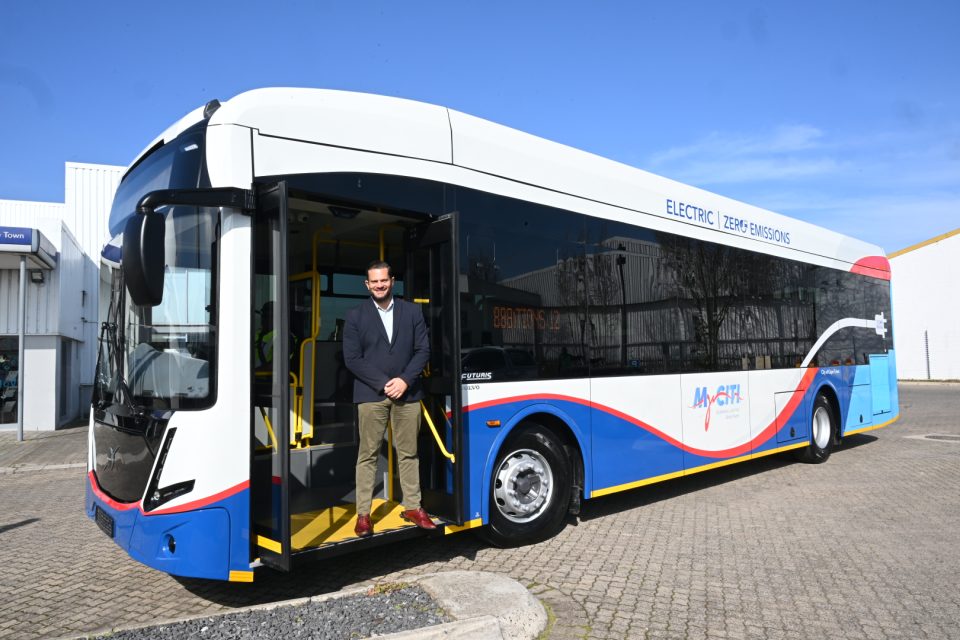
Cape Town’s first electric MyCiTi bus has arrived, marking the beginning of real-world testing ahead of the planned introduction of 38 battery-electric buses into passenger service.
The prototype arrived from Johannesburg, where the bodies for the new electric bus fleet are being manufactured, and will now undergo testing on a variety of routes across the city.
The pilot will examine how the bus performs on steep inclines and downhill sections, in stop-and-go city traffic, during congested peak periods and over longer distances.
The City of Cape Town is expected to take delivery of 38 low-floor battery-electric buses during 2026, with the fleet earmarked for operational rollout in 2027.
The 12-metre Volvo BZRLE battery-electric buses will also be the first MyCiTi buses with bodies designed in South Africa and manufactured locally in Gauteng.
“The MyCiTi service is now 16 years old. The arrival of our first e-bus is a major highlight in this journey and supports our transition towards a cleaner, more sustainable public transport system that is not only more cost-effective to operate and maintain, but more resilient,” said the City’s Mayoral Committee Member for Urban Mobility, Councillor Rob Quintas.
Quintas said some countries operating electric buses have reported reductions of up to 70% in operating costs, making the Cape Town pilot important for understanding the potential financial and environmental benefits in local conditions.
“We are eager to see how this bus performs in our local environment in coming weeks, in particular as we are operating in an increasingly volatile global energy market,” he said.
The prototype has been branded in the familiar MyCiTi colours and will be tested on several routes and road conditions across Cape Town.
Testing locations will include Hospital Bend, the N2 highway and Camps Bay, while the bus may also be tested along routes including Polkadraai Road and Jip de Jager Drive.
“I encourage residents to be on the lookout for this low-floor bus. It will be clearly branded,” Quintas said.
While the prototype will travel across different parts of Cape Town during testing, the future electric fleet is primarily intended to support the second phase of the MyCiTi service.
The buses are earmarked for routes connecting Mitchells Plain and Khayelitsha, Wynberg and Claremont, as well as routes operating within the Cape Town CBD.
Research accompanying the pilot is being conducted in collaboration with the University of Cape Town and will examine how the electric bus performs across different route profiles.
The research is funded by the City of Cape Town and through a grant from the Urban Electric Mobility Initiative.
Researchers will assess battery performance, energy consumption, charging times, passenger loading, different route profiles and the impact of Cape Town’s climate on vehicle performance.
The findings will help the City prepare for the operational requirements of an electric fleet, including charging strategies, maintenance, driver training, infrastructure readiness and the deployment of buses across appropriate routes.
“The research will help us understand how the electric buses will perform in our local context, and what challenges we need to consider before we roll out the e-bus fleet in 2027,” Quintas said.
“This information will ensure that we are well-prepared for the introduction of electric buses into scheduled passenger service.”
The City says the operational data gathered during the pilot will also help inform future investment in zero-emission public transport.
If the programme remains on schedule, the first electric buses are expected to begin carrying passengers from 1 July 2027.
The initial operational routes will connect Mitchells Plain and Khayelitsha, Wynberg and Claremont, with additional services planned for the Cape Town CBD.
The acquisition of further battery-electric buses remains a strategic priority for the City, although expansion beyond the initial fleet will depend on the availability of future funding from National Government.
For Cape Town commuters, the arrival of the first prototype represents the first visible step towards an electric public transport fleet that could reduce emissions while providing data on whether large-scale electric bus operations can deliver both environmental and operational benefits in South African city conditions.