Social TV
Education And TrainingNewsPress ReleaseRest of Africa

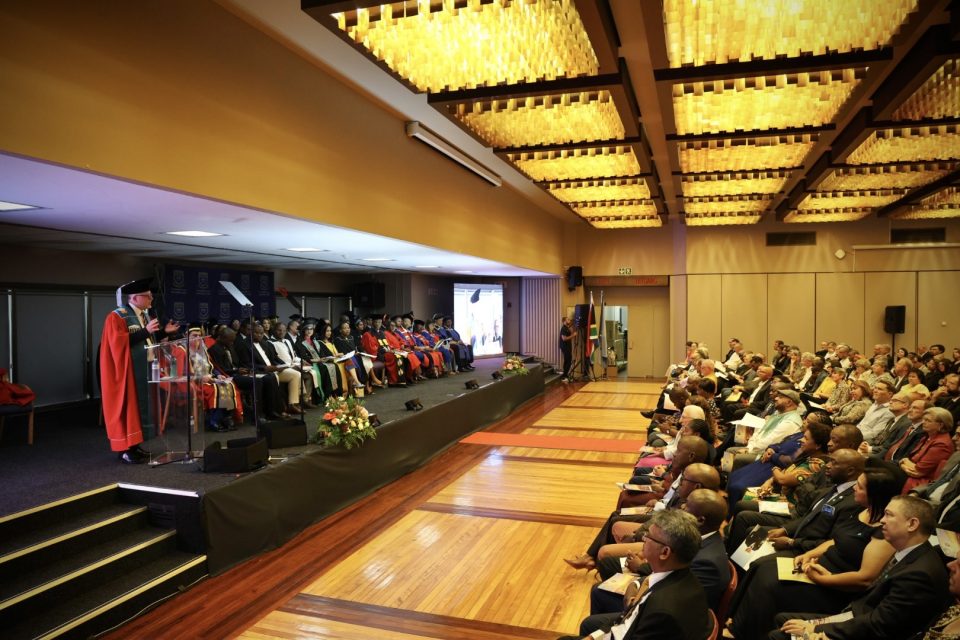
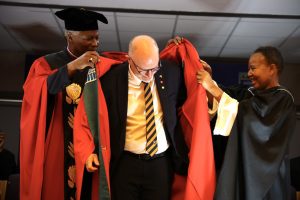
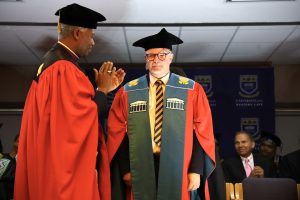
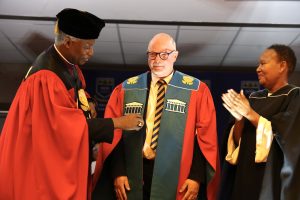
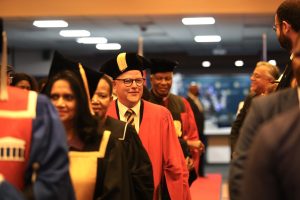
Inauguration of the 8th Rector and Vice-Chancellor of the University of the Western Cape – Prof Robert Balfour

1) Introductory remarks

Dumela, Dumelang, Sanibonani, Thobela, Molweni, Kunjani, Goeie Middag, Good Afternoon, Asalaamu ‘Alyakum, Namaste, en Baie Welkom hier!

  • Honourable Minister of Higher Education, Dr Nobuhle Nkabane

  • Former Minister, Dr Naledi Pandor

  • Members of the Consular Corps

  • Provincial Ministers of the Western Cape

  • The Deputy Mayor of the City of Cape Town

  • Chair and Members of the Portfolio Committee on Education

  • Chancellor of the University of the Western Cape, His Grace Archbishop Thabo Makgoba

  • Chair and Members of Council of the University of the Western Cape

  • The UWC Board of Trustees and all our esteemed donors and supporters of the UWC

  • Student Representative Council President and members of the Students Representative Council of the UWC

  • Senior Management of the University of the Western Cape

  • Chair of Universities South Africa, Prof Francis Petersen

  • Former Vice Chancellor Professor, Tyrone Pretorius

  • Vice Chancellors and Deputy Vice Chancellors of other Universities

  • Members of Senate

  • UWC colleagues

  • Distinguished guests

  • Ladies and Gentlemen

As I stand before you today as the 8th Vice-Chancellor and Rector, I am conscious that my predecessors are honoured as leaders who in laying the foundations for UWC, have had to confront the distortions of our racist past, and to affirm in the soil of the Western Cape, that incredible resilience that is uniquely South African. From resistance to resilience UWC has affirmed what is best about South Africa: as a place where the marginal and the unseen have an opportunity to thrive and succeed. Our past as UWC is defined by struggle and the consequences of heroic principled action that refused race categorisation, refused the marginalisation of apartheid spatial planning or the perversion of honest labour, and unaccountable capital, within a colonialism of a special kind.

A consequence of the intellectual and activist underpinnings of the UWC community is that we have rejected the ideas that certain forms of labour must be reserved for certain types of people, as perversions of human creativity. UWC has instead affirmed values that are core to the human condition: the creativity and generosity of the human spirit, solidarity amongst the oppressed, equal opportunity and affirmation especially of those marginalised in society.

UWC perspective of academe

From that struggle has come an affirmation that the incredible human wealth of the academy – from a UWC perspective – is an open wealth; a common-wealth as it were; it is welcoming, and its expertise rests in the service of communities, professions and work for the common good.

Universities do not function as businesses, and should not be viewed as such because the bottom-line is not the only balance sheet, but the generational layering of contributions to science, to arts and humanities, to care, and to development. We have produced and will continue to produce leaders equipped to govern, statesmen and women who are set apart by their intellectual accomplishment and civic commitment, professionals whose investment in communities is not predicated on short-lived accumulation of wealth, shallow notions of status, but rather on persistent ideals about belonging, inclusion, and success. Our University is South Africa’s prized Protea flower in its African garden. Above all, UWC graduates are people who love South Africa as a place of hard realities and high aspirations, and in that love commit to place and people.   As I stand here today, I want to pledge my commitment to the values underpinning the academic project.

Chancellor, and our distinguished guests: We live and work in a place where people are poor, and unemployed, and we are a place where the marginal and the unseen look for hope for a better future and a more bearable present. Ours is not a place devoted to ideas of excellence that are destined to become the privileges of an elite: where knowledge is made to be self-serving, or where access to education is withheld. Instead UWC is proudly a place of plenty, despite a context of resource limitations, and an excellence for all because we realise that even the graduate whose personal best is a 50% pass, is able to uplift society and transform it for the better.

UWC as a Resilient organisation

While we recognise and celebrate excellence, we understand that excellence arises not only from the individual’s attainments, but the firmament which produced it. Much like the Protea that adorns threefold the UWC shield, our history and becoming can be likened to the Protea: we have thrived in a soil that is tough, at times even arid, a sun that at times nurturing and at times blistering, and we know well that we outlast our origins or even our anticipated ends: think of the UWC story of placement on the outskirts of Cape Town and how we have, through the Gerwel and Pretorius years countered apartheid physical and social marginalisation by deliberative relocation to city centres; or the O’Connell years where we countered the ideas that science and medicine were not our fields, to became places where science is central to our curricula.

Struggle might be the soil in which our Proteas have grown, but distinguished guests, it is resilience which is surely the flower of our prosperity.  This resilience has ensured that UWC is, for every parent whose child has come here, the hope for a better future in Africa, and for every graduate coming through here, the realisation of an African dream in which global academic recognition, and even sporting fame, are not only exceptions, but testimony to an exceptional education.

Currently published UWC Vision

I come to the UWC vision – as it is currently crafted –  for the next ten years which is to become by 2035, a leading research university, most notably for the nexus between its undergraduate and postgraduate degree programmes and its research endeavour, its substantial place in key areas in the knowledge ecosystem, its keen focus on the public good and transforming lives, and its productive relationships and effective partnerships.

My role in this, as first servant of the University, is to ensure that the maps by which we chart our course, are clear and guiding, and our means by which we attain our milestones, are made adequate and are kept sustained. As steward of the Proteas of this cherished institution, I am guided in turn, by our key governance structures of our Council and the academic custodianship of our Senate. It should be said, going forward of this University, that those relationships must be supportive, trusting and engaged. Everything we do as the collective of both academic and support leadership, should be seen, and also experienced, to be in the service of our public mandate of trust to provide an excellent education, an array of opportunities for research impact innovation and an experience of engagement with our communities that is elevating and inclusive. Stewardship of our resources and custodianship of our public mandate are critical for our work.

Managing resources effectively

Let us thus unite to exemplify what it means to love South Africa, and to prize above all, the role of education in its freedom. Let this be a place to which government turns for partnerships to explore the sustainability solutions of our uncertain times, and the place to which capital and industry turn for research and innovation that is characterised by integrity and ethical practice. UWC might well have been placed here by a design of the forces of a darker era, but we are in that very placement, also the possibility of a bright future.

To ensure that future, we need to consider that stewardship requires a long term view: a public university is funded by the shared wealth of society, wealth derived from the labour of its people, in the interests of the public good. When we are charged with responsibilities in public universities, we are also charged with responsibilities to the public. This responsibility exceeds our obligations to the present. It includes the need for fidelity to the courage and commitment of those who have come before us and to the promise of those who will come after us.

Some of the frameworks within which we undertake our work, such as law and policy, are given to us more than they are shaped by us. Judicious decisions have to be made within what are, in particular moments in time, objective constraints.

A university leader has a substantive responsibility – and that responsibility carries weight, but that weight accumulates in times of crisis.  Responsive leaders must remain acutely in touch with societal realities. With millions of people—especially young people—without work, endemic hunger, millions without decent homes, frightening levels of violence, and increasing human rights atrocities, our society is, for most of us, in deep crisis. The contours of the planetary crisis are all too clear and include environmental devastation, massive global inequalities, war, and growing support for dangerous forms of populism and authoritarianism in many countries.

Universities are not isolated from these lived realties and therefore around the world – as a sector – we face serious challenges. For a long time now there has been pressure to, in the words of Mahmood Mamdani, shift towards the idea that “higher education is more of a private than a public good”. South African universities face deep structural challenges. While we can contribute to assessing those challenges and making suggestions to ameliorate them no university can, on its own, resolve them. We remember nonetheless, that difficult circumstances have, in this history of our university and our country, often been met with commitment, creativity and courage.

When Jakes Gerwel was inaugurated as the Vice-Chancellor and Rector of this university in 1987, he, speaking during a time of popular insurrection and brutal state repression, seized the moment to exercise commitment, creativity and courage. His address was a moment of transcendence. It is often recalled that he saw that the University of the Western Cape should be “an intellectual home for the Left.” We should also recall that his address was an affirmation of the need for the intellectual life of a public university to be integrated with and emerge from, the experience of the people, all the people.

For Gerwel this was not a matter of applying some or other dogma. It required careful processes of collective discussion and reflection committed to what he called “the values and vigour of rigorous scholarship.” This is still a relevant and distinctive commitment for UWC. Gerwel’s speech was a potent expression of what Paulo Freire called “Education as the practice of freedom” – but as we know too well – freedom never rests. There are, of course, moments of particular political intensity but freedom is never won in full or permanently. Sustaining and deepening it requires constant commitment.  This in my view, is a call to us to refocus our attention on the historical legacy of the university, not as an artifact of the past, but as a set of commonly shared values forming the basis of a new research and socially informed agenda.

The idea of the left is, in the hands of its most brilliant thinkers, a commitment to universal equality, to the dignity and freedom of all. It is a commitment to receiving each person as a full and autonomous person. Frantz Fanon suggests that when we speak of all people we must mean all people without regard to class, race, gender, sexuality, religion and national origin. We must also understand that the oppressed, the excluded and the denigrated require particular forms of deliberate and dedicated support.

A university of the left must strive to receive and engage all people with respect, care and compassion. It must understand itself as located in wider communities, and committed to the public good. It must, in Crain Soudien’s wonderful phrase, work towards wider and wider “inclusion of the whole treasure store of human knowing”.

It is often difficult to keep sight of our higher ideals in the day-to-day pressures of life and work. We should thus be motivated by remarkable stories of people in this great institution of ours, the University of the Western Cape. But our University has a remarkable history. In The Perversity of Gratitude, his new book reflecting on his education in South Africa, Grant Farred, who has passed through many of the best universities in the world, writes that his teachers at UWC were “the most committed tertiary instructors I have ever encountered”. This is just one of many affirmations of what has been achieved in the past, often under exceptionally difficult circumstances. This history matters.

2) Contributing to the intellectual tradition of leftist thought and activism at UWC

The work of reflection and critique is and must be ongoing. It should be a permanent mode of scholarly life and its impact should be felt in the forms of activism (which we sometimes refer to as engagement) in and around communities. But there are also moments, whether consequent to the demands of social or institutional crisis or a result of a deliberate intention to create time and space for this work, in which this work can be organised, expanded, and accelerated.

Chancellor and dear guests, my address today is an invitation to participate in an organised process of reflection — reflection on a range of matters important for the intellectual tradition of UWC, and matters important for the future relevance and future sustainability of our University.  The questions which we must answer in this reflective process include:

  • How we can ground our university in the values of trust, openness, transparency?

  • How we can ensure that all our people – academics, support staff, and students – are welcomed and valued and provided with opportunities to thrive?

  • How we can be the best teachers and offer the best courses which are the consequence of inspiration by the intellectual tradition of the left?

  • How we can continue to advance our scholarship, – not just scholarship but rigorous scholarship that contributes to wider society so that we are impactful in our scholarly endeavours?

  • How we can ground our teaching scholarship in our own context – including our history, contemporary circumstances and forms of life and aspirations – and yet still be open to the world, all of the world?

Even though our human talent pool comprises gifted and committed teachers, brilliant and important scholars, and many people who do the day-to-day and often less visible work to ensure that the university flourishes, it is important that we move towards achieving the same strategic goals, albeit in different ways. Strategy is important in other ways because hard work alone will not help move the university forward. Indeed, if we are headed in the wrong directions, our efforts and energies are wasted.

3) Strategic Reflections for UWC as a University of Futures

3.1 Future-readiness of our programmes

As a University, our foremost commitment is to ensuring the future-readiness of our programmes. What is evident from government guidance on the curriculum, is that the size and shape of undergraduate to postgraduate mix requires re-conceptualisation and new vision. In this regard, the University will undertake a future-fit curriculum review. In doing so we will consider – a number of parameters, not least of which is the role of information and communication technologies – in relation to our commitment to providing high quality contact education with selected online support –in a way that creates the necessary skills set among its students to work effectively and engagingly in ways anticipated by industry.

Within teaching as praxis – we must consider the advances made by artificial intelligence on how we teach with integrity and on how our students learn with values.  We therefore need to find ways to instil in students high levels of accountability, self direction and collaboration because these skills underpin postgraduate research and teaching.

3.2 Our postgraduate curriculum

Another commitment concerns our research for reach, in which I also consider our postgraduate curriculum as integral: the 21st century delivers a range of complex challenges that require more from us in terms of elevating inter-Faculty, transdisciplinary collaborative and team-based teaching in our postgraduate programmes such as the value of sciences for social sciences, of humanities for economics.

In summary, these two commitments entail the reduction of narrow undergraduate specialisations in favour of stronger general degrees and multiple entry points into a wider array of transdisciplinary postgraduate programmes. The one caveat to this part of my vision, is to recognise that those of our programmes which are regulated by statutory and professional bodies must be prized for their accreditations status which guarantees the ongoing employability of graduates emerging from these programmes for example, in pharmacy, accounting, law, education, and in  health.

3.3 A spirit and ethos informed by student and communities’ experience

“Freedom,” Ruthie Wilson Gilmore writes, is not just a set of abstract commitments to curriculum. It is also “a place”. Nowhere is this perhaps more relevant than in Bellville, Belhar, Mitchells Plain and Khayelitsha — the surrounding communities from which we not only draw our students, but also which serve to house and accommodate our students.  UWC is thus not only the experience of campus life, but also life in our communities. Thus when we proudly claim “I am UWC”, we must consider whether this is equally applicable in Mitchells Plain and Fisantekraal; in Unibel as also in Hector Petersen residences.

3.4 Living and learning: our students and staff facilities

I have made it clear in my preliminary observations to Council, that improving the conditions of our students and the delivering on accommodation for our students is important, in the context where demand for university-controlled rooms, far exceeds supply, and requires a high degree of collaboration with private providers, but also transparency and accountability to students themselves. Residences are home from home for our students, and our development programmes should be inclusive of privately accommodated as well as on campus students. Among other strategies, well designed, user-centred systems to enable students to evaluate and report on accommodation offered, will enable us to better monitor the quality of what is provided in the accommodation ecosystem, including the responsiveness of landowners. I propose that my Executive Team commits to adopting particular facilities and engaging through regular visits to personally engage with students and staff on their lived experiences in our facilities.

3.5 Accountability and transparency through digital transformation

Accountability and transparency help ensure that our University is a place where belonging is also the practice of freedom and so a review of our systems is needed. We need to commit to a modernisation of how we run the organisation so that we reduce manual paper-based work, leverage technology to improve process efficiencies, and draw on the power of data analytics to make responsible and evidence- based decisions.  Among areas that are worthy of review and potential digital transformation are the admissions processes, registrations processes, financial aid, transport & safety, wellness and academic-staff liaison, post-tertiary futures; and alumni relations.

3.6 Equality and belonging

As suggested above, place is also a powerful understanding of what it means to belong at UWC. How do we account for the visible support for and inclusion of persons from our most marginal constituencies and stakeholders in terms of lgbtiqa+ persons and persons living with disabilities. UWC needs to commit to develop a leadership academy in which priority is accorded to women, persons from the lgbtiqa+ community and persons living with disabilities.

3.7 People matter

Finally, in terms of my emphasis on place, people and UWC, there is the need to explore the development of a framework for the promotion and recognition of support staff. Inevitably this requires benchmarking in South Africa and perhaps abroad, but if we accept that ours is learning community, in which students, academics and support staff are encouraged to grow and learn, then in principle there should be policy in place. While we know that there are resource implications of such initiative, were we to be such a place, it would surely encourage not only loyalty, reduce flight risk, but most importantly promote higher levels of expertise development.

3.8. From a research-led university to a leading research university

In the opening remarks of this address, I situated my understanding of UWC as a place, space and circumstance. Circumstances affecting the place ‘UWC’, affecting the historical importance of UWC and the ongoing critical relevance of UWC, are important for our thinking about the role of the institution. What emerges powerfully from the period of my induction and onboarding in late 2024, is the need to reconsider our approaches to stewarding our resources, if we are to move from our commitment to being a research-led university to a leading research university. A radical investment in postgraduate and post-doctoral research fellowship programmes, is necessary to make this leap forward. The resources needed for this are not evident in current budget planning, but I do believe that should we allow ourselves to dream about a future for UWC in which we can begin to see where the opportunities lie to address this challenge. One such opportunity that needs much more verve is our approach to donor funding, alumni relations and the role of convocation in supporting these efforts.

3.9 Sustainability 

Chancellor, and distinguished guests, this then brings me to the question of sustainability. A UWC Sustainability Strategy must include stewardship principles applied to the core functions of the institution (inclusive of student life and sport) towards growing and diversifying the revenue base. Faculties must be enabled to pursue commercialization of expertise which increases the visibility of the university, increases also involvement of industry and our adaptability to market as also social needs. How might this be done? UWC is a large provider of employment and business opportunity in the local and surrounding communities: through our Innovation Hub a strategy to involve small and medium enterprises in the ongoing maintenance and development work of the university is a means of involving community, elevating work-quality as also the trustworthiness of, and reputation of SMME’s around us. Good performance builds trust and further opportunities for work creation.

Another opportunity to enhance sustainability is to leverage our existing capabilities in our technology-transfer mission, centres for entrepreneurship and innovation and our state of the art Immersive Technologies Centre in which we stand out in respect of our capabilities to develop AR and VR content for a number of scenarios in both education and industry.  There arises an opportunity to micro-credential industry-relevant, or more compellingly, profession to university CPD development opportunities, which bring the curriculum to the workplace. From a curricular perspective this has the potential to earn additional income at different organisational levels.

4) UWC Culture, Values and Change

In concluding my address, I want to focus on UWC as a place of culture and values. I have been overwhelmed in my meeting with colleagues, by the warmth of welcome from among our artisans, workmen and women, safety personnel, as also academic and administrative support staff and the student body. To be sure, the periods of unsettlement in our sector and institution needs to be followed by a recommitment as to why we are here and how being here affects space, place and purpose. In listening to, and meeting with students and staff, I have been engaged with the complexity of issues and also the readiness to proffer solutions and new ideas. We need a collective series of critical conversations at the university about how our systems and processes may be reconsidered to become more optimal and inclusive: if we want to move from being research-led to a leading research university, we must be motivated by a commitment to inclusion, diversity and enablement. Invested in these three words is, of course, social justice: that ethical commitment that touches all South African universities differently, and which should make UWC, distinctive.

A commitment to social justice in these terms is aimed at supporting the creation of a positive environment, in which work, sport and art are celebrated. Our alumni include Dullah Omar, Kader Asmal, but also people like Zoe Wicomb, Rhoda Kadalie, Zachie Achmat, Chester Williams, Wally Morrow and Senamile Masango, to name a few, that embody the UWC spirit of body, mind, and activism. Too often in my experience there arises in large organisations a disconnect between management and staff, where outputs are not seen as integral measures of progress, and delivery is not committed to wholeheartedly. In large organisations this risks institutional inertia. We are a public and common good organisation. In a society of great inequality, the provision of work, on the basis of public funds made available through government, is a privilege and not entitlement. It requires a commitment to a work ethic sadly not always evident in public service, but it is in my view important as a public service leader. Let us recognise firstly, we are lucky to have jobs where we are. We are fortunate to be working in an environment devoted to the holistic education of people, and the integration of the life of the body and the mind. Respectful engagement with students and workers is a requirement in our context because how we work together sets both the example and the tone for students, the community around us, and all other stakeholders.

In the coming five years, our collective work on what I have termed, the UWC Way, is a means of developing a shared understanding of the commitment to harmony of work processes, harmony of workers and harmony of the work we do. Harmony is not a soft intangible, but rather a resolute commitment to identify dysfunction so as to create synergy, to optimise processes, so as to create effectiveness, to remove obscurity so as to create transparency, to identify distrust so as to establish trust. The UWC Way includes revisioning the discourse of work so as to recognise interdependencies better so that we account to each for processes stretching across structural arrangement.

Chancellor, and distinguished guests, I commit to work on the basis of these values: Trustworthy, Respectful, Ethical, Accountable, Transparent = TREAT with care. As we re-commit our esteemed institution to a future of greatness, our basis is shared and lived values. Some initiatives I have suggested are incremental steps, others are leaps forward, but what is critical, is that the changes we define together are experienced as deep, fundamental and authentic: they take into account that our history of struggle is also our future of leadership, our humble beginning is our foundation of greatness; our constrained circumstance is our appetite for transformation, our sense of margins, is our understanding of the power of inclusion, our experience of poverty is our commitment to abundance of opportunity; our past of isolation is our passion for partnership. Ours is the future UWC and now is its making. Let us build together that future place to belong and to uplift, an intellectual home of unshakable foundations and singular vision.

Thank you.

Professor Robert John Balfour

Related posts

UWC and University of Wisconsin-Madison Study Reveals Critical Insights into Lethal Colon Infection

Mapule Mathe

Volkswagen enhances technical learning experience at Kariega high school

Mpofu Sthandile

Shoprite bursary applications open for 2024 and 2025

Mpofu Sthandile

Mission 300 Africa Energy Summit: Continent to connect 300 million to electricity by 2030 in new ambitious and collaborative initiative

Mapule Mathe

Traditional healers earn formal qualifications

Mapule Mathe

Supporting Loeriesfontein learners adjust to the new COVID-19 normal

Mapule Mathe
Translate »