
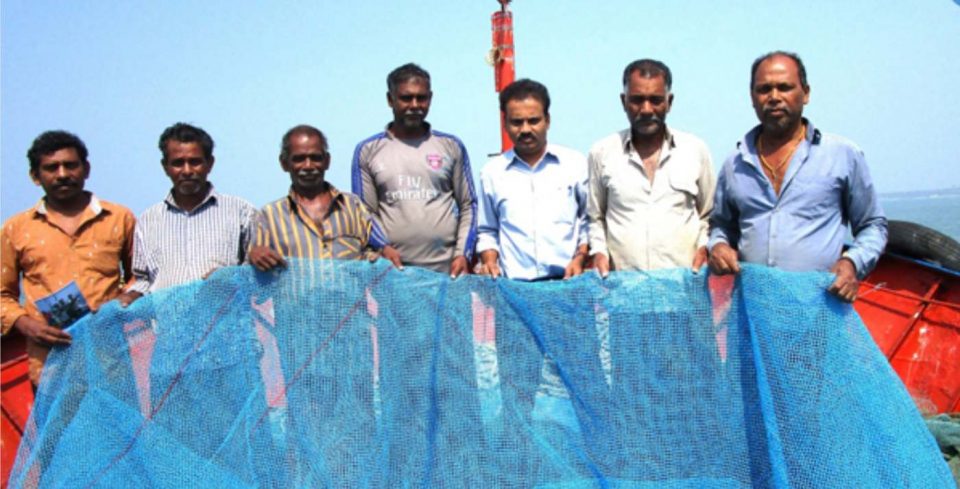
A sliver of coastal land on the southwest tip of India, Kerala has a thriving fishing community. According to a report from the Hindu, the fishing industry directly employs 55,000 people working on 3,600 boats, and almost a million indirectly, while generating 1.5 billion rupees, or $14 million in revenue.
As plastic content has gradually increased in the fishing waters, the local government took notice, passing a clean seas law known as the Suchitwa Sagaram, which instructed the harbour authority to distribute nylon bags to fishing boats with the request that they save every scrap of plastic that gets caught in their nets.
Once ashore, the plastic, often far too mangled or contaminated for available recycling methods, is shredded into a kind of confetti and mixed with asphalt to make roads. The arithmetic is positive, as it requires the plastic equivalent of a million shopping bags per kilometer of road while replacing one ton of emissions-heavy asphalt and reducing road costs by about 9%.
The plastic in the roads appears also to give roads resistance to the immense heat of the midday Indian sun.
An April update on the Kerala fishermen’s work from the Guardian details how the project has so far amassed 176,000 pounds (80,000 kilograms) of plastic, of which more than half has gone towards creating 84 miles (135km) of road.
“Previously, we didn’t care much about the plastic we collected in our nets,” Peter Mathias, president of the All Kerala Fishing Boat Operators’ Association, told the Guardian. “But not any more—we’re now protecting the ocean to save our livelihoods. Had we continued to be reckless, there wouldn’t have been any more fish for us to catch.”
Local sources also explain that attitudes are changing in the state towards plastic pollution, and there’s now a sense of pride in these efforts, such that locals try and keep littering tourists in line, and fishermen put stickers on their boats displaying their participation.
Source: GNN
